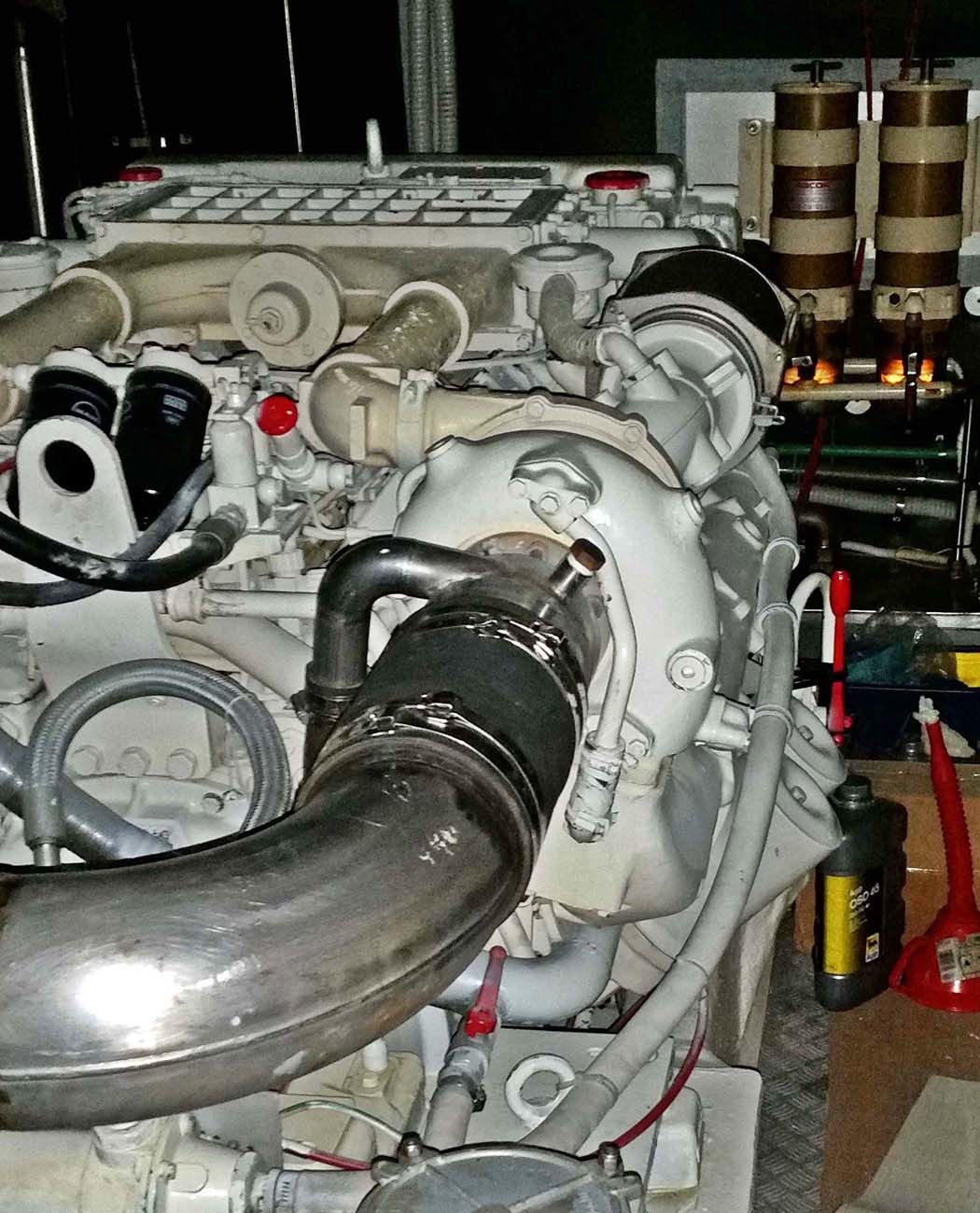
Fitting EGT probes+gauges to diesel (MAN) engines

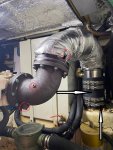
There are four tappings into the exhaust, just after the turbos.
It seems to me that in those spots the exhaust pipe is jacketed, under the superficial thermal insulation.
If that is the case, beware: a probe would only give you the temperature of the raw water re-injected into the exhaust, not of the exhaust gas.
 
It seems to me that in those spots the exhaust pipe is jacketed, under the superficial thermal insulation.
If that is the case, beware: a probe would only give you the temperature of the raw water re-injected into the exhaust, not of the exhaust gas.
The tappings go through the water jacket, directly into the exhaust gas.
 
I was thinking exactly along the same lines as Vas.
Chris, did you open the screwed cap and see a short welded pipe inside, going through the jacketed part of the exhaust?
If not, and you were just told by some mechanic instead, in your boots I'd be a bit skeptic...
 
I was thinking exactly along the same lines as Vas.
Chris, did you open the screwed cap and see a short welded pipe inside, going through the jacketed part of the exhaust?
If not, and you were just told by some mechanic instead, in your boots I'd be a bit skeptic...
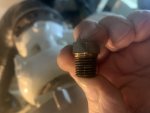
Took the threaded bung out, covered in black soot.C7861C00-9F09-433E-9895-64B4F16A63DB.jpeg
 
No way that thing is long enough to pass through the external jacket of the exhaust pipe.
My guess is that the darkened thread is just due to some surface oxidation.
Pretty normal for anything that gets warmed up and "washed" with salt water every time you turn the engine on, and is then left drying out every time the engine is turned off.
Btw, it reminds me of some caps with a threaded hole in the internal part, used to fit pencil anodes - which obviously could make sense only wherever there's raw water.
Anyway, if you look inside the pipe hole upon removal, you can easily check beyond any reasonable doubt what's what:
if the hole is only one inch or so deep, it means that it only goes through the sea water jacket.
Otherwise, it should be as deep as the whole exhaust pipe, i.e. 5+ inches, by and large.
 
another test is remove the screw and start the engine :rolleyes: :
if you flood in seawater, its on the jacket
if you suffocate on exhaust fumes, you're fine it's all the way through...

?

just undo the bolt and push a screwdriver in if it goes all the way in, you're fine. Somehow still doubt it.
and to make things worse, you said there are 4 of these holes in EACH pipe, or one on each?

V.
 
Primary function was for inspection.So they will go to where the gas runs .
Pretty std exhaust manufacturer fitment .
Also test probes on engine surveys.So you could sub in permanent probe / sensor .


Not sure after the turbo is actually jacked tbh .
My old ones were not and indeed recent this yr fitted new are not until the far exit ends .

Most are pipes up and away above the WL , then water is injected away from the turbo sos not to run back .
This cools the gases ready for escape via plastic mufflers and or in Pershings case a UW exhaust A FG boat .
 
Last edited:
Chris has only pulled one of theses .
B50A5ABD-19CF-4FB7-9107-2CCB3CBCFC9E.jpeg
You can see the safe water injection point twixt the tank .

Looks like this close up , the” double skin “…..but away from the engine so a wave , or abrupt stop or what ever prevents egress by back flush into the vulnerable turbo .
33AF0D6A-20BD-4512-8C6D-09399299E834.jpeg
 
To my knowledge, all V engines have a threaded port right before the flange where the boat-specific part of the exhaust is attached.
It's the one in the red circle below.
The smaller one on the s/steel pipe is an equally good alternative, but you might have that or not depending on how the boat exhaust was fabricated, while all the white painted parts exist in any MAN V engines (one for each bank, obviously).

Just for the records, in the meantime I decided to NOT fit probes+gauges on my engines.
Reason being that after 4 seasons with them, during which I randomly checked the exhaust temp of each cylinder (which is something only feasible pointing an IR gun on the manifold, straight at each cylinder output), I never noticed anything unusual.

Now, leaving aside overloaded boat and dirty bottom, which could increase overall engine load and EGT but are conditions the helmsman should be aware of regardless of any instrument, the main risk that can only be spotted by EGT is a defective/leaking injector (=more and/or less nebulized fuel injected).
And for this purpose, an IR gun (even if somewhat "filtered" by the manifold metal) is much more accurate than the EGT probe, whose temperature is not cylinder-specific, because it's either a compound of 4/5/6 cylinders on V8/V10/V12+L6 engines.

OqM1pyMs_o.jpg
I think the white Allen key hex you have circled and indeed the others to the right of are air bleed screws for the closed cooling .
Not access to the gases .

Access to the gas in this pic is from from the square headed bolt to the left of the flange .
Convention is all before the flange is the manufacturers responsibility and all after is not = thus the builders .
Indeed that sq brass nut is not through any double skin FWIW , it’s a turbo cane inspection port or a probe , a suitable probe by a experienced engineer .
They not only test temps but back pressure as well FWIW .
Back P is equally important.

When I had mine replaced by MAN engineers they did indeed do a sea trail with sensors + lap tops plugged in every hole . before the final sign off .

TBH anecdotally it’s got a more wroughty sound , a bit quite quieter and feels more lively, more powerful .
 
you said there are 4 of these holes in EACH pipe, or one on each?
I believe that what Chris meant was 4 overall, i.e. 2 for each engine (one on each exhaust pipe).
Remember, he has V engines, with one exhaust pipe for each cylinder bank.
 
Not sure after the turbo is actually jacked tbh .
My old ones were not and indeed recent this yr fitted new are not until the far exit ends.
If you are not sure, you didn't look at Chris pics carefully enough.

As an aside (though totally irrelevant in this context), whaddumean by your old ones were not jacked?
A dry steel exhaust pipe from the turbo flange all the way to the u/w exhaust of a GRP hull is a recipe for setting the boat on fire!
 
While we are on the subject of closed cooling air bleeding of the turbos on MAN s .It’s important as depending on the inclination when flushing the coolant air pockets can develop at highest point .Usually these turbos .
Cutting to the chase the bearings overheat = shortens life span .
If you are not sure, you didn't look at Chris pics carefully enough.

As an aside (though totally irrelevant in this context), whaddumean by your old ones were not jacked?
A dry steel exhaust pipe from the turbo flange all the way to the u/w exhaust of a GRP hull is a recipe for setting the boat on fire!
Re read my post .
See old ones , the water enters at the end or after the curve ( bend ) to minimise flow back probabilities.
If it’s fully jacketed with raw water before the loop and develops a unseen pin hole = kiss goodbye to the turbo after shut down = Water seeps back down .

DBD119FD-A0A2-4E7D-9F51-67B51F05DF76.jpeg
old one straight pipe for the over / loop then the water injection at the end .If that leaked water just ran down into the UW box and out NOT into the zillion € turbo + any thing else .
 
If it’s fully jacketed with raw water before the loop and develops a unseen pin hole = kiss goodbye to the turbo after shut down = Water seeps back down.
Nonsense. The best u/w exhausts are fully jacketed, and if many (like yours) are not, it's just because they are more expensive to build.
And of course, they can only be used with NO riser (or loop, as I think you are calling it).
 
No way that thing is long enough to pass through the external jacket of the exhaust pipe.
My guess is that the darkened thread is just due to some surface oxidation.
Pretty normal for anything that gets warmed up and "washed" with salt water every time you turn the engine on, and is then left drying out every time the engine is turned off.
Btw, it reminds me of some caps with a threaded hole in the internal part, used to fit pencil anodes - which obviously could make sense only wherever there's raw water.
Anyway, if you look inside the pipe hole upon removal, you can easily check beyond any reasonable doubt what's what:
if the hole is only one inch or so deep, it means that it only goes through the sea water jacket.
Otherwise, it should be as deep as the whole exhaust pipe, i.e. 5+ inches, by and large.
100% black exhaust soot, not been anywhere near water.
 
Nonsense. The best u/w exhausts are fully jacketed, and if many (like yours) are not, it's just because they are more expensive to build.
And of course, they can only be used with NO riser (or loop, as I think you are calling it).
Mine have a jacket straight from the flange that bolts to the turbo, as can be seen in the pics, they also look to have water flow going into the exhaust it’s self.
 
Mine have a jacket straight from the flange that bolts to the turbo, as can be seen in the pics, they also look to have water flow going into the exhaust it’s self.
Is there a water entry into this jacket at or near the turbo before the riser / loop bit ?
Pics thus far look like the thermal insulation .
Aside the plug you removed is too short to transgress a water jacket .
 
Nonsense. The best u/w exhausts are fully jacketed, and if many (like yours) are not, it's just because they are more expensive to build.
And of course, they can only be used with NO riser (or loop, as I think you are calling it).
Madness leaving sitting sea water on the engine side of the riser in a jacket .Absolute chocolate tea pot design .
Even SS + diesel exhaust fumes = nasty metal busting acids .They lurk under the cake .The cake is the layer of soot .
It might have a double layer engine side , but does raw water run through?

I recall MarkC replacing some OEM elbows on his MTUs again jacketed but iirc no raw water at side of the riser / loop .

That std 12 mm long inspection bolt Chris is holding as he says see soot only .Are you saying it goes through a raw water sea water jacket ? There is a failure point there as well = water seeps through and back in the familiar Sod’s law + boats way . :) .

Well if so it’s Russian roulette in the spring after a long shut down at start up .Has it or hasn’t the engine side water jacket seeped water back into the turbo and worst still through into an open E valve .Madness absolute madness .

Not my problem.;)
 
Last edited:
Madness leaving sitting sea water on the engine side of the riser in a jacket. Absolute chocolate tea pot design.
.
.
.
Not my problem.
Porto, if you never came across a fully jacketed wet exhaust with NO riser at all, where no raw water is left inside anywhere while at rest, you could as well refrain from commenting.
It's not like you have any obligation to ramble on all subjects regardless of whether you have anything to say or not, you know.

This is one example of such type of exhaust (on a very similar MAN V10, by coincidence), where you can see the raw water re-injection point right after the turbo flange.
No risers whatsoever, and no dry section anywhere - which means that you can keep your hand on any part of the exhaust pipe also while running WOT.
By the time the pic was taken, the boat was 20+ years old, had clocked around 2.5k hours, and the whole exhaust system was still the original one.

Now, remind me, why did you replace your fine exhaust instead?
v2gV7B9k_o.jpg
 
Porto, if you never came across a fully jacketed wet exhaust with NO riser at all, where no raw water is left inside anywhere while at rest, you could as well refrain from commenting.
It's not like you have any obligation to ramble on all subjects regardless of whether you have anything to say or not, you know.

This is one example of such type of exhaust (on a very similar MAN V10, by coincidence), where you can see the raw water re-injection point right after the turbo flange.
No risers whatsoever, and no dry section anywhere - which means that you can keep your hand on any part of the exhaust pipe also while running WOT.
By the time the pic was taken, the boat was 20+ years old, had clocked around 2.5k hours, and the whole exhaust system was still the original one.

Now, remind me, why did you replace your fine exhaust instead?
v2gV7B9k_o.jpg
My point is you and Vas assumed chris ‘s was a water jacket .
Need a similar pic , I have asked Chris if there is any water injection and commented on the pic thus far it looks like thermal insulation only .
This thread is MarkC s dry before the riser / loop design …..but was jacketed engine side but no sea water flow .
Thought i was correct .^^^ .
2 cracked exhaust elbows - MTU

Does the pipage actually run down away from the turbos anyhow in the above pic ?
It’s still a chocolate tea pot / grenade /Russian roulette at start up after a winter lay up .Has it , or has it not weeped ?
You are not selling it to me .
MarkC and myself and I suspect Chris can sleep easy over the winter lay up and look Fwds to turning those keys in the spring .


What boat is that ^^^ who’s done that ? out of curiosity.

Btw that’s not the OEM , it’s a replacement.
Note the overspray over everything else .
Got two legs try pulling the other one .Original exhaust my arse ! :)
See the fresh g box hydraulic pipe as well - zero overspray.
 
Top