Fishing boat lost.

Well to begin with, I wouldn’t do it piecemeal. The thing needs a thorough re think from cover to cover.

Perhaps the posts above prove the point thst colregs confuse. There is clearly a “may” rule in 17 and a separate “shall” rule. They’re doing different things but that’s a mess- they need integrating.

But I’ll to try to answer your question. First, there is a debate to be had about whether the legal obligation in 17b should exist at all. It doesn’t on the road. Why does every collision need some blame both sides? (Actually that’s a myth- it doesn’t even under colregs if you read them with precision, but it’s a very widely held view, so there’s a failing in the colregs right there).

But let’s suppose on balance it makes sense to have the 17b obligation. In that case, the timing is all wrong. The 17b obligation is only triggered when collision can’t be avoided by the actions of the give way vessel alone. In almost every situation the manoeuvrability/response time/turning circle of the 2 vessels will be different, from which it logically follows that in 50% of cases 17b fails to achieve its aim of avoiding collision.

Example- imagine a small fast powerboat as the give way vessel and a container ship standing on. The point at which the 17b obligation crystallises on the container ship is when the powerboat can’t (not won’t) avoid the collision, at which point there is no meaningful ability to alter the motion of the supertanker. So the rule is, frankly, dumb.

Obviously collisions don’t happen often but this is not because of coltegs, it’s despite them. They’re doing no good.

While I’m at it, why do colregs jump between give way/stand on, shall not impede/vessel not to be impeded, and keep out of the way of? Three phrases doing the same thing or slightly different? And what’s difference between shall not impede passage and shall not impede safe passage? is there meant to be a difference?

what if I’m helming a 24m power boat and I’m on collision course with a 15m sailing boat in a narrow channel eg marina. Does rule 9b override the power/sail rule? What is the hierarchy of these rules sprinkled about the place? There might be an answer but it’s very hard to find.

There are many other faults - this post would get long if I listed them all.
Incidentally, in open sea if I’m stand on in 24m motorboat to a 200m container ship, I stand on, as the law positively requires. This rule should have nothing to do with the greater effort required to steer a big ship and everything to do with predictability of actions, imho.

Finally, what sort of cackhanded English is “as will best aid to avoid collision”. The verb “aid” followed by the preposition “to” - really? Or is it not a preposition at all - maybe “to avoid” is an infinitive serving as the object of “aid”? Heck. Ugly English, 1/10 marks, either way.
Thank you. I'm glad I am not on the international team trying to get agreement to any changes to the rules (last updated in 1972) especially as most of the team members will not have English as their first language. :oops:

www.solocoastalsailing.co.uk
 
With the circumstance I've got in mind, I don't think it should ?
But a set of rules needs to cater for all circs, not just some particular circs.

What’s wrong with right of way and give way?

Simple. Just like roads. None of this garbage about the guy in the right suddenly being wrong if a crash happens.

Which, contrary to pop belief, is not what rule 17 says must be the case, if you read it forensically. Not that anyone should even need to read it forensically.
 
Most accidents/ collisions are from the human side , a lapse of watch keeping . Either not concentrating on screens / gadgets / helm electrotwackery or simply not looking out , looking up with the mk1 eye ball .

Can‘t see a CoL reg rewrite or wording tidy up in Eng then translate that ( with all the syntax looses ) is gonna effect the accident rate occurrence .

It can’t be any simpler.One stands on , one manoeuvres to avoid collision.That said common sense comes into play where size is right and ( super tankers ) restricted movement due to shoals etc . More common sense as you enter a rule 17 distance situation.

Remember it’s easy to alter speed too to miss go astern .This is assuming the other vessels watch ever saw you and hasn’t turned into your path ? = Back to watch keeping .

I remember that Pershing a few yrs back whacking a buoy in the dark leaving a CI .Helm did not see it despite a plethora of screen s and gadgets .

The fishing boat knows the ferry time table , knows it’s rough course it’s gonna come in @ .Also knows the tides re when he can get in / out .So it’s all a sum of very small events which I postulate they both had poor watch procedures.

Our marina has a disproportionate number of SY movements .You can listen to them on the VHF , the captains calling in .
Turning and manoeuvring makes passages a challenge to little boats ……so we just wait hold fire until the “ coast is clear “

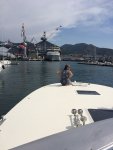
Marina Genoa ( airport one ) is busy with all sorts massive vessels requiring tugs .You can hear it all kinda work out if it’s safe to enter / leave again on the VHF .You just have to pick your moment to move .

9FB101B0-B0DE-49D9-A952-023E872066E5.jpeg
We are moving here aiming to turn to port .But if any of those cruise liners started to move ( hearing vhf or witnessing tugs ) and there are 8-10 other ships out of shot btw then really CoL regs don’t work .The channel is very tight if one of those occupied it .
So it’s just common sense using mk1 eye ball .

In the bay ships creep about .
AFBB37EC-1D0E-4786-894C-D9E0EE213BE0.jpeg
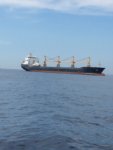
Bit out of focus, its approaching the entrance …..a Yacht transport vessel with one on .To it’s rhs out of shot is a tanker with 3 tugs attaching lines attached also on its way in .

I went quite slow at D speed until we’ll clear before planing .Watching all the time ships coming .

We were ironically heading to Portofino.Could have just left the marina got out and turned set the autopilot and got it up .But instead had to manoeuvre through this type of ship field into clear water .There was a couple of other leisure boats that morning heading S .
But the point is this I can’t see how a rewrite of the Col regs would have helped. Because at the end of the day folks need to be alert and see each other and apply common sense . So the regs are better slightly slack with a bit of wiggle room .

Eg it’s daft me standing on forcing a ship like this ^ to alter course because I am protected by rewritten cast iron new regs .
First of all he will sink us .I d rather have the slack to be able to pick my own course without worry , hiding behind rule 17 if necessary.Safe in the knowledge no one’s gonna report me to officialdom .= Applying common sense .
 
It always seemed to me that the rules are written to:
1) make sure no authority can be at fault
2) make sure that neither party in a collision situation is totally exempt from fault.

I've always preferred being the give way vessel - you have the control - you don't need to have that jittery moment when you're not quite sure what the other will do.

As for this, half of my mates work down the harbour in Jersey so I've heard every possible story (which I will not be sharing on here).

But whoever is at fault, 3 people are almost certainly dead. There is plenty of evidence of the collision on the bow of the Commodore and the wreckage has been located .

It was dark but not restricted visibility, AIS was on both and you'd like to think each vessel picked up the other on radar and was tracking with ARPA. So the jury is out for now...
 
This is Rule 17...

"Rule 17 - Action by Stand-on Vessel

(a) (i) Where one of two vessels is to keep out of the way the other shall keep her course and speed.
(ii) The latter vessel may however take action to avoid collision by her manoeuvre alone, as soon as it becomes apparent to her that the vessel required to keep out of the way is not taking appropriate action in compliance with these Rules.

(b) When, from any cause, the vessel required to keep her course and speed finds herself so close that collision cannot be avoided by the action of the give-way vessel alone, she shall take such action as will best aid to avoid collision.

(c) A power-driven vessel which takes action in a crossing situation in accordance with sub-paragraph (a)(ii) of this Rule to avoid collision with another power-driven vessel shall, if the circumstances of the case admit, not alter course to port for a vessel on her own port side.

(d) This Rule does not relieve the give-way vessel of her obligation to keep out of the way."

Even if I'm the stand-on vessel, is there any harm in me taking a 5 degree turn to starboard as soon as I realise that we might be on a reciprocal course?
 
Even if I'm the stand-on vessel, is there any harm in me taking a 5 degree turn to starboard as soon as I realise that we might be on a reciprocal course?
Perhaps not but I suppose the only question is whether 5° is "substantial" enough. The aim is to make your manoeuvre in good time and such that it can be immediately recognised. It depends on the circumstances I suppose.
 
This is Rule 17...

"Rule 17 - Action by Stand-on Vessel

(a) (i) Where one of two vessels is to keep out of the way the other shall keep her course and speed.
(ii) The latter vessel may however take action to avoid collision by her manoeuvre alone, as soon as it becomes apparent to her that the vessel required to keep out of the way is not taking appropriate action in compliance with these Rules.

(b) When, from any cause, the vessel required to keep her course and speed finds herself so close that collision cannot be avoided by the action of the give-way vessel alone, she shall take such action as will best aid to avoid collision.

(c) A power-driven vessel which takes action in a crossing situation in accordance with sub-paragraph (a)(ii) of this Rule to avoid collision with another power-driven vessel shall, if the circumstances of the case admit, not alter course to port for a vessel on her own port side.

(d) This Rule does not relieve the give-way vessel of her obligation to keep out of the way."

Even if I'm the stand-on vessel, is there any harm in me taking a 5 degree turn to starboard as soon as I realise that we might be on a reciprocal course?
Rule 17 won’t apply ‘initially’ if you are on reciprocal courses in a head on situation ? Both vessels (assuming 2 power driven vessels) will be obliged to alter to starboard. If one opts not to then yes you would alter course further or adjust speed to avoid a collision.

5 degree may not be significant enough to be interpreted clearly.
 
Even if I'm the stand-on vessel, is there any harm in me taking a 5 degree turn to starboard as soon as I realise that we might be on a reciprocal course?

I'd assume otherwise in this situation but often in a head on or crossing situation, there is the temptation to just make small course changes to widden the CPA. We had it (almost literally) stamped into our brains to never do this - you make at least a 20 degree alteration and if possible (eg. other vessel fine off stbd bow) show the other side of the bow / other nav light as DavidJ points out. It has to be obvious enough to show up on a radar as well as visually.
 
It always seemed to me that the rules are written to:
1) make sure no authority can be at fault
2) make sure that neither party in a collision situation is totally exempt from fault.
Item 2 is not achieved by the Colregs. Under the wording of the rules, it is possible to be in a collision and be totally without any fault.
 
This is Rule 17...

"Rule 17 - Action by Stand-on Vessel

(a) (i) Where one of two vessels is to keep out of the way the other shall keep her course and speed.
(ii) The latter vessel may however take action to avoid collision by her manoeuvre alone, as soon as it becomes apparent to her that the vessel required to keep out of the way is not taking appropriate action in compliance with these Rules.

(b) When, from any cause, the vessel required to keep her course and speed finds herself so close that collision cannot be avoided by the action of the give-way vessel alone, she shall take such action as will best aid to avoid collision.

(c) A power-driven vessel which takes action in a crossing situation in accordance with sub-paragraph (a)(ii) of this Rule to avoid collision with another power-driven vessel shall, if the circumstances of the case admit, not alter course to port for a vessel on her own port side.

(d) This Rule does not relieve the give-way vessel of her obligation to keep out of the way."

Even if I'm the stand-on vessel, is there any harm in me taking a 5 degree turn to starboard as soon as I realise that we might be on a reciprocal course?

I don't follow your logic Pete. If reciprocal course, you MUST turn to starboard; you're not a stand on vessel.
 
Rule 17 won’t apply ‘initially’ if you are on reciprocal courses in a head on situation ? Both vessels (assuming 2 power driven vessels) will be obliged to alter to starboard. If one opts not to then yes you would alter course further or adjust speed to avoid a collision.

5 degree may not be significant enough to be interpreted clearly.
I agree all that but actually you're applying common sense, not what the rules actually say. That's my only point - the rules are very poor and we generally avoid collisions despite them not because of them, by applying common sense.
 
Does anyone know how many collisions are actually the result of "confused " colregs?
I don't know but I'd guess almost zero. However, the answer to the inverse question, "how many collisions are avoided despite the regs not because of them?" is a big number and I'd start the bidding at 1000 per day :)
 
Eg it’s daft me standing on forcing a ship like this ^ to alter course because I am protected by rewritten cast iron new regs .
First of all he will sink us .I d rather have the slack to be able to pick my own course without worry ,
It's hard even to begin to work out what your point is, as usual. However, current rules already do, and any sensible new rules should, allow you "slack" to drive around a ship that isn't giving way when it should.
 
Top