Fire Extinguishers

A question on the subject. A few days ago I replaced my powder extinguishers, though the tiny pressure gauge was in the green sector, they were 6-7 years old so I bought new ones. While shaking them (the old ones), I could not feel any powder displacement inside, so I went in the garden and emptied one: it worked very well, it did not last long which I expected but a lot of powder came out, the ground was all white, very thin powder like talc. After that I unscrewed the top, and to my surprise about one half of the inside volume of the bottle was still filled with powder, all very soft and without any lumps.
Is it normal that a fire extinguisher is filled by about double the powder it ejects?
Increasing the pressure/quantity of gas could make it last a lot longer, the bottle is light so I guess made by light alloy, walls are quite thin, probably limiting the maximum inside pressure. Anyone knows -even approximately- what kind of regulatory requirements lead to this kind of product? Why aren t manufacturers making extinguishers saying ''mine costs more but lasts double than the others'' ?
 
When mounting dry power fire extinguishers, the best way to mount then is not vertical but horizontal so any movement of the boat will tend to move the powder sideways and less likely to compact
 
Still got five 1Kg Halon extinguishers that I rescued from the skip when my company had to ditch them. Fortunately never used and I don't know how I'd ever top them up if I did use them
 
Still got five 1Kg Halon extinguishers that I rescued from the skip when my company had to ditch them. Fortunately never used and I don't know how I'd ever top them up if I did use them
Don’t think you would be able to refill them.

I think halon is toxic.

They must be pretty old.

Do they have a pressure gauge on them? Can that gauge be relied upon after so long?

I would think a mixture of extinguishers was best bet; or water mist and foam as the two minimums.
 
Just a question about the statement Co2 is dangerous. (toxic) Obviously not toxic as such but excludes oxygen however I would think the actual fire would be just as productive of Co2. In other words you would in any case need to fight the fire from a position of clean air and be wary of need to escape. So seems to me a Co2 extinguisher would be as good as any in a boat. Certainly no mess.
The halon extinguishers mentioned above if like the old gas type have nipple which must be broken off to release gas. No dial just unscrew the head and observe the nipple is still intact. In which case IMHO should be good for a fire. But as above be wary of breathing gas. (comes out as a liquid) Yes the old gas ones were banned due to destruction of the ozone layer. (when used)
ol'will
 
If you don't isolate fuel and electrics you have a slim chance of putting the fire out.
An interesting theory.

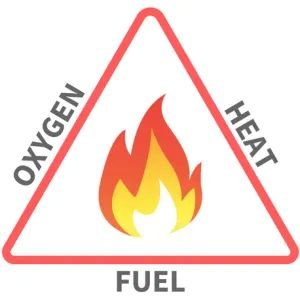
When I did my Fire Warden course with the local fire service they were very keen on the Fire Triangle and were quite clear in their instructions. Stop any one side of the triangle and the fire would go out.

Fire.jpg

I've even witnessed a firefighter walk up to a car fire were the fuel pump was still spraying petrol onto the fire and extinguish the flames using foam. Given the heat there was no way anybody could enter the vehicle and switch off the ignition.

Is your master electric switch and fuel/gas shut off valves easily accessible? I know mine are not as they are in the rear cabin and the entrance is just beside the gas cooker, hence I have a water mist extinguisher near the cooker.
 
Last edited:
Just a question about the statement Co2 is dangerous. (toxic) Obviously not toxic as such but excludes oxygen however I would think the actual fire would be just as productive of Co2. In other words you would in any case need to fight the fire from a position of clean air and be wary of need to escape. So seems to me a Co2 extinguisher would be as good as any in a boat. Certainly no mess.
The halon extinguishers mentioned above if like the old gas type have nipple which must be broken off to release gas. No dial just unscrew the head and observe the nipple is still intact. In which case IMHO should be good for a fire. But as above be wary of breathing gas. (comes out as a liquid) Yes the old gas ones were banned due to destruction of the ozone layer. (when used)
ol'will
CO² is used to fight electrical fires, but rubbish at fighting anything else!

While you might have a short in your electrical system that will ignite solid materials around, we all know that boats are filled with flammable solids, and you need to switch extinguisher type - that's why we have different types.

I've been fortunate enough to do several Fire Warden courses, to demonstrate the point you get to use the 'wrong' extinguisher on a material just to see how ineffective they are.

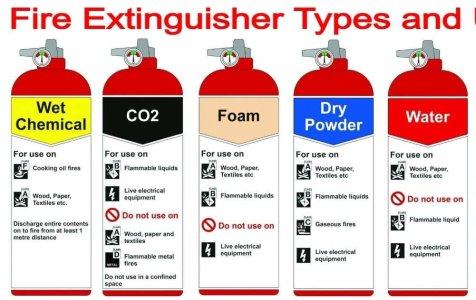
This is the colour code for UK extinguishers. You will note that CO² is not to be used in confined spaces like a boat.

Fire-Extinguisher-Types-and-Uses.jpg
 
I had a couple of Chubb dry powder fire extinguishers on my Stella. I also had a Stuart Turner petrol engine. One day we were well out to sea & about half a pint of petrol went in to the bilges on top of a lot of water ( We had suffered sever damage & were leaking badly). I managed to ignite the petrol, which went up in a whoosh, under the floor boards. I lifted the boards & fired the first extinguisher at the flames i could see. The powder put out the flames instantly but because the petrol was on top of water they floated back. So i had to take every board up the full length of the boat. The bitumen paint on the hull was burning as well. I managed to put the flames out with the last burst of the last extinguisher.
I would recommend powder extinguishers every time.
We just washed the powder into the bilges with buckets of water & pumped it out with the rest of the water.
Any powder/water mix on the floor was like a skating rink
 
Fantastic on electrical fires, liquid fires (fuel etc) or galley fires.

NOT
Think carefully, enough brackets of water will stop the fire from spreading to other flammable objects. Water seems to work well for all of those fire engines in the uk . It is always the fire spreading, and getting out of control, which is the danger. If you wet everything it does not burn very well. Then you can get on with cutting battery leads, turning off fuel or switching off gas. Best of luck with Lithium batteries because they supply their own oxygen and flammable gasses so water, powder, CO2 or whatever is not going to work but water will even stop a lithium battery fire from spreading to other flammable material.
 
Last edited:
Think carefully, enough brackets of water will stop the fire from spreading to other flammable objects. Water seems to work well for all of those fire engines in the uk . It is always the fire spreading which is the danger. If you wet everything it does not burn very well. Then you can get on with cutting battery leads, turning off fuel or switching off gas. Best of luck with Lithium batteries because they supply their own oxygen and flammable gasses so water, powder, CO2 or whatever is not going to work but water will even stop a lithium battery fires from spreading to other material.
Oh dear.
 
Slightly off topic I know, however if we all spent a little more time identifying the most likely sources of ignition and putting measures in place to reduce the chances of such rather than just what extinguishing media to use we would be a lot safer.

For example electrical fires for me would be near the top of my list due to our boats being full of diy wiring by people with varying degrees of competency. The obvious control measure here would be fusing. That said only 2 weeks ago my 12v alternator failed and was emitting smoke and flames which was luckily noticed in the early stages, so maybe detection?
 
Think carefully, enough brackets of water will stop the fire from spreading to other flammable objects. Water seems to work well for all of those fire engines in the uk . It is always the fire spreading, and getting out of control, which is the danger. If you wet everything it does not burn very well. Then you can get on with cutting battery leads, turning off fuel or switching off gas. Best of luck with Lithium batteries because they supply their own oxygen and flammable gasses so water, powder, CO2 or whatever is not going to work but water will even stop a lithium battery fire from spreading to other flammable material.
I cannot really imagine having my head in lockers randomly cutting wires from the batteries with smoke from a fire all around me. I take the point that one might want to do what is possible in the first few minutes, (I agree gas fuel )but after that one might spend the early time on crew safety & getting some important property (money, passports, cards identity papers, liferaft etc) off the boat as well as fire fighting with the equipment available
Cutting wires is a bit final. If one can put a fire out without damaging too much of the infrastructure, then there is a chance the vessel can be operating again. Very important if at sea.
 
Last edited:
If you don't isolate fuel and electrics you have a slim chance of putting the fire out.
But I did!
The fire originated in the starter motor solenoid. This has a permanent, unswitched connection to the battery.
The item on fire was an adjacent fresh water hose, no fuel involved.
CO2 stopped th flames and a saucepan of water cooled the fire source.
Unfortunately, I stopped the engine and, due to the demise of the solenoid, I couldn't restart it.
 
Think carefully, enough brackets of water will stop the fire from spreading to other flammable objects.
Well enough buckets of water will sink the boat and solve the problem!
Water seems to work well for all of those fire engines in the uk .
They carry extinguishers too and use them when appropriate. But the pump capacity of a modern fire engine and the way their hoses distribute the jet and the protective equipment the crew wear mean it is possibly for a skilled person fight a cooking oil fire with a fire hose - if you try it with a bucket on a boat you are more likely to make matters worse.
It is always the fire spreading, and getting out of control, which is the danger.
Throwing buckets of water on any burning oil (whether kitchen or engine related) probably isn’t the best start then…
 
But I did!
The fire originated in the starter motor solenoid. This has a permanent, unswitched connection to the battery.
The item on fire was an adjacent fresh water hose, no fuel involved.
CO2 stopped th flames and a saucepan of water cooled the fire source.
Unfortunately, I stopped the engine and, due to the demise of the solenoid, I couldn't restart it.
Sorry Graham, but the engine battery should have an isolator switch that completely isolates it.
 
Top