Andrew_Trayfoot
Well-Known Member
One of my 4 instruments tends to drop out when I start the engine.
Any suggestions on what can be done to mitigate?
Any suggestions on what can be done to mitigate?

Quite a lot off faff to rewire the battery setup for one instrument.Use a dedicated engine start battery.

It’s not for one instrument though. It’s to ensure that the domestics don’t discharge your battery to the extent that they can’t then start the engine.Quite a lot off faff to rewire the battery setup for one instrument.
I was wondering if there was some some electronics that wound hold the voltage up for 3 or 4 seconds.

Think that would be a fully functioning battery and suitable cablesQuite a lot off faff to rewire the battery setup for one instrument.
I was wondering if there was some some electronics that wound hold the voltage up for 3 or 4 seconds.

Not really. Replace the 1.2,both with something like a BEP switch cluster which gives you individual circuits, VSR for split charging and and a parallel switch. Basic small car battery for engine start and combine your current 2 batteries into one for domestics. Apart from solving the current problem, you will have enhanced domestic capacity and all your batteries will last longer because they are only doing one job.Quite a lot off faff to rewire the battery setup for one instrument.
I was wondering if there was some some electronics that wound hold the voltage up for 3 or 4 seconds.
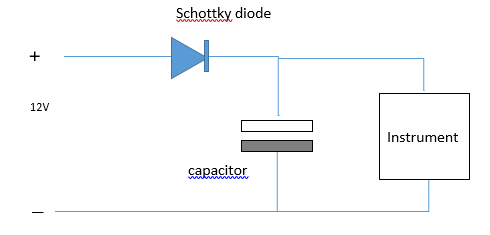
Nice diagram and quite right. would however suggest a larger capacitor. I don't think high in put surge current will be a problem . ol'willYou could try a diode and capacitor to hold up the voltage.
View attachment 157589
You would have to experiment to find the right value of capacitor. You could start with a 1000uF 25V electrolytic and see if it holds up for long enough. This obviously depends on the current drawn by the instrument.
If the capacitor is too large it will draw a momentary large current as it charges up when you switch on. This may take out your overcurrent trip or blow a fuse. Not an off the shelf solution as it needs setting up for your particular instrument.
If you are not an electronics geek with a handy box of capacitors, then this is probably not a solution for you.


I think the "Getting a bit tired" may be a clue. However if all the instruments listed are supplied from the leisure battery and you are specifically using the engine start battery to start the engine. How are they connected? Or does it only happen when not starting from cold and you have both batteries or just the leisure battery in circuit?So the setup is:
2 batteries: 1 110ah leasure(getting a bit tired), 1 cranking.
1,2, both switch.
Wiring is all up to or above spec.
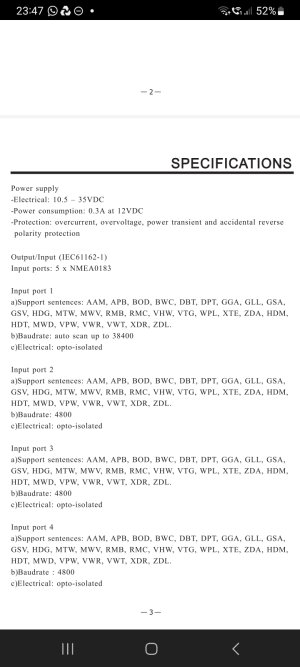
Garmin GPS 126, FishFinder100, Matsutec HP33A AIS. All perfectly ok when starting the engine.
Owna KMR-6 drops out.
I tend to only use the engine battery to start from cold.
So the only current problem I have is the drop out of the Owna.
Might look at VSR etc next winter.
DC-DC converter and the diode/capacitor look interesting so will look at that.

1-2-B switch, everything runs from whichever battery is selected.I think the "Getting a bit tired" may be a clue. However if all the instruments listed are supplied from the leisure battery and you are specifically using the engine start battery to start the engine. How are they connected? Or does it only happen when not starting from cold and you have both batteries or just the leisure battery in circuit?
Fair enough Paul but 1-2- B switches I have seen select the engine start battery. I know not all the same but wondered on OP's configuration.1-2-B switch, everything runs from whichever battery is selected.
Lots of suggestions in the thread to workaround a system that wa never designed to be used with this level of equipment (was conceived decades ago, to give redundancy for engine starting, to basic systems of the day), rather than fir a dedicated battery for the engine, doubling domestic capacity in the process.
If the voltage is dropping enough for an instrument to crap out, your battery is either nearing end of life, or you have a wiring problem and this is the first warning sign.