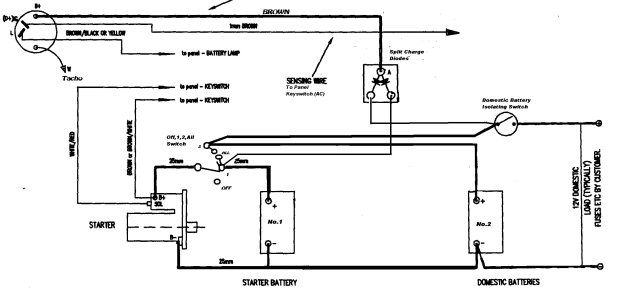
Engine Start Voltage Drop suppression

Fair enough Paul but 1-2- B switches I have seen select the engine start battery. I know not all the same but wondered on OP's configuration.

Generally the 1-B-2=off switch is just a switch to choose which battery for use ... or both ... or completely off. The Start and domestics are rarely separated and can power all on board based on switch position.
 
Generally the 1-B-2=off switch is just a switch to choose which battery for use ... or both ... or completely off. The Start and domestics are rarely separated and can power all on board based on switch position.
IIRC they were a logical development from the first simple single battery systems where boats had maybe a few lights, an echo sounder and maybe a car radio for entertainment. The principle was use one battery one day then switch to the other but switch to both for charging. Whilst there was a “spare “ battery in car one flattened the day battery it wasn’t vital as most could be hand started. Even
My old Volvo 2001 could be hand started but I think I only did it once to see how hard it was and vowed never again!

With modern loads and engines that don’t have a manual start capability I’m astonished that people still advocate systems that don’t preserve an independent engine start battery
 
IIRC they were a logical development from the first simple single battery systems where boats had maybe a few lights, an echo sounder and maybe a car radio for entertainment. The principle was use one battery one day then switch to the other but switch to both for charging. Whilst there was a “spare “ battery in car one flattened the day battery it wasn’t vital as most could be hand started. Even
My old Volvo 2001 could be hand started but I think I only did it once to see how hard it was and vowed never again!

With modern loads and engines that don’t have a manual start capability I’m astonished that people still advocate systems that don’t preserve an independent engine start battery
Absolutely, especially the last paragraph (y)
 
IIRC they were a logical development from the first simple single battery systems where boats had maybe a few lights, an echo sounder and maybe a car radio for entertainment. The principle was use one battery one day then switch to the other but switch to both for charging. Whilst there was a “spare “ battery in car one flattened the day battery it wasn’t vital as most could be hand started. Even
My old Volvo 2001 could be hand started but I think I only did it once to see how hard it was and vowed never again!

With modern loads and engines that don’t have a manual start capability I’m astonished that people still advocate systems that don’t preserve an independent engine start battery
Reading first paragraph ... yes ... it was a step on from the old days of a single battery to power a cabin light ... and maybe start a small engine ... as people added to the boats - a second battery came along etc. etc.

Second paragraph ? It reads like you ignore the fact that there is choice to disconnect and 'preserve' one battery ... I accept that mistakes can be made and both left connected while engine stopped - but most users of the 1-B-2-off switch have developed routine ...
Before the regulars jump on the wagon ... like everything in life - things improve or different ways to do things evolve ... we all accept that ...
 
It's interesting sometimes how these threads drift..
I got the answer I was looking for way back ...
I do appreciate that my 1,2,Both system is probably nearing the end of its useful life, but it has worked well for me for a long time.
When I got the boat in 1997 it had 1 leasure battery, a vhf and a rotary depth sounder.
I now have domestic battery, starter battery, 70a alternator, solar panel, inverter, GPS, AIS transponnder, fish finder, wind indicator, electromagnetic log, nmea repeater, NMEA over WiFi, VHF, Android Stereo chart plotter, FM radio. an electric windlass, electric cold box, shore power, an electric kettel, and a micrwave. All on a 26' boat!!!
I even managed to 'work from home' on the boat for 2 days last week with a laptop!
So given all that my existing system copes pretty well.

Think I will get 2 new 110ah leasure batteries over the winter and find a new home for the starter battery, but in the mean time if a diode and a capacitor solve my issue them I'm a happy boy...

And the boat lives on a swinging mooring, so no shorepower available for charging.
 
Think I will get 2 new 110ah leasure batteries over the winter and find a new home for the starter battery, but in the mean time if a diode and a capacitor solve my issue them I'm a happy boy...
If you want to try a capacitor I think you need to be considering one with a capacity measured in Farads rather than microFarads.

The instrument is rated at 300mA - but let's say 200mA. Say you need it to be powered for 10 seconds then you need a capacitor capable of supplying 2 Coulombs - if you are prepared to let the supply voltage drop to 10V then you need a capacitor with a capacity of 1C/V - 1 Farad.

Such devices are commonly available and used in car audio applications.

BTW what I did with the 1-2-Both switch I inherited on my boat was to add a second switch that connected the domestic bank to the domestic supply and left the 1-2-both just powering the engine start. Solves most issues with a very simple installation.
 
If you want to try a capacitor I think you need to be considering one with a capacity measured in Farads rather than microFarads.

The instrument is rated at 300mA - but let's say 200mA. Say you need it to be powered for 10 seconds then you need a capacitor capable of supplying 2 Coulombs - if you are prepared to let the supply voltage drop to 10V then you need a capacitor with a capacity of 1C/V - 1 Farad.

Such devices are commonly available and used in car audio applications.

BTW what I did with the 1-2-Both switch I inherited on my boat was to add a second switch that connected the domestic bank to the domestic supply and left the 1-2-both just powering the engine start. Solves most issues with a very simple installation.
You mean like this. Was what I alluded to in earlier post. Much better than clever solutions such as diodes and capacitors, which although feasible, are to my mind a bit of an enthusiastic bodge. When for the cost of a switch and a bit of wire you can fix the whole system.


Engine wiring 2.jpg
 
You mean like this. Was what I alluded to in earlier post. Much better than clever solutions such as diodes and capacitors, which although feasible, are to my mind a bit of an enthusiastic bodge. When for the cost of a switch and a bit of wire you can fix the whole system.


View attachment 157671
Yes - that is pretty much what I use - but I don't have the separate negative feed to the domestic battery. That means that I still get some voltage drop on the instruments due to voltage drop across the common part of the -ve wiring.
 
That does not seem the answer. First the OP does not have a charge splitter. He seems to have a "traditional" 1,2,B where either or both batteries are connected to the engine and the DC circuits. Having a switch that isolates the DC when the engine starts will certainly solve the problem, but is that practical?

Every time you want to use the engine you have to isolate the DC so losing all the electronics on board. The basic issue is that he is using one battery to start the engine and power the DC and the load of the starter is dropping the voltage below what that instrument needs. Probably made worse if the battery is a bit tired. I don't know whether a capacitor will help, but it will just be a sticking plaster covering up the fact that he is asking an antiquated system to do too much.
 
That does not seem the answer. First the OP does not have a charge splitter. He seems to have a "traditional" 1,2,B where either or both batteries are connected to the engine and the DC circuits. Having a switch that isolates the DC when the engine starts will certainly solve the problem, but is that practical?

Every time you want to use the engine you have to isolate the DC so losing all the electronics on board. The basic issue is that he is using one battery to start the engine and power the DC and the load of the starter is dropping the voltage below what that instrument needs. Probably made worse if the battery is a bit tired. I don't know whether a capacitor will help, but it will just be a sticking plaster covering up the fact that he is asking an antiquated system to do too much.
You have separate switches - and feeds - for domestic and engine so the domestic circuit doesn't suffer voltage drop when the engine is cranked.

The only thing required is an additional switch and wiring - pretty straightforward to do - and with the additional benefit of being able to switch off the engine circuit while keeping the domestic circuit powered up.
 
Agreed my 1,2,both setup is probably at the end of its life (along with my leasure battery) however I only have the issue with one of 5 devices (if you include the Yakker) that are running of the instrument supply which feeds into a multi fuse distribution box before going to each instrument.
 
BTW what I did with the 1-2-Both switch I inherited on my boat was to add a second switch that connected the domestic bank to the domestic supply and left the 1-2-both just powering the engine start. Solves most issues with a very simple installation.
This is an acceptable solution. Wire the 1-2-B so that the common terminal goes to the engine, (1) goes to the starter battery and (2) goes to the domestic isolator load terminal.

So:

(1) Engine circuit on.
(2) Engine battery isolated, engine and domestics all use the domestic battery, (provided the domestic isolator is on).
(B) Parallels both batteries/banks. All circuits connected to both batteries. If the domestic isolator is turned off everything runs from the engine battery.

This would need a split charge device too.
 
You mean like this. Was what I alluded to in earlier post. Much better than clever solutions such as diodes and capacitors, which although feasible, are to my mind a bit of an enthusiastic bodge. When for the cost of a switch and a bit of wire you can fix the whole system.
I have very similar to this but with a 2 way switch so I can run the domestics off either battery. No split charge diodes as the engine switch controls the charging. When I fit the Cyrix battery combiner the charging control will become automatic.
 
Top