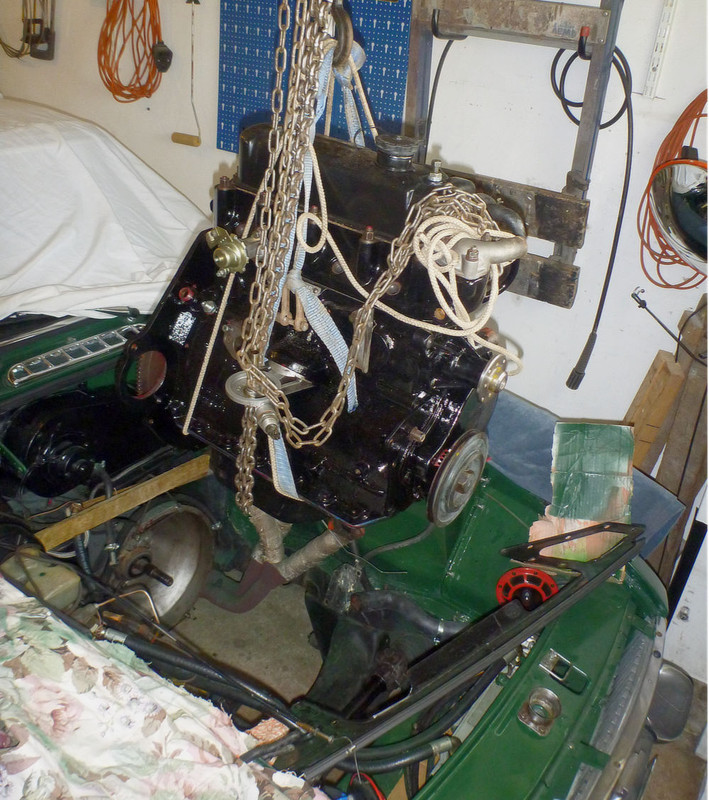
Engine removal

WD40 is a water-displacing agent; clue’s in the name. It can have a remarkable effect on wet outboard HT leads, and I used to spray it into a potentially-damp toolbox to keep the contents from rusting, but every other use is clever marketing.

I haven’t tried home-made mixes like yours, but PlusGas is made for the purpose and certainly wicks itself into joints the same way.

Pete
WD40 make other products than their well-known water displacing one. I have a can of their penetrating fluid.
 
I would strongly advise not to do this. I don't think there's anything clever about making home-made concoctions of harmful substances.
On the contrary, it seems like an imaginative and intelligent thing to do. Drinking the results might be ill-advised, but so would be drinking the individual components.
 
What is it with this forum that people can’t stop making judgements? So patronising. I ask the question because I don’t want to drive for 90 minutes to the boat only to find out I have the wrong size spanner you snob.
And if over the years one bolt ( or more)have been changed ??
It’s a boat : Bring Out All Tools
 
The stupid old gits who do this sort of thing might agree with you, but I don't.
What is more stupid about mixing acetone and brake fluid in small quantities then maintaining a can of compressed flammable substance.?

From the plus gas material data sheet.:

Danger
Hazard statements:
H222 Flam. Aerosol 1: Extremely flammable aerosol.
H229: Pressurised container: May burst if heated.
H315 Skin Irrit. 2: Causes skin irritation.
H336 STOT SE 3: May cause drowsiness or dizziness.
H411 Aquatic Chronic 2: Toxic to aquatic life with long lasting effects.
Precautionary statements:
P210: Keep away from heat, hot surfaces, sparks, open flames and other ignition sources.
No smoking.
P211: Do not spray on an open flame or other ignition source.
P251: Do not pierce or burn, even after use.
P261: Avoid breathing vapours/spray.
P264: Wash contaminated skin thoroughly after handling.
P271: Use only outdoors or in a well-ventilated area.
P332+P313: If skin irritation occurs: Get medical advice/attention.
P410+P412: Protect from sunlight. Do not expose to temperatures exceeding 50°C/ 122°F.
P501: Dispose of contents/container in accordance with national regulations.
Contains:
Kerosine (petroleum), hydrodesulfurized

Many of us routinely have quantities of acetone sitting around and few sheds do not contain a bottle of ATF or dot4 brake fluid... I've never had an incident with either liquids but I accidently punctured many aerosols or activated them when things moved in the back of the van.

Not to mention the harmful gasses added and the minute quantities of usable product versus the amount of packaging...

Stupid old gits is a very disrespectful term.
 
When moving heavy kit in confined spaces, a multi-part block and tackle or a small ratchet strap or two can be very useful in taking the strain or preventing a mechanical lump from shifting unexpectedly, especially if you are working on your own..

A bundle of old cloth can be useful to prevent sensitive engine parts (pipes, levers, etc) from banging into hard parts of the boat structure

Is the engine fitted with a lifting point or two at the top end ?

I have a chain block hoist (it was only about £30 on eBay) which I have used on three engine replacements now. They huge advantage is that they are slow and precise, you can rely on them not to suddenly let go and you can step back and do other stuff during the lifting or lowering process.

AM-JKLXH5BLQLl6G4A0mjwAr3uPDrDQMGahud0yIJEJSYGi77E-yH-8F4ASgT8rDQL9DgX9I93ZXQjNTld5poiEQ6Ki2SCcJG1RVI2gB00F_4M0QY5W99IVhVNo3OiHUkMdZTkfcbQqRXIR6fie8rjD1rR8d=w628-h837-no


I usually use straps and ropes under the motor; giving two independent harnesses for resilience.


engine-ready02.jpg


DMW0-0t4oib1EptIo2QFeo-m9d-5Id-RjJmuaiR9n-j9JCyHaPNDksWFmYQblRy3Khk2b3dVMzEK_8neCiaTy59BVbbUUGzqxzMxEZh3Kiee-uXCqXJfrWyiJblg-TcmeFAJOwUd5UPRZf1cFs1o_SNceb2HIeVTk1oqfRsxqcwNUvX-HTQWElUb_58SSNhkIl93hbG_EFA7R2_3p7u3iu0QX7KHxsG_h-K3RgXrVWrWGXljTHz2bN3gMSs5J1Njl9FyntmZ2eZIfrPUNqjq6tTKXcOa7Sg93V8J2urugUfqr_jAf5BUUFnfGnbsQjDyqz5YRzzKm6C2j0ibh6AMxpiKcHC-NKAobB8YiYTnfx9hPQ5q6jEh8_pG7YMO9SVJaWT7IcZrqkRd1BKGckij2Uq2keoyVh9V2TrFo3AAnHESZ1lCbpGBH_Wk3huDquMs8nSjO8bQuFFND1pBuZq2ZYXL6-G_dG0dhiUyZuIMXqBfJt3IoFsHN2YxCn6g6Xjhf4CHBHfZx-DqOD4cVggcHGmIXAOuqcN9oeb-84kYN-4c9IwC828Orq_o63pYU880bfCB_-YA1PzS4y-FgQj0lGE_MnqMlQf7djZzovXkL5rgUPCbRaaSJdJ5UL7n_sy9iGDw3nbFJDSlzGM3BQ2436GRPtOiledHe2fHG3cCFvBOBYRlHoxKjAX1N8lzCCTw8OXDMWbqD98xEMsgnqiABxM=w800-h600-no
 
Only owning Japanese cars/vans (plus a Beta and Tohatsu on the French boat) means I need every metric spanner between 6mm and 32mm - inc. the even numbers - and I still don’t have anything that’ll fit the crank pulley bolt!

At least the various imperials I’ve collected over the years rarely get used - until I come across a rogue fastener from the 12 years the boat spent in the States!
I had to buy a full large socket set and torque wrench for this very purpose! 19mm through to around 50mm. I also have a bloody big one for an old MD2B that I no longer own...
 
WD40 make other products than their well-known water displacing one. I have a can of their penetrating fluid.
A year ago I was dismantling my 1952 lightweight bike and had problems removing the seat pillar and handlebar stem from the frame. Daily doses of Plus Gas for a week did nothing so I applied Zamrazacz Freeze mixture ( from Amazon) which did the trick for both cases. ...one was aluminium in steel and the other was steel in steel. It's said to cool things to -55 C.
 
That is, without doubt, the only sensible course of action. If you try to take only the specific spanners and sockets that you hope you will need, I guarantee that you end up kicking yourself as the size you leave behind will be the one you need. Ring spanners and sockets up to 24mm plus a large adjustable should cover it.

I really was only trying to be helpful.

Richard
There's a first for everything. ?

Teasing don't get serious
 
Remind me of your qualifications to assess their actions.
My personal choice would not be to use brake fluid mixed with anything. It can cause enough damage when it's in a bottle clearly labelled DOT5.1 so I wouldn't want to be applying it liberally to anything where it might end up dripping onto something else.

ATF would be fine.

Richard
 
I have a chain block hoist (it was only about £30 on eBay) which I have used on three engine replacements now. They huge advantage is that they are slow and precise, you can rely on them not to suddenly let go and you can step back and do other stuff during the lifting or lowering process.

AM-JKLXH5BLQLl6G4A0mjwAr3uPDrDQMGahud0yIJEJSYGi77E-yH-8F4ASgT8rDQL9DgX9I93ZXQjNTld5poiEQ6Ki2SCcJG1RVI2gB00F_4M0QY5W99IVhVNo3OiHUkMdZTkfcbQqRXIR6fie8rjD1rR8d=w628-h837-no


I usually use straps and ropes under the motor; giving two independent harnesses for resilience.


engine-ready02.jpg


DMW0-0t4oib1EptIo2QFeo-m9d-5Id-RjJmuaiR9n-j9JCyHaPNDksWFmYQblRy3Khk2b3dVMzEK_8neCiaTy59BVbbUUGzqxzMxEZh3Kiee-uXCqXJfrWyiJblg-TcmeFAJOwUd5UPRZf1cFs1o_SNceb2HIeVTk1oqfRsxqcwNUvX-HTQWElUb_58SSNhkIl93hbG_EFA7R2_3p7u3iu0QX7KHxsG_h-K3RgXrVWrWGXljTHz2bN3gMSs5J1Njl9FyntmZ2eZIfrPUNqjq6tTKXcOa7Sg93V8J2urugUfqr_jAf5BUUFnfGnbsQjDyqz5YRzzKm6C2j0ibh6AMxpiKcHC-NKAobB8YiYTnfx9hPQ5q6jEh8_pG7YMO9SVJaWT7IcZrqkRd1BKGckij2Uq2keoyVh9V2TrFo3AAnHESZ1lCbpGBH_Wk3huDquMs8nSjO8bQuFFND1pBuZq2ZYXL6-G_dG0dhiUyZuIMXqBfJt3IoFsHN2YxCn6g6Xjhf4CHBHfZx-DqOD4cVggcHGmIXAOuqcN9oeb-84kYN-4c9IwC828Orq_o63pYU880bfCB_-YA1PzS4y-FgQj0lGE_MnqMlQf7djZzovXkL5rgUPCbRaaSJdJ5UL7n_sy9iGDw3nbFJDSlzGM3BQ2436GRPtOiledHe2fHG3cCFvBOBYRlHoxKjAX1N8lzCCTw8OXDMWbqD98xEMsgnqiABxM=w800-h600-no
You are Lakesailor / Mercury Rising / Phil Brown and I claim my £5. (y)

Richard
 
M personal best was a recent purchase of two 36 mm. sockets but that was for agricultural purposes so may not count.
Somewhere I still have a 44mm socket (3/4" drive) for undoing front hubs on a 2CV. Which are done up to 260 ft-lb, as I recall and need even more grunt to undo them.
 
My personal choice would not be to use brake fluid mixed with anything. It can cause enough damage when it's in a bottle clearly labelled DOT5.1 so I wouldn't want to be applying it liberally to anything where it might end up dripping onto something else.

ATF would be fine.
A good point. I have tried to eliminate glycol brake fluid from my life: the Herald has silicone in it and the DS uses LHM hydraulic oil. As did the 2CV for its braking system, which seemed like a Very Good Thing.
 
Somewhere I still have a 44mm socket (3/4" drive) for undoing front hubs on a 2CV. Which are done up to 260 ft-lb, as I recall and need even more grunt to undo them.
I have a complete 3/4 inch driver socket set including ratchet handle, extension bar, and sockets in imperial and metric sizes. I think it goes up to 50mm.

When it's all in it's case, it's almost unliftable so I've never taken in out of the garage.

Richard
 
Top