QBhoy
Well-Known Member
Anything stray coming from galvanic protection somehow?



Not sure how to take that really ! In the spirit of diplomacy and Xmas cheer…I’ll offer my sincere apologies for not noticing you’d said similar. In an effort to appeal to the less abrasive side of your nature, should there be such a thing ! All the best
If drawing 50mA kills a relay driving circuit it's not of merchantable quality.
Under bottom step of companionway there are a black and red isolator switch for engine (fairly standard chunky twist 90 degree for off) with both turned off engine wont run but house electric still run so negative isolator presumably for engine only but I need to re-visit and confirm.
The relay takes its earth from the Earth bus and has a permanent fused live feed from engine battery so if that had been wired in to the isolator then the feed to relay would not have a supply so fan would not run.
So it does sound like it has not been wired up very well and as Paul says could be removed altogether but it has alerted me to some stray voltage present in the engine circuit which still needs me to find the cause.


No! I dont think the fault is in th ECU. Covering it up with your suggestion is irresponsible to say the least.Are we delving into VP ECU repair? I'd say that was a bad idea. However unorthodox it will remedy the OP's problem in a way unlikely to cause another problem in its place.

Why is 1.7v sufficient to energise a relay of what coil voltage? It is not uncommon for feeds from ECUs to have a small voltage on them in the "off" state.So, I have an extractor fan in the engine bay running from a fused relay and the signal line comes from the red wire going to the ecu, so when engine is running relay runs the fan and when engine is turned off the fan goes off so all good except at night after we turn off the two pole battery isolators for the engine.
With all power disconnected from engine the extractor will run randomly for a few seconds repeatedly from time to time.
I replaced the relay but it still did it, so I removed the signal wire from the relay and there is generally 0.8 - 1.0 volt on the wire coming from the engine electrics when the neg and pos from engine battery isolated and sometimes it climbs briefly to 1.7 volts which is then enough to operate the relay.
So I appear to have one or two stray volts flowing around my engine electrics which doesn’t sound great.
Could it be a problem with the Split charger feeding voltage back through alternator?
It is a VP D1-30, where should signal line for extractor be taken from.
If it wasn’t for the extractor I wouldn’t even know about the random voltage in my engine circuit when supposedly disconnected.
Any ideas anyone, please.
Good idea. Photos may also help. If the OP is unsure of what he actually has it may be difficult for him to show on a drawing! e.g. split charging system. VSR, Diodes or what??I'll reiterate my suggestion the OP records what wiring he has on a diagram and shares that here; we're in the dark until the electric string is mapped out.

Anything stray coming from galvanic protection somehow?
1.7v could be a stray galvanic current in the system somewhere, how do the anodes wear and how are they bonded, problem could be on a nearby boat.
There should be a spare terminal on the ignition switch that could feed your fan, I have twin VP's and have the spare terminals linked (via chunky diodes) to a relay to power stuff that I want on when engine is running, works fine like that.
+1 Totally agree . In any case galvanic action could not produce sufficient, if any, current (amps) required to operate a relay. As previously stated we just don't know enough to be able to diagnose this on line. We have no idea of Exactly where the OP is getting the 1.7 volt reading from. I have a sneaking suspicion that what he is reading is the Potential Difference (PD) across the relay coil when it is operating. The actual Open Circuit voltage will be in the region of 12 volts, I would suspect. Could of course be wrong ! There appears to be various versions of the ECU or MDI referred to. Again not knowing which doesn't help.I dont think you will get as much as 1.7 volts from "galvanic sources". It is not likely that you will get significantly more than 1.0 V. (See a galvanic series chart or table of galvanic potentials , eg on Vyv's website)
I dont think the OP has an ignition switch in the usual sense.
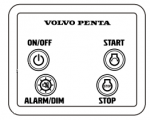
He has not told us much about his installation but a D1-30F would normally have a "Button panel" ( He mentions pressing buttons in one of his earlier posts and in July 2021 he told us that it was a D1-30 F installed professionally in 2013)
View attachment 148036
I assume references to an "ECU" actually refer to VP's notorious "MDI" black box ?
.
Yeah. I’d say you’re right about probably not getting as much as 1.7v all being normal with the anodes. To be honest, I had it in mind that it was mentioned that 0.7v was the trigger value for the relay, when I posted earlier. Agree that wouldn’t be much more than 1v produced. That’s if all was as it should be, I’ll caveat!I dont think you will get as much as 1.7 volts from "galvanic sources". It is not likely that you will get significantly more than 1.0 V. (See a galvanic series chart or table of galvanic potentials , eg on Vyv's website)
I dont think the OP has an ignition switch in the usual sense.
He has not told us much about his installation but a D1-30F would normally have a "Button panel" ( He mentions pressing buttons in one of his earlier posts and in July 2021 he told us that it was a D1-30 F installed professionally in 2013)
View attachment 148036
I assume references to an "ECU" actually refer to VP's notorious "MDI" black box ?
.
The mdi box is nothing special, relays energise the starter, earth the block when glowplugs are on and the stop solenoid when stop is called for. Just a step up from the relay box on older models with some trickery to convert engine data to nmea 2000 and some trickery to energise the start solenoid automatically when start conditions are met, ie temp if glow plugs required.I dont think you will get as much as 1.7 volts from "galvanic sources". It is not likely that you will get significantly more than 1.0 V. (See a galvanic series chart or table of galvanic potentials , eg on Vyv's website)
I dont think the OP has an ignition switch in the usual sense.
He has not told us much about his installation but a D1-30F would normally have a "Button panel" ( He mentions pressing buttons in one of his earlier posts and in July 2021 he told us that it was a D1-30 F installed professionally in 2013)
View attachment 148036
I assume references to an "ECU" actually refer to VP's notorious "MDI" black box ?
.
My money is on a bad earth somewhere causing a reverse flow through the relay coil.
I'm slightly disturbed by this talk of a double pole isolator - given that the normal way to wire the DC on a boat is with both house and start batteries sharing the negative, introducing something that isolates the *negative* side of the system is likely to cause all sorts of stray currents!
Agree with the above. Would also be interesting to see if the feed present, can be dissipated to earthThere is not a double pole isolator, but there is an isolator that only isolates the engine negatives. As i said earlier, that's not how the boat would have been wired from new (at least i have never seen a Jeanneau wired that way). Th negative isolator would have isolated all negatives.
You are correct that this arrangement could cause issues. It would be worth the OP turning the engine positive off, but leaving the negative on, see if that "cures" the problem.
Regardless, i would either, connect all negatives to the switch, or connect them all to a terminal post (or bolt the together) and connect the now redundant switch to the load terminals of the engine and domestic isolators to be used as an emergency parallel switch.
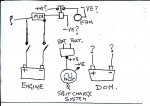
Paul, My very rudimentary, back of a fag packet, take of the system from the description. ? marks denote cables that have the destination or origin unknown. No idea of the split charge system, how or where it is connected. Similar for Domestic. Would you agree with this? Maybe some of the other experts could comment!There is not a double pole isolator, but there is an isolator that only isolates the engine negatives. As i said earlier, that's not how the boat would have been wired from new (at least i have never seen a Jeanneau wired that way). The negative isolator would have isolated all negatives.
You are correct that this arrangement could cause issues. It would be worth the OP turning the engine positive off, but leaving the negative on, see if that "cures" the problem.
Regardless, i would either, connect all negatives to the switch, or connect them all to a terminal post (or bolt them together) and connect the now redundant switch to the load terminals of the engine and domestic isolators to be used as an emergency parallel switch.