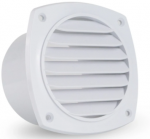
Eberspacher fresh air intake in cockpit?

We usually have the forepeak hatch open and the washboards out during the day.

- W
Personally, if it's not easy to route your cabin air input to the great outdoors, I 'd consider just making sure there is plenty of other controllable ventilation? On my boat I could consider a vent in the transom to the aft berth, this would only need to be closed in very cold weather or very rough seas.
But then we're the kind of people who keep a bedroom window open in the UK unless it's blowing a gale.

I've been on a lot of other people's boat where they boil and fry things with the hatches closed, it can be gross.

As I said in an earlier thread, I think using a Chinese heater in a small yacht is more like heating a Morris Minor than heating a flat, efficiency is out of the window along with the damp!

If water vapour from the stove and cooking smells were an issue, I'd consider an extractor fan, that's what we do at home.

My boat has one of those novelty solar powered vents. It's a bit limp. but gives me the idea that dumping any spare solar power into a decent computer fan might actually work quite well for a boat locked up on the mooring?
 
Mine was installed to heat and recirculate cabin air which is much more economical but does encourage build up of moisture from breathing. If I were to install another, I would take the intake air from outside the cabin. Combustion air would be taken from wherever the heater is situated.
 
So, yeah, I said at the beginning I wanted to take the fresh air from the cockpit.

I was really wondering what the best way to do it was. 60mm is a big hole.

Up from the heater is the cockpit sole. Behind it I could run the duct through a shallow locker under the quarterberth then vertically up to exit under the cockpit coaming. About 1.5m run with 2x90 degree bends. Would that be OK? I would need a closeable vent to keep water out on passage or in driving rain.

- W
I would be worried about having a closable vent or even one that someone could lean against and block if the intake is in the side of the cockpit coaming. Have you got space for one of these, facing downwards? Vetus Scirocco Shell Ventilator | Force 4 Chandlery

Www.solocoastalsailing.co.uk
 
Mine draws its heating air from inside the decksaloon, so I suppose it's recirculating, BUT it also draws its combustion air from the saloon, so that ensures that fresh air is constantly being drawn in. Works fine, and with double glazed windows, condensation isn't a problem.
 
It would be better to take the intake from outside of the engine room for sure. Avoiding nasty fumes or smells. But unlike the old Eberspacher units of old, that had their temp controlled by measuring the intake temperature, these can take the temp reading from the remote control unit.
 
They take the temperature from the controller on these.
So? Taking cold air from outside, and heating it up to an acceptable temperature for inside, is going to use much more fuel than simply boosting the temperature of the inside air.
 
So? Taking cold air from outside, and heating it up to an acceptable temperature for inside, is going to use much more fuel than simply boosting the temperature of the inside air.
Only if you're not letting any warm damp air out of the boat.
If you have any ventilation, the heat input will need to compensate for that, whether the fresh air comes via the heater or straight from the hatch, the heat it needs will be much the same.
I think the air leaving the heat exchanger is maybe 80degC? So taking outdoor air at 5degC or bilge air at 15 degC is not a big % difference anyway.

What you are saying might make sense for someone running their boat closed up tight with a dehumidifier, or if they don't mind it getting humid.

I think there are advantages either way, but I don't think it's going to make that much difference most of the time?
Has anyone had real issues with a strong wind fighting the heater fan or anything?
 
So? Taking cold air from outside, and heating it up to an acceptable temperature for inside, is going to use much more fuel than simply boosting the temperature of the inside air.
Thats true but is what is recommended by Eberspacher presumably to avoid build up of moisture and mildew problems. I've had a recirculation setup and if doing it again would heat fresh air from outside but it's up to you.
 
Only if you're not letting any warm damp air out of the boat.
If you have any ventilation, the heat input will need to compensate for that, whether the fresh air comes via the heater or straight from the hatch, the heat it needs will be much the same.
I think the air leaving the heat exchanger is maybe 80degC? So taking outdoor air at 5degC or bilge air at 15 degC is not a big % difference anyway.

What you are saying might make sense for someone running their boat closed up tight with a dehumidifier, or if they don't mind it getting humid.

I think there are advantages either way, but I don't think it's going to make that much difference most of the time?
Has anyone had real issues with a strong wind fighting the heater fan or anything?
Mine takes its heating air from floor level in the saloon, so it's only heating the air from, say 16° to say 21°. The result is that the heater, once it has the air in the saloon up to an acceptable temperature, is mostly running at a low demand and therefore using little fuel. I fully accept that ventilation is essential, but the steady demand for air for combustion, as evidenced by the air going out of the exhaust, ensures at least a minimum of ventilation. More is better, but using freezing air from outside seems very inefficient. I live in a relatively cold part of the world.
 
Still trying to work out where all the bits of the Chinaspacher are going.

The heater itself will be in the engine compartment.

Hot air ducting is in, the exhaust will exit into the lazarette then out through the cockpit coming.

I want the intake air to come from outside, not in the boat.

There are no cockpit lockers, but am happy to give up some space in the starboard quarterberth (which is just storage) . My idea is to have the intake hose come up into the quarterberth then out through the cockpit side aft of the morse control but without protruding into the cockpit.

To do this I would need to create a recess. My worry would be making everything watertight in case we shipped a green one and filled the cockpit.

Alternatively, I could extend the intake hose across the quarterberth against the underside of the cockpit seat and up into the cockpit coming (on the opposite side to and well away from the exhaust)

The intake hose is quite short, what could I extend it with?

- W
Hi Webby, our old westerly had blown air intake and furnace combustion air intake inside the engine compartment which worked well and did not give engine fumes as not used at same time as engine. D4 4kw worked well for a 31fter

Our 27 ft LM has blown air intake and combustion intake high under stern deck as that is where heater is. The boat is not suited to big seas as the cockpit is barely self draining and if the water gets up to two air intakes we will be in liferaft. The disadvantage in cold weather is that heater then has to raise the temperature of incoming air from freezing someset or cornish winter to enough to heat the saloon 5 metres away. Our original D1 1Kw did nothing, our next D2 2kw did little and I am now in process of changing cassete to a D4 4kw. As changing cassete second hand plus increasing pipe size cost about £800 ago I am not pleased.

Now I understand you sail in warmer climes so maybe not so much of an issue.

Blown air intake should be same size as blown air output so readily extended by simply adding more pipe. I trust chinese copy did not deviate from that arrangement. Combustion air intake should be same size as exhaust so again extendable except that you dont need thermal wrapping. There is a limit on total length of combustion intake and exhaust and ideally they should be similar, but playing around with my various diesel and gas heaters the things are not that sensitive and combustion chamber intake and outlet can be quite close together maybe only 30 cm apart. Perhaps you are making things hard for yourself

The exhaust must go outside the boat via stern or gunwale or you risk CO poisoning, the combustion intake can literally be anywhere but best inside the confines of the hull to avoid seas splashing into it.
 
I am very much in favour of taking fresh air from 'outside' the boat, for the reasons stated by others above. Sure, it's cheaper to recirculate the air (but negligible in the context of overall boat costs), but it would be even cheaper to not have the heating on.

One could, of course, fashion an intake that was switchable between external and internal, space permitting.

Even if one were in favour of having recirculated air I definitely wouldn't take it from the engine compartment because of potential fumes and odours.

Our 27 ft LM . . . original D1 1Kw did nothing, our next D2 2kw did little and I am now in process of changing cassete to a D4 4kw. As changing cassete second hand plus increasing pipe size cost about £800 ago I am not pleased.

Interesting. The ancient Eber D3 (3kW) in my LM27 is more than enough: once on, even in the UK winter, it soon needs to switch to low power mode (which the Eber doesn't like, but it's probably decades overdue a service). I was imagining replacing it, when the Eber eventually conks out, with a 2kw heater, but you've got me rethinking that.

It may make a difference to the effectiveness of the present heater that I have big (90mm) ducting, and three outlets (forecabin, saloon, wheelhouse), but on the other hand it is at present all uninsulated (including the exposed long run from the heater under the aft deck to the accommodation).
 
Mine takes its heating air from floor level in the saloon, so it's only heating the air from, say 16° to say 21°. The result is that the heater, once it has the air in the saloon up to an acceptable temperature, is mostly running at a low demand and therefore using little fuel. I fully accept that ventilation is essential, but the steady demand for air for combustion, as evidenced by the air going out of the exhaust, ensures at least a minimum of ventilation. More is better, but using freezing air from outside seems very inefficient. I live in a relatively cold part of the world.
You probably have drier air too, in terms of absolute humidity. Down here on the South Coast, even at home we quite often put the heating on because it's damp rather than particularly cold.
 
I am very much in favour of taking fresh air from 'outside' the boat, for the reasons stated by others above. Sure, it's cheaper to recirculate the air (but negligible in the context of overall boat costs), but it would be even cheaper to not have the heating on.

One could, of course, fashion an intake that was switchable between external and internal, space permitting.

Even if one were in favour of having recirculated air I definitely wouldn't take it from the engine compartment because of potential fumes and odours.

Interesting. The ancient Eber D3 (3kW) in my LM27 is more than enough: once on, even in the UK winter, it soon needs to switch to low power mode (which the Eber doesn't like, but it's probably decades overdue a service). I was imagining replacing it, when the Eber eventually conks out, with a 2kw heater, but you've got me rethinking that.

It may make a difference to the effectiveness of the present heater that I have big (90mm) ducting, and three outlets (forecabin, saloon, wheelhouse), but on the other hand it is at present all uninsulated (including the exposed long run from the heater under the aft deck to the accommodation).
The D1 came with 50mm piping and the D2 needed 60mm and then proved clearly inadequate though I saw duct routing gave some kinks. I was going to just change to 75mm piping, cutting new holes in bulkheads re routing as necessary (oops straight through manual bilge pump pipe) to see if that improved the flow for D2, and insulating with 100mm over pipe or wrapround sheathing.

But having spent £400 on 75mm plus insulation I thought I might as well upgrade. I though Airtronic D3 would be ideal but none available 2nd hand and Navigator reminded me the D4 was not really over much on old Westerly Pentland cabin which was similar volume to LM27 saloon and wheelhouse. Might be slight overkill.

Having run both D2 and D4 on my patio I can readily tell D4 is indeed more like I had on Westerly so gives me confidence when I come to fit and use it this season. Battery drain for straight D4 (40w fan) not much different to D3 but squeezed extra battery in by turning aux battery sideways. As I said all might be overkill but I plan long trip to western isles and dont want to be cold
 
I’ve tried both recirculating air and outside air approaches on the same boat, and the outside air system (via clamshell vents on the transom) easily won because the boat stayed drier and felt fresher, yet fuel consumption seemed much the same.

Incidentally, in eco mode our Wallas 3kW heater uses only 0.1 l of diesel per hour and 12W of electricity, and in this mode it’s still comfortable down to about zero degrees ambient. The heater is almost completely inaudible both outside and in, and the exhaust/combustion-air pipe is dual concentric i.e. it has a balance flue like a home boiler so is not affected by wind. The heater has a remote on/off option so we can switch the heater on before arriving at the boat, and this system also works as a remote battery monitor.
 
We'll I'm at home just now, sitting in a room heated, as are all the other rooms in the house, by hot water radiators. The radiators heat the air, setting up a convection system whereby the hot air rises, circulates and warms the room, and then drops down before being warmed again by the radiators. Probably a classic example of heating by recirculating. It doesn't cause any condensation or dampness. Why should a similar system in a boat be any different? But please yourselves, if you want to raise a constant stream of freezing cold air up to a comfortable temperature, then go ahead, but maybe just think about the unnecessary use of fuel involved.
 
We'll I'm at home just now, sitting in a room heated, as are all the other rooms in the house, by hot water radiators. The radiators heat the air, setting up a convection system whereby the hot air rises, circulates and warms the room, and then drops down before being warmed again by the radiators. Probably a classic example of heating by recirculating. It doesn't cause any condensation or dampness. Why should a similar system in a boat be any different? But please yourselves, if you want to raise a constant stream of freezing cold air up to a comfortable temperature, then go ahead, but maybe just think about the unnecessary use of fuel involved.
A boat isnt insulated the same as a house and is a damp environment...a house should not generally be. As said before the fuel consumption on these units is not a consideration as they are so frugal.
 

Other threads that may be of interest

Top