Dyneema guard 'wires'

CPD

Well-Known Member
Joined
20 Sep 2006
Messages
3,014
Location
Hampshire
Visit site
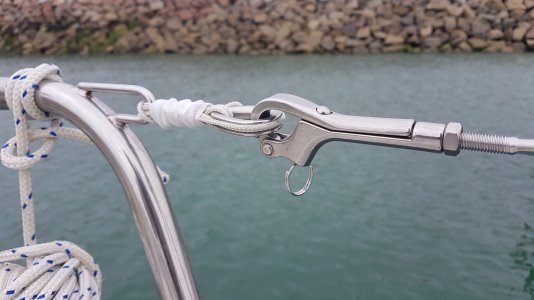
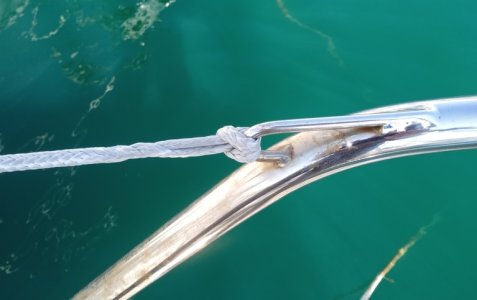
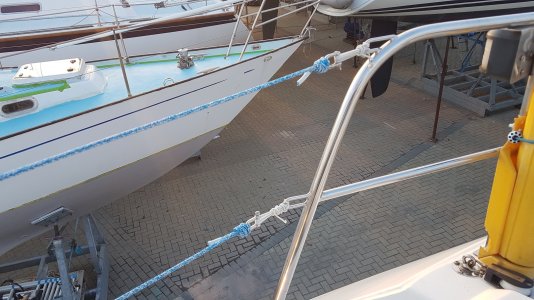
To those who have switched from wire to dyneema for guard wires, how did you attach the dyneema to the pushpit/pullpit ?. Any pictures or links to fittings would be most welcome ...... many thanks :).
 
To those who have switched from wire to dyneema for guard wires, how did you attach the dyneema to the pushpit/pullpit ?. Any pictures or links to fittings would be most welcome ...... many thanks :).
I haven't done it but I'd imagine a splice around a thimble would be good enough?
 
I have a guard wire to replace on my 38 ... and considered replacing all with Dynema or Parafil .... but then checked the race rules ... the boat is 'measured' for racing and wire is stated in the 'book' .....
 
My thoughts too I just wondered if there was a better method, as it is likely that the attachment could be the weakest link if not done well !!

No matter how good you are at it .. knots, bends, hitches and splices are ALWAYS the weakest link in the rope .... but choose the right one and you can get nearer to ropes original strength ..

I would suggest that with Dyneema - you would be advised to make sure the length of 'splice' is greater than with ordinary rope due its 'slippery form' ... just my thoughts.
 
I did it on my recently sold boat, they were brilliant, kinder on the legs and arms and much appreciated by my crew but as mentioned, no good for racing though.

Mine were tied on at the bow for the first year in case we didn't like them and also to get any small amount of stretch out then later spliced around a thimble at the bow and with thimbles and pelican hooks at the pushpit end

I already have the 6mm dyneema and fittings to replace the wire on my new boat

Guard wires 1.jpg

Guard wires 2.jpg
 
At the bow pulpit I have seen both eye/thimble splice + lashing, or a long eye splice then fitted this way, though I personally have steel wire I'd prefer this second solution for the bow attachment, it's less bulky, less chafe for the genoa base; if resistance is a concern go a size up with dyneema braid.
dynpulp.jpg
 
Why do you want use dyneema for life lines? The weight saving is going to be negligible; I’d guess a couple of kilograms at best. The frequency that you need to change lifelines makes the cost and effort between the two options negligible yet the potential for chafe when you tie fenders on could result in a failure of a key MOB prevention measure.

What am I missing?
 
Why do you want use dyneema for life lines? The weight saving is going to be negligible; I’d guess a couple of kilograms at best. The frequency that you need to change lifelines makes the cost and effort between the two options negligible yet the potential for chafe when you tie fenders on could result in a failure of a key MOB prevention measure.

What am I missing?
You could be like me, and tie your fenders onto your stanchions.
 
You could be like me, and tie your fenders onto your stanchions.
or your toe rail, which has nice little holes evenly spaced along its length.

Stainless wire is great until a strand breaks - and then its lethal.

You can instal dyneema without any special tools (except for a sharp knife) replacing stainless wire demands specialist equipment. You can instal Dyneema yourself - stainless wire needs a rigger, who has the right tools, you need to book his visit, maybe need to be on the boat when he does the new installation - much better making a few splices on a warm afternoon.

Jonathan
 
We've got them and I've done it to several customers boats . Just and splice round a stainless thimble and then a normal shackle etc

Why wouldn't you do it should be the question. Lighter and stronger, can install yourself in a few minutes with even just a cursory glance at a splicing book or video, much cheaper than wire now, no waiting for someone else to make them up and swage ends etc, don't rust, don't make clothes hung on them dirty, kind to the hands etc. Also, in an emergency can be cut away more easily and your spares kit in case of accidental damage is a small roll of 4mm or 6 mm dyneema.

The only downside is that occasionally they hum in the right wind but then we just slack them off if at anchor and wanting to sleep and tighten again when we wake up / head off
 
Post 12 is great.

Dyneema is so easy to work with (even I can do it).

I would say only change if the need arose because if it isn’t broken …

By the way, I thought a dyneema back splice was STRONGER than the initial single strand of dyneema ( a post above implied that was not so).

Splicing onto a Swan neck fitting should be a piece of cake ; lots of YouTube videos and special tools not really needed until one becomes obsessed with dyneema and it’s great capabilities and then you really have a hobby upon your hands.
 
You can instal dyneema without any special tools (except for a sharp knife) replacing stainless wire demands specialist equipment. You can instal Dyneema yourself - stainless wire needs a rigger, who has the right tools, you need to book his visit, maybe need to be on the boat when he does the new installation - much better making a few splices on a warm afternoon.
Who gets a rigger out for guard rails? Measure them and order online. Fitted in no time. A 10m made up rail with fork and thread is £33, fit and forget for 20 years.
 
Perhaps the greatest concern re. Dyneema lifelines, is the burrs in the stanchions. Virtually all of the documented failures were due to chafe in the stanchion holes. If they were bare wire and anyone leaned on them, the burrs will cut the line. Smooth them off and polish the holes. A fine rat tail file to start, and then a flap of sandpaper in a split mandrel on a Dremel tool. Something like that.

Also be careful about thimbles. If the thimbles has sharp edges or if it is a cable thimble, it can actually make things worse by cutting the rope.

Cerebus: A Dyneema eye splice should be about 85% of the strength of the line. They normally break at the spot where the bury taper starts. The only termination that does not weaken the line is to wrap several turns around a large diameter drum and then clamp the end (or rather that is how cordage strength is tested).

---

I had a Dyneema whisker stay fail last year. It was not chafe. It was not a splice. A sheet ran across it under load during a sloppy jibe and burned through the mid point. Judging by the condition of end lashings, the lack of distortion on any fitting, and the estimated load on the sheet, it failed at maybe 20-25% of breaking strength. Lots of melting at and for several feet near the break. Food for thought.
 
or your toe rail, which has nice little holes evenly spaced along its length.

Stainless wire is great until a strand breaks - and then its lethal.

You can instal dyneema without any special tools (except for a sharp knife) replacing stainless wire demands specialist equipment. You can instal Dyneema yourself - stainless wire needs a rigger, who has the right tools, you need to book his visit, maybe need to be on the boat when he does the new installation - much better making a few splices on a warm afternoon.

Jonathan

????? So what happened to take the old to a rigger and have him make up in workshop ... you pay .. take new back to boat and fit yourself ?

Even if you don't have old - easy enough to measure total length pulpit to pushpit and get rigger to make ...

I have a wire that has 'stranded' near midships ... 2 strands have broken where passing through stanchion. This winter - will remove - give to rigger and then fit new myself.
 
????? So what happened to take the old to a rigger and have him make up in workshop ... you pay .. take new back to boat and fit yourself ?

Even if you don't have old - easy enough to measure total length pulpit to pushpit and get rigger to make ...

I have a wire that has 'stranded' near midships ... 2 strands have broken where passing through stanchion. This winter - will remove - give to rigger and then fit new myself.
Take to rigger, he's up a mast, wait for 30 minutes - you choose him because he's popular. You go back, to collect new wires, - that's 2 trips to the rigger (and you have learnt nothing)

Read post 14.

This is still PRACTICAL boat owner. Some of us still enjoy working on our yachts. Where are you going to draw the line - if its so cheap and easy - do it yourself. (Fortunately - its not rocket science).

Jonathan
 
Last edited:
Top