Dyneema for an anchor to chain connection ?

An issue occurs when you do the inevitable chain service and you chop the 'slightly' corroded links off the chain end, where it meets the shackle/anchor. If you don't know chain alignment is important you will re-attach any old way. But if you do know but don't pay attention to the detail and If your chain WAS aligned correctly when you chop of one or 3 links your chain will now be incorrectly aligned.

Another issue - twists will pass over some bow rollers, even if they do not pass through the windlass. Having the chain aligned correctly will not work for every assembly (which is why a Boomerang can be helpful). Slotted rollers would (or could?) remove this issue.

Jonathan
 
With Dyneema, there is chafe, and then there is chafe. A wooden surface or smooth steel surface is nothing. A chain link (snubber) with little movement is nothing. A rock with side-to-side is totally different; under load you can rub it through in hours, like a knife. If the surface is granular enough to catch fibers and hard enough to cut them, it fails.

What helps is a weave that creates a fuzzy buffer. This is why webbing and some double braids do well; the fuzz takes the pressure, not the load bearing fibers. Side-to-side resistance is all about the weave.
 
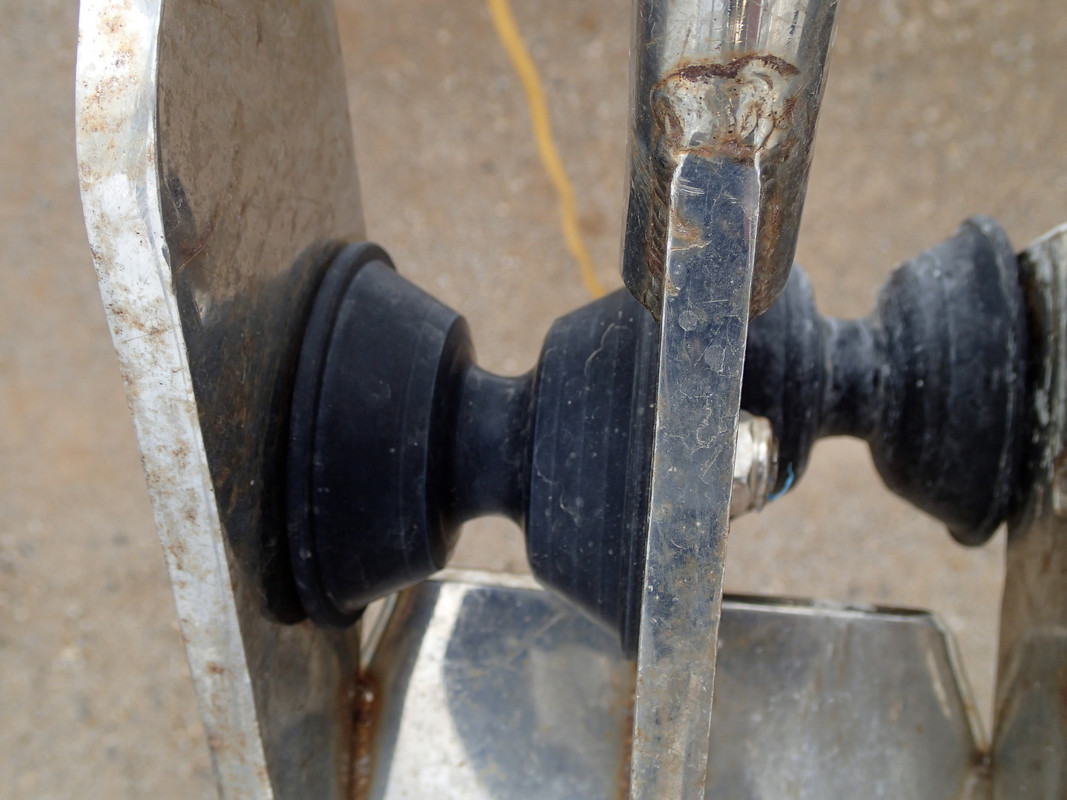
This discussion comes up endlessly and my response never varies. If you don't need a swivel, don't buy one. We find we do. Despite all the well-meaning advice above, when we went a full season without one we had endless problems with the anchor coming up the wrong way round, despite having a deep grooved bow roller. The short distance between the roller and the windlass made it very difficult for Jill, who does the bow work, to turn the anchor over. This shows our bow rollers. No idea why the chain jumps it but it definitely does.


We have tried four different swivels in the interests of research. Our original one, cheap and cheerful, failed due to stress corrosion cracking in very light wind. A cranked Osculati one never seemed to set properly, sometimes in the most bizarre way. A double cranked one we tried last season seemed OK but its design was less good than that of our favourite, the Kong. We have now owned this for more than ten years and once I had developed the additional three links of chain idea it has never let us down.
 
We have now owned this for more than ten years and once I had developed the additional three links of chain idea it has never let us down.

+1 we copied Vyv and never looked back on a 17t boat in some wild conditions.

Chain / Kong Swivel / 3 larger chain links / Crosby Shackle / Spade Anchor
 
+1 we copied Vyv and never looked back on a 17t boat in some wild conditions.

Chain / Kong Swivel / 3 larger chain links / Crosby Shackle / Spade Anchor

+1, in conjunction with the post by Vyv, who underlines, twists will come over the bow roller

For those few that do need swivels

Its amazing that after this consistent advise -

The topic comes up again and again.

I might suggest looking for an Ultra swivel if you cannot find a Kong.

Jonathan
 

I am sure you are correct. Cromox shackles I am sure are equally as good.

Are they available as bow shackles allowing articulation in the shank slot?


It is not only breaking (even 316 doe not break that easily) - it is also their ability to withstand deformation as a result of side loading. For me this is an unknown - and side loading of an anchor shackle is not unusual. For those that advocate HT stainless - hopefully they can define the performance of these shackles - when side loaded.


The only galvanised shackles we have on our cat that fit our rode are Grade B shackles, Crosby 209A or Campbell Orange pin. These BOW shackles 3/8th" have a WLL of 2t. Virtually every other galvanised shackle of the same size, excepting CMP's Black Pin shackles has a WLL of 1t. We do not have any '1t' shackles on our yacht. There can be no confusion. We do have some small gal shackles, but they will not fit on the rode (they will not actually fit on the anchor). We do have one 1/2" shackle, they suit our alloy Excel better than does the 3/8th" - this 1/2" shackle is a CMP Black Pin.

We have a host of stainless shackles, both bow and 'D'. Most, or maybe all, are used in a straight line loading situation (which is how shackles should be used). There is no chance of side loading. A problem I foresee is that good (HT) stainless shackles are easy to mistake for 'any' stainless shackle - unless you are very strict and impose this strictness on your crew. My fear is one dark night someone mistakes a good HT stainless shackle for a bog standard stainless shackle.

I have never had the need to use a stainless shackle in the rode, and knowing how easily most stainless shackles available from chandlers bend like spaghetti I see no reason to take the risk (accepting we, unusually, swap anchors fairly frequently). Here HT stainless shackles cost an arm and leg. I have tested many standard stainless shackles - it does not matter the source, reputable brand name, like Ronstan or unnamed, they all fail the same way - they bend too easily - for use on the anchor rode (where loads may be side loads). I have never tested an HT stainless shackle, too expensive - so at what point they yield - I don't know.

But if you want your chain to be the weak link then the shackle, by definition must be stronger. If your shackle 'lock up' in the anchor slot its WLL is halved. This is why a 3/8th" Grade B shackle with a WLL of 2t (3/8th") make a good pairing with a G30 8mm chain (that WLL become 1t if the shackle is locked up).

I would be interested in how HT shackles perform if side loaded, as should those who advocate their usage. I've seen too many failed sideloaded shackles.

For us a galvanised bow shackle is - an anchor shackle, nothing else. Stainless shackles are everywhere else - and the 2 types are not mixed.

I've seen, people give them to me, too many failed anchor shackles to take the risk of a mistakes being made.

Others may be more organised - but I will not recommend stainless, for the fears expressed above. If knowing those fears you choose stainless - well and good.

Jonathan
 
Last edited:
It is not only breaking (even 316 doe not break that easily) - it is also their ability to withstand deformation as a result of side loading. For me this is an unknown - and side loading of an anchor shackle is not unusual. For those that advocate HT stainless - hopefully they can define the performance of these shackles - when side loaded.

In my testing of anchoring equipment I have always based the work on 8 mm chain. Most people will use 10 mm shackles, as the pin will pass through the final link of the chain. Looking at the results (under connectors on the website) I see that the Wichard one, 316, not 17/4PH, failed at 6.67 tonnes. This of course is massively greater than the strength of most 8 mm chain. The yield strength of 316 is 50% of the UTS, so even at 3.33 tonnes this would be greater than the UTS of many Grade 30 chains. I use the 17/4PH version with the countersunk pin, unfortunately no longer available from Wichard, which probably gives me at least 10% greater strength.
 
Using dyneema for a rode seems illogical, as stretch is good in a rode.
Using 8mm rope of any flavour where it might touch the bottom for more than a few hours is just asking for trouble.
Dyneema is often chafe-resistant compared to other ropes, but it is not chafe-proof.
When the anchor gets buried, there can be a lot of grit, gravel, stones and debris getting personal with the last few metres of rode. I've laid a lot of temporary racing marks, amd even mooring an inflatable mark can quickly cause a lot of chafe if you just tie the anchor to the rope rode. We (almost) always use a short length of chain even for that. The exception might be a small short term mark (e.g. inner limit starting mark) which is just anchored by a weight not an anchor.
 
I'm a wee bit surprised by the above. Surely peeps are able to identify places on a rope rode where chafe is likely - or probable - and secure some chafe-guard material there....? It's commonplace to do that where the rode leads through a fairlead, and I use lengths of recycled firehose with a securing cord at each end for that purpose. Cheap as chips and effective.

Why would this not occur to owners and be fitted to protect a rope-chain splice?

The problem with chafe guarding material wrapped around your chain-warp connection is that it retains water and accelerates the corrosion of the chain, while hiding the process from you.
 
In my testing of anchoring equipment I have always based the work on 8 mm chain. Most people will use 10 mm shackles, as the pin will pass through the final link of the chain. Looking at the results (under connectors on the website) I see that the Wichard one, 316, not 17/4PH, failed at 6.67 tonnes. This of course is massively greater than the strength of most 8 mm chain. The yield strength of 316 is 50% of the UTS, so even at 3.33 tonnes this would be greater than the UTS of many Grade 30 chains. I use the 17/4PH version with the countersunk pin, unfortunately no longer available from Wichard, which probably gives me at least 10% greater strength.

My result are very similar - and I have also based my testing round an 8mm chain standard, a 10mm 316 stainless shackle will fail, it will part (somewhere) at something over 6t. Testing of shackles are conventionally in a straight line.

Sadly all shackle makers provide warnings that shackles side loaded will have a reduced WLL and UTS of 50% (of specification) - which brings the UTS to less than the UTS of the chain. Moreover because of the shape of a shackle the yield of the shackle is much less than 50% of UTS of the whole and it commences to deform long before 50% of UTS. Many of the stainless shackles I have tested have not failed because the 'wire' has failed but because the clevis pin has pulled out of the thread - the yield has been sufficient to allow release (and in one case the allankey head has pulled right through the eye). Unlike good rated shackles where failure is through sheer stainless failure is as a result of yield.

Failed shackles (none are stainless) in my collection all indicate some form of side loading - suggesting much shackle failure is possible because the shackle was not sitting 'perfectly aligned' in the shank slot - and possibly the shackle had locked up. I have retrieved our anchor occasionally with the shackle locked up in the slot. For both reasons I therefore take notice of the warnings of shackle makers that side loading potentially reduces WLL and UTS.

Jonathan

https://www.practical-sailor.com/is...Shackles-The-15-Insurance-Policy_11773-1.html

https://www.practical-sailor.com/blog/Tips-on-Choosing-and-Sizing-Anchor-Shackles-12098-1.html
 
Last edited:
...I use the 17/4PH version with the countersunk pin, unfortunately no longer available from Wichard, which probably gives me at least 10% greater strength.

It was your advice that prompted me to do the same, and I have not regretted it for a millisecond!

But since Wichard no longer make this model I think that the one from S3i is likely to be just as good: made in the UK, comes with a CoC and tested to BS EN 10203, made from forged 316L and you can purchase on-line.
 
Many of the reputable items we use (or could? use) on the rode, excluding the chain, are not easy to source - in fact downright inconvenient. So much so I have this nasty suspicion that people give up and possibly buy items of nefarious origins - which is why we still here stories of shackle, or swivel failure.

I understand Knox Anchor now stocks Crosby 209 and 209A shackles, Kong swivels, and a variety of hooks, carbon or stainless, (for snubbers) (and has sold the actual nylon snubbers and springs for some time).

I think their focus is in the 8mm and 10mm chain range (so items that fit those chains).

I don't know how their costs compare.

If your chain is too small for the smallest Crosby G209A then the best option is a CMP Black Pin Titan shackle. They supply them in smaller sizes and could be available in the UK (or Europe) from anyone supplying Titan chain (from CMP) and or Rocna anchors. The Black Pin shackles are not a good as Crosby's the 3.8th" (from memory) is 1.8t vs Crosby's 2t. They were marking them 2t but have downgraded the spec and some 'old specification' shackles may still be on shelves - I tested a few of the 'old spec' models and they did not meet their own 2 t spec, hence the change. I have not tested any since. Their Yellow Pin shackles are not so good again 3/8th" is a 1t shackle.

I get the impression making a 3/8th" 2t WLL shackle is quite difficult - very few achieve that spec, in fact I only know of Crosby and Campbell. Others make bigger, Van Beest and Columbus Mackinnon - and there maybe more - but only those 2 at 'our' sizes.

Given the choice buy Crosby, if there is no choice, buy the smaller Black Pin.

I do have an unbranded galvanised shackle where the pin simply pulled out of the thread - it does happen in real life - a new anchor was lost. Stainless has a lower yield, usually, than the steel that is used for gal shackles (though unbranded gal shackles are an unknown quantity) and as I have bent in test 316 stainless too easily I am very cautious (and would not use it as good gal shackles are available). The data is all available on suppliers spec sheets; basic data on the steels used, giving yield; data is available on Vyv's website and in a series of articles in Practical Sailor - individuals can make their own assessments.

Jonathan
 
tnx, black pin Titan will def fit.

from http://coxeng.co.uk/anchoring/connectors/
'Stainless steel shackles were consistently stronger than galvanised steel ones'

hm, so titan or SS ??

You could enlarge the end link on your 6mm chain, assuming it is G30 or G40. There was a thread on this a couple of weeks ago and Norman S suggested using a xxxx - its on the tip of my tongue!!! and Vyv suggests simply squeezing the link in a vice. Someone will fill in the xxxx later :)

The trouble with going down too small in shackles is, might be, that the shackle that fits the unaltered 6mm link might not fit the shank (though with a 10kg Delta, maybe that's not an issue).

I'd suggest - either open the link so you have a bigger and better choice of shackle (and maybe a bigger one) and/or take a link and the anchor with you to your chandler and match to fit.

I'd recommend opening the final link to take a bigger shackle.

I have not checked but I am sure this advice is somewhere on Vyv's website

A final option is - look at Omega links, Van Beest's Excel G10/G100 range, and have them galvanised, talk to Geoff at Knox Anchor (who is also Highland Galvanisers). They are so small - you can post them (but I don't know if they are too small for Geoff to handle). We use high tensile, 6mm chain (38' cat, 7t) and also use G10/G100 Omega links matched to 3/8th" (209a) and 1/2" (Black pin) gal shackles and the alloy equivalent of 15kg steel anchors.

Jonathan
 
Top