Dotted line on Admiralty chart

dgadee

Well-Known Member
Joined
13 Oct 2010
Messages
4,730
Visit site
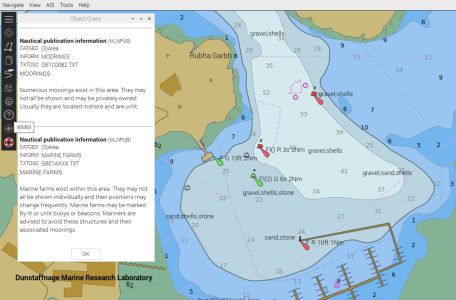
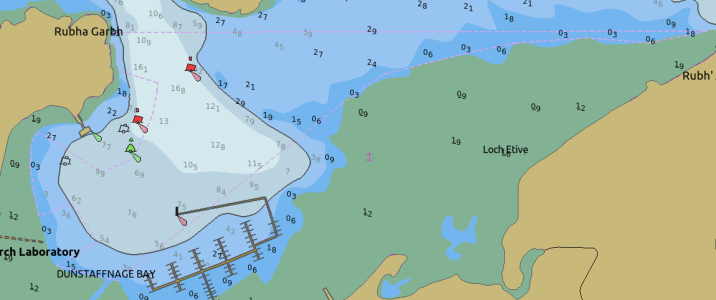
What is the dotted line on the chart indicating in Dunstaffnage? I have looked in Chart 5011 and can't see what a dotted line without symbol or text could mean.

1759511163841.png
 
"Numerous moorings exist in this area. They may not all be shown and may be privately owned. Usually they are located inshore and unlit."

The dotted line is a generic symbol to indicate an area.
 
Last edited:
"Numerous moorings exist in this area. They may not all be shown and may be privately owned. Usually they are located inshore and unlit."

The dotted line is a generic symbol to indicate an area.
According to Chart 5011 there should be the word 'moorings' associated with such an area. I am using OpenCPN and o-charts and looked at the texts (right click) but didn't see that 'Numerous moorings ...' Where is that to be found? I notice the dotted line goes through the marina pontoon.

Antares doesn't have that line.
 
According to Chart 5011 there should be the word 'moorings' associated with such an area. I am using OpenCPN and o-charts and looked at the texts (right click) but didn't see that 'Numerous moorings ...' Where is that to be found? I notice the dotted line goes through the marina pontoon.

Antares doesn't have that line.
So are you sure you are actually looking at an “Admiralty Chart” - what exactly is the source of the O-Charts you purchased (NB. I think I know the answer to that, but not certain).

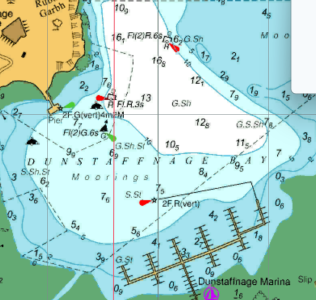
The UKHO raster chart 2388 for Dunstaffnage Bay to Connel Bridge also has the dotted lines around the pier area, black in this case. But it also has text saying Moorings outside the dotted box - not shown on your O-Chart.

As noted above, a dotted line simply shows a boundary to an area. The area can be many things. The UKHO raster chart version I am using has an issue with sometimes losing Notes, so perhaps there is a note on the original chart to explain.
 
1759522101941.png
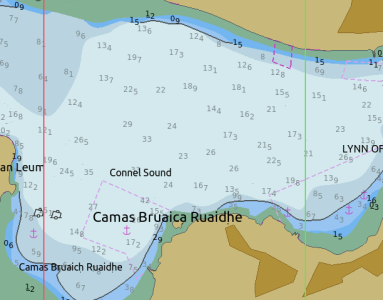
It looks to me that there are two layers - anchorages and marked areas.

Everything comes from the Admiralty charts - basically a license to reuse is pennies - so I presume VMH and O-Charts use the same data.
 
The data on leisure charts is not assured to the standard that ENCs from a hydrographic office are, which is one reason the plotters state that they are not to be used for navigation. Savvy Navvy did not include a layer of data which showed fish farms and overhead power lines. This was brought to their attention and they said that they will correct. The point is, leisure, consumer navigation charts, may not show data derived from hydrographic office data sets or even show the data compliant with a recognized standard e.g. Navionics rock symbol is black cross with background of red dots in a matrix. It couldn’t be more shite if they tried. The rock awash symbol is the same as UKHO.
 
......... I am using OpenCPN and o-charts and looked at the texts (right click) but didn't see that 'Numerous moorings ...' Where is that to be found?
I use o-charts too. The pink (to my eyes) broken line that you are seeing is only shown when I select "Show ENC Anchoring Info".

You've already right-clicked on the chart (post #4) to do an Object Query but to see the "Numerous moorings" text you need to scroll down that text box. Interestingly pretty much anywhere I right-click on that chart I get the same message, even on land. I looks like a general warning rather that something which is restricted to the area bounded by the pink broken line.
 

Attachments

  • Screenshot 2025-10-04 130647.png
    Screenshot 2025-10-04 130647.png
    466.7 KB · Views: 37
Yes, those text messages also cover Connel bridge.

I was anchored there before haul out and couldn't work out what the marked areas represented.
 
Another point about these charts. The old bw ones had much more information on the nature of the seabed. The current ones (even Antares) have much less detail, if any at all. How are you supposed to choose a spot to anchor from a chart if you don't know whether it is sand or rocks? At least Navily and suchlike have some indication.
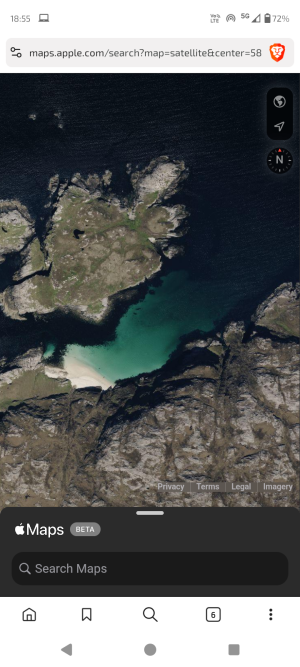
 
How are you supposed to choose a spot to anchor from a chart if you don't know whether it is sand or rocks? At least Navily and suchlike have some indication.
Google maps or better still Apple maps aerial view. You can often see clean and sandy seabed in water where there's still 3 metres at low water.
 
The data on leisure charts is not assured to the standard that ENCs from a hydrographic office are, which is one reason the plotters state that they are not to be used for navigation. Savvy Navvy did not include a layer of data which showed fish farms and overhead power lines. This was brought to their attention and they said that they will correct. The point is, leisure, consumer navigation charts, may not show data derived from hydrographic office data sets or even show the data compliant with a recognized standard e.g. Navionics rock symbol is black cross with background of red dots in a matrix. It couldn’t be more shite if they tried. The rock awash symbol is the same as UKHO.
I don’t believe that is entirely the case.
I believe the “not for navigation” on leisure charts is due to licensing conditions set by (some of?) the Hydrographic Offices - who sell the same data at much higher prices as official Electronic Navigation Charts (ENCs) to commercial shipping.
The electronic leisure charts do differ in terms of visual standards (eg Imray prefer their colour scheme), symbols (again these are chosen for what the suppliers believe is ease of use) and data sources.
Some just use the official data sources - like the UKHO raster charts and I suspect the O-Chart vector charts.
However, other leisure chart publishers include additional information from other sources not shown on official ENCs. This varies depends on location, but may include more detailed harbour plans, additional survey data or updates due to reported rocks. Based on analysis of many examples, the official ENCs are not always the most compete or most accurate.
NB. I am not referring to the crowd sourced data here, which is a layer I personally keep switched off.
The RIN and CA in conjunction with RYA, ICC and others have recently done some in depth investigations into this.
 
Last edited:
Another point about these charts. The old bw ones had much more information on the nature of the seabed. The current ones (even Antares) have much less detail, if any at all. How are you supposed to choose a spot to anchor from a chart if you don't know whether it is sand or rocks? At least Navily and suchlike have some indication.
The o-charts do have some information on the nature of the sea bed as you can see from the picture in post #9.
 
The o-charts do have some information on the nature of the sea bed as you can see from the picture in post #9.
As does the UKHO raster chart shown in post #5. Basically from the same source.
But there is certainly a justifiable view that some of the older black and white fathoms charts had extra survey data which was not digitised and carried forward when the metric charts were introduced.
(And in at least one case they omitted a very large area of drying rocks!)
 
Last edited:
Top