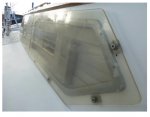
Does Anyone Know What These are Called and Where I Can Get Them?

I've never seen them, but looking at the size & shape, could they have been specifically made?

One thought is to have some made of whatever size & thickness stainless steel is needed, tapped in the middle to take the securing bolt. If they recess into the superstructure, then a suitable SS nut welded onto a SS plate will do just fine.
 
It's a small piece of metal with 3 holes in it, the middle one tapped.
You get them from a metal scrap bin and cut, file, drill, tap.
Or look to 're-purpose' some stainless component.
 
Just a thought re a slightly different way of arranging storm covers - I remember seeing something like this on a yacht some years ago.
Rather than fasteners as shown in the photo, small U-Bolts were used, with one in each corner of a rectangular shaped storm cover.
The size was such that if a slot was cut in the storm cover for the U-Bolt, then a carabiner hook (or similar - even a shackle could be used) was put through the 'U' to secure it in place.
They would not be 'watertight' covers - they just help to stop the window underneath from fracturing if a big sea hits it.
The cover panels shown in the photo above would not necessarily be watertight either, unless a lot of sealant was employed underneath them.
 
If you use anything like a rivnut or similar derivative you will finish up with a hole through your mounting surface that will allow water in. Even fitting the "bolts" in place will allow some water ingress unless you seal them. A flat plate drilled and tapped and surface mounted as has already been suggested would be best. The two mounting holes and plate could be permanently sealed with sika or similar. The centre hole, not penetrating the wall could be left open.
I can't help thinking though that to fit covers like this in any heavy weather at sea would be extremely difficult. Fiddly screws and trying to line up the holes with one hand whilst hanging on would make it difficult. Lots of spare screws needed. Obviously better to fit them before the weather arrives but like putting a reef in, we don't always get it right with our predictive actions.
 
Last edited:
I can't help thinking though that to fit covers like this in any heavy weather at sea would be extremely difficult. Fiddly screws and trying to line up the holes with one hand whilst hanging on would make it difficult. Lots of spare screws needed. Obviously better to fit them before the weather arrives but like putting a reef in, we don't always get it right with our predictive actions.
Perhaps the OP wants to just put them on & leave them on before ever leaving the pontoon
 
T nut
May have to grind the top off a bit if too long . Use a cheese head bolt & washer to fit the sheeting. Or you could put nylon washers on the stem to pack it out a bit so that the upright does not come through the plastic & you can tighten down
 
Last edited:
Thanks chaps, useful feedback. To my mind, the purpose of storm covers is to take the impact from green waves or a knockdown, thus preventing the actual window from smashing. Of course, there are other types of covers designed to be fitted after the event, but surely it’s better to avoid the smash and consequent flooding in the first place.

For this type of cover, I see no reason why they have to be waterproof. But they do need substantial fixings to survive the shear forces produced by green water rolling along the deck.

Other than this image, I’ve yet to find any decent example of storm windows - even though they are frequently referred to in most, if not all, books on heavy weather sailing.

Clearly, any such arrangement needs to be put in place before you are in storm conditions. Just as you would also ready your drogue or para anchor well in advance.
 
Just a thought re a slightly different way of arranging storm covers - I remember seeing something like this on a yacht some years ago.
Rather than fasteners as shown in the photo, small U-Bolts were used, with one in each corner of a rectangular shaped storm cover.
The size was such that if a slot was cut in the storm cover for the U-Bolt, then a carabiner hook (or similar - even a shackle could be used) was put through the 'U' to secure it in place.
They would not be 'watertight' covers - they just help to stop the window underneath from fracturing if a big sea hits it.
The cover panels shown in the photo above would not necessarily be watertight either, unless a lot of sealant was employed underneath them.
I like that suggestion, as having sharp-ended bolts sticking out is a menace. Another version I saw on a Fisher was to have a rail on either side to slide the cover into - a very quick way to employ if things started to get rough.
Tugs in our neck of the woods frequently use heavy steel screen grating to cover their wheelhouse windows. The grating allows for visibility while breaking and dispersing the impact of solid water.
 
If I had the OPs dilemma I'd simply buy a suitable sized long piece of stainless, chop into pieces, drill for the fixing bolts and tap for the bolts for the covers. I did think the ones in the image looked a bit flimsy for storm boards in that the water could get under the board - a big sea develops a lot of pressure in very unexpected places. Its not the waves running down the decks but the beam seas breaking over the cabin roof. When you need storm covers you don't need to see out - the covers are there to protect integrity. Glass covered foams seems a better option.

Jonathan
 
Top