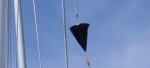
Do you ever display a motoring cone?

I love the way that so many people assume people on the bridge of a ship always have a complete awareness of wind and sea conditions from a sailing boats point of view. The many and varied comments along the lines of 'it's obvious that I'm motoring because my sails flat in and I'm going straight into the wind.'

I have a huge respect for 99% of bridge watchkeepers of commercial vessels but it's a bit much for them to do instant appraisals of the sailing characteristics of an unknown yacht, guess the wind speed and direction you are experiencing and the angle of your heading relative to the wind and then make a judgement about whether your boat speed is reasonable for the sailplan you have up.

The rules about day shapes are there for a reason. Don't be lazy; put the correct shape up!!! I don't understand how people can even start to justify their idleness at not complying... Each to their own I guess.
 
Last edited:
The rules about day shapes are there for a reason. Don't be lazy; put the correct shape up!!! I don't understand how people can even start to justify their idleness at not complying... Each to their own I guess.

People learn from experience and observation. In my own case I often see anchor balls in use. There are many occasions where it appears sensible to use one. Consequently I have an anchor ball (it's a black ball fender) and generally use it when at anchor.

In contrast I have never seen a motorsailing cone in use. If I were to hoist one it would not be visible to all other boats, being obstructed from some angles by the headsail. I believe that most people on the boats under engine that I encounter, typically 12' to 24' angling boats, would be uncertain of the cone's meaning, if they noticed it at all.

I hope that helps you understand, although I fully respect your different outlook.
 
People learn from experience and observation. In my own case I often see anchor balls in use. There are many occasions where it appears sensible to use one. Consequently I have an anchor ball (it's a black ball fender) and generally use it when at anchor.

In contrast I have never seen a motorsailing cone in use. If I were to hoist one it would not be visible to all other boats, being obstructed from some angles by the headsail. I believe that most people on the boats under engine that I encounter, typically 12' to 24' angling boats, would be uncertain of the cone's meaning, if they noticed it at all.

I hope that helps you understand, although I fully respect your different outlook.

So you justify being too lazy to buy and then use a motorsailing cone to comply with IRPCS on the basis that you suspect other people might not understand its use?

(PS You can always make one out of a bit of scrap plywood and some black paint of you don't want to spend money.)
 
So you justify being too lazy to buy and then use a motorsailing cone to comply with IRPCS on the basis that you suspect other people might not understand its use?

(PS You can always make one out of a bit of scrap plywood and some black paint of you don't want to spend money.)

+ a bunch
 
I love the way that so many people assume people on the bridge of a ship always have a complete awareness of wind and sea conditions from a sailing boats point of view. The many and varied comments along the lines of 'it's obvious that I'm motoring because my sails flat in and I'm going straight into the wind.'

I have a huge respect for 99% of bridge watchkeepers of commercial vessels but it's a bit much for them to do instant appraisals of the sailing characteristics of an unknown yacht, guess the wind speed and direction you are experiencing and the angle of your heading relative to the wind and then make a judgement about whether your boat speed is reasonable for the sailplan you have up.

The rules about day shapes are there for a reason. Don't be lazy; put the correct shape up!!! I don't understand how people can even start to justify their idleness at not complying... Each to their own I guess.


Not being lazy just obtuse and argumentative.:)

I would expect an OOW to have a pretty good idea of current wind and sea conditions although he might not give a rats ass about a small sailing vessels point of view.
just making a simple point which you are free to tell my I'm wrong.

e) A vessel proceeding under sail when also being propelled by machinery shall exhibit forward where it can best be seen a conical shape, apex downwards

It appears to me. The motoring cone is only required if you are proceeding under sail.

If there is no wind. and your main sail although still hoisted is sheeted hard. Are you proceeding under sail.? Some judge may have ruled otherwise. But I think you are not proceeding under sail.
Sort of the opposite of having your engine on but not in gear when you are sailing.

logic would follow if you have a sail up but not in gear when motoring. When there is no wind. why would you be required to have a cone?

The simple fact there is no wind makes it apparent to an observer on another vessel you are not sailing but motoring.

On the other hand if you are proceeding under sail and supplementing this with the motor a cone is required to be hoisted forward where it can best be seen even if it can’t be seen from some directions.
 
Not being lazy just obtuse and argumentative.:)

I would expect an OOW to have a pretty good idea of current wind and sea conditions although he might not give a rats ass about a small sailing vessels point of view.
just making a simple point which you are free to tell my I'm wrong.

e) A vessel proceeding under sail when also being propelled by machinery shall exhibit forward where it can best be seen a conical shape, apex downwards

It appears to me. The motoring cone is only required if you are proceeding under sail.

If there is no wind. and your main sail although still hoisted is sheeted hard. Are you proceeding under sail.? Some judge may have ruled otherwise. But I think you are not proceeding under sail.
Sort of the opposite of having your engine on but not in gear when you are sailing.

logic would follow if you have a sail up but not in gear when motoring. When there is no wind. why would you be required to have a cone?

The simple fact there is no wind makes it apparent to an observer on another vessel you are not sailing but motoring.

On the other hand if you are proceeding under sail and supplementing this with the motor a cone is required to be hoisted forward where it can best be seen even if it can’t be seen from some directions.

Not being lazy just obtuse and argumentative seems to sum up things nicely...
 
What's with the slightly silly inverted snobbery of not hoisting the correct day shapes, which appears to be top trumped by 'I don't even own the correct shapes'.

Once upon a time, yachtsmen and women were proud to try and act in a seamanlike way.

Do you display the prescribed lights and shapes when towing a dinghy?
 
When I am told I must do something. My first response is usually, Why?
Well its in the rules don't you know. I still ask why?

So far the answers are.
Its in the rules. Well like all rules they are subject to interpretation.
My interpretation might be wrong.
My suggestion is interpreting the rule to mean any vessel with any sail up under any circumstance and conditions must display a cone apex down. If the engine is being used. To propel the boat. Is not what the rule actually says.

Apart from its in the rules, It has been suggested I might confuse the Captain or OOW of a VLCC.

Which I think is silly and irrelevant, being a vessel of less than 20m in length. I am required not to impede their passage in the first place regardless of my status, power driven vessel or sailing vessel.
(The example given was the Casquetts TSS) , I’m sure their experience would be more than ample for them to assess the situation.

So I suppose I am lazy, unseaman like and possibly some form of snob.

I would have hoped those of you who are RYA Instructors or examiners would explained it better. If you believe motoring with one sail up without a cone. Is unseaman like.
 
A motoring cone is required under the rules in the USA too, but apparently only for vessels >12m or 39ft LOA. I would like to comply even though we are only 36ft these days and at least like to have one on board, but true to septic logic over here you cannot buy such things in the chandleries.


So any of you lot who are not bothering to use yours please send it to me please.:encouragement:

Try Defender: http://search.defender.com/?expression=motoring+cone&x=0&y=0
 
On a line from the spinnaker halyard to the pulpit, give it a flick round the forestay so it hangs outside (to starboard of) the sail. Vessels crossing from the port side, or overtaking, won't be able to see it, but that's ok because they have to keep clear of you whether you are sail or power. It's the guys on your starboard side who need to see it, because it changes them from keep-clear to stand-on.

Like you I tried to work out where it would be visible to who needs to see it. I tend to hang it from the port signal halyard - so not visible to a stbd pdv in a crossing, but I reckon he'll see it when I give way (early). I thought that if I was stbd tack while motoring, then port tack SV is likely port of me; same if I'm port and another port is upwind, the cone will be visible, and my manoeuvre will not necessarily show my stbd side.

My homemade cone:P4010463-604x270.jpg
 
Last edited:

Thanks when I searched Defender it didn't appear, it does say 'New' and it is made by Plastimo, France! I will order one even though according to the USA rules which I have a copy of, we are not required to display one if we are under 12 metre/39ft LOA ( our current boat is a titchy 36ft), same with anchor ball shape unless we are actually anchored in a channel ( which would be a dumb thing to do). Strange rules it seems to me but we do alredy have the anchor shape and it is no hassle to hoist it and hang the anchor light from it too at night. The motoring cone can rest at the base of the babystay all ready to be hoisted up it on the spinnaker pole uphaul when required Also according to the USA rule book the cone is not required in inland waters either so in the ICW doesn't need to go up it seems. They just have to be different don't they whilst pretending it always the rest of the world out of step not them. I must admit when back in European waters I never used a motoring cone though I had one on board, but then like others we never ever motorsailed with a headsail up but a sheeted in mainsail usually was as a roll stopper if nothing else
 
Last edited:
I wonder how many of the posters who don't/won't use a motoring cone as per the IRPCS have previously shown their 'disgust' at the fishermen who have their day shapes 'welded' to the mast?

PW
 
Do you display the prescribed lights and shapes when towing a dinghy?

Very funny. :) Its the equivalent of claiming to be a fishing vessel when trolling for mackerel (and in the latter case the rules quite explicitly say you are NOT a fishing vessel…)

But no doubt you appreciate that a towing vessel is just a power driven vessel as far as IRPCS is concerned and gains no extra 'rights' unless the towing vessel is severely restricted in its ability to manoeuvre by its tow.
 
So you justify being too lazy to buy and then use a motorsailing cone to comply with IRPCS on the basis that you suspect other people might not understand its use?

Laziness is not a factor.

If it were I wouldn't use an anchor ball.

There are countless laws, rules and regulations. I choose not to obey some. For example when in my car I sometimes drive on motorways at 75 mph when my experience and judgement tell me it's safe to do so.

In my limited boating experience, about 10,000 NM in total, I have never seen a motorsailing cone in use. From other posts in this thread I gather that they are rarely seen in British and Irish waters. As others have pointed out there are many fishing boats that have day shapes welded in place, which seems to show the seriousness with which professionals view some of the rules.

I am not aware of the non-use of a motorsailing cone having caused any significant difficulty. Perhaps you are. If so I'd be interested to read the CHIRP report.
 
When I am told I must do something. My first response is usually, Why?
Well its in the rules don't you know. I still ask why?

So far the answers are.
Its in the rules. Well like all rules they are subject to interpretation.
My interpretation might be wrong.
My suggestion is interpreting the rule to mean any vessel with any sail up under any circumstance and conditions must display a cone apex down. If the engine is being used. To propel the boat. Is not what the rule actually says.

Apart from its in the rules, It has been suggested I might confuse the Captain or OOW of a VLCC.

Which I think is silly and irrelevant, being a vessel of less than 20m in length. I am required not to impede their passage in the first place regardless of my status, power driven vessel or sailing vessel.
(The example given was the Casquetts TSS) , I’m sure their experience would be more than ample for them to assess the situation.

So I suppose I am lazy, unseaman like and possibly some form of snob.

I would have hoped those of you who are RYA Instructors or examiners would explained it better. If you believe motoring with one sail up without a cone. Is unseaman like.


I'm a little confused by your assertion that as you are less than 20 metres you are not supposed to impede any large vessels. In open waters and when not in a TSS that isn't true... My limited experience tells me most every ship try's very hard to comply with IRPCS. Just because it's 'unfashionable' to use a cone when motor sailing, or the fact that you say you haven't seen one, doesn't make failing to comply right. I admit that I've been too lazy to get the thing out on short passages sometimes. However if were motoring across the channel in winds too light to sail in but with the mainsail up to reduce rolling, out comes the cone. IMHO it's a seamanlike thing to do.

Laziness is not a factor.

If it were I wouldn't use an anchor ball.

There are countless laws, rules and regulations. I choose not to obey some. For example when in my car I sometimes drive on motorways at 75 mph when my experience and judgement tell me it's safe to do so.

In my limited boating experience, about 10,000 NM in total, I have never seen a motorsailing cone in use. From other posts in this thread I gather that they are rarely seen in British and Irish waters. As others have pointed out there are many fishing boats that have day shapes welded in place, which seems to show the seriousness with which professionals view some of the rules.

I am not aware of the non-use of a motorsailing cone having caused any significant difficulty. Perhaps you are. If so I'd be interested to read the CHIRP report.

But there have been countless times when a power driven vessel has taken action to avoid a 'sailing yacht' only to discover to their annoyance that the yacht wasn't sailing at all. Why shouldn't we encourage sailors to avoid ambiguity and comply with IRPCS.

I'm not going to die in a ditch over this matter, but I am flabbergasted by some of the attempts by some to justify not complying when appropriate.
 
Very funny. :) Its the equivalent of claiming to be a fishing vessel when trolling for mackerel (and in the latter case the rules quite explicitly say you are NOT a fishing vessel…)

But no doubt you appreciate that a towing vessel is just a power driven vessel as far as IRPCS is concerned and gains no extra 'rights' unless the towing vessel is severely restricted in its ability to manoeuvre by its tow.

I can't see anything in the rules which exempts my dinghy (7'6" GRP at the end of a 50' painter) from the IRPCS requirements - can you? And while it gets me no additional rights, the rules are there for a reason ... to allow give way vessels better information about the course change required.

How many yachts over 12m carry and display the prescribed lights and shapes for running aground?
 
Top