Do VSR’s always charge in both directions?

I don't believe it is a solid state relay. Perhaps you should Google the number to find out what it is for sure.

Maybe - but the info I have gained after investigating shows negligible voltage drop in use - which usually means either its a very good mechanical or solid state ... given the lack of any clicks and its size ... ? But could well be mechanical.

Good thing though is its simple and works ! I do not want my banks to ever feed each other ... if that had happened on that last stormy crossing - I would have had dire circumstances with both banks dead.
 
A switch. or maybe a relay operated from the oil pressure sender on engine. Either add in series or replace the VSR with relay.
I assume the lithium battery has a built in charge controller to permit it to be charged from alternator. ol'will
A switch (or relay) in the negative connection will disable the VSR.
Post #9

"You'll likely want the alternator to put some charge into the LifeP04, so you can fit a normally open relay in the negative wire to the VSR and have this relay energised by the alternator charge warning lamp."

;)
 
Maybe - but the info I have gained after investigating shows negligible voltage drop in use - which usually means either its a very good mechanical or solid state ... given the lack of any clicks and its size ... ? But could well be mechanical.

Good thing though is its simple and works ! I do not want my banks to ever feed each other ... if that had happened on that last stormy crossing - I would have had dire circumstances with both banks dead.
Sorry, but you've got this backwards.

Your existing relay will close when the engine is running, according to your description, which connects the two banks in parallel. If, while the relay is closed a fault occurs it could completely deplete all batteries.

A VSR only closes when a set voltage is reached. If a fault occurs that would drain all batteries with your existing relay the VSR will open and only one bank will be depleted.

This is why VSRs are now used in place of standard relays.
 
If I put a diode in the cable from VSR to LiFePo battery would that be inefficient?
Presumably fitted so that it allows the alternator to charge the LiFePo leisure battery but blocks the leisure battery charging the engine start battery?

If you use a silicon diode it will impose a voltage drop of about 0.7 volts drop on the alternator to leisure battery charging.

A single sensing VSR would solve the problem ... I suspect that was what you were thinking about in your original post . It would avoid the faff of fitting and wiring a relay or any downsides of fitting a manual switch, like forgetting to close it when running the engine.
 
Last edited:
This is starting to get a bit like a bodge on top of a bodge.

A B2B is one solution.

Having the VSR negative routed through a bog standard automotive relay. energised from the ign warning lamp connection on the alternator, is another. It's cheap, easy to fit and no current can flow in either direction unless the engine is running, whilst maintaining the features of a VSR.

The OP also needs to be aware of my earlier comments regarding leaving the LifeP04 being left fully charged for extended periods, very easily done in a camper van with 200w of solar, it's likely that the battery will sit fully charged virtually all of the time.
 
A single sensing VSR would solve the problem ... I suspect that was what you were thinking about in your original post . It would avoid the faff of fitting and wiring a relay or any downsides of fitting a manual switch, like forgetting to close it when running the engine.
This^^
I already have a manual switch on dash to turn VSR off when not required, I’m just trying to stop the VSR ‘taking’ power from the LiFePo overnight in winter. Obviously I can do this by simply switching VSR off with dash switch but I keep forgetting.
 
The OP also needs to be aware of my earlier comments regarding leaving the LifeP04 being left fully charged for extended periods, very easily done in a camper van with 200w of solar, it's likely that the battery will sit fully charged virtually all of the time.
Sorry Paul, should have said -camper van is my daily driver, used every day with Eberspacher and fridge on plus using inverter fed kettle during breaks, so no risk of battery being left fully charged.
 
I already have a manual switch on dash to turn VSR off when not required, I’m just trying to stop the VSR ‘taking’ power from the LiFePo overnight in winter. Obviously I can do this by simply switching VSR off with dash switch but I keep forgetting.
So do the following that Paul says:
Having the VSR negative routed through a bog standard automotive relay. energised from the ign warning lamp connection on the alternator, is another. It's cheap, easy to fit and no current can flow in either direction unless the engine is running, whilst maintaining the features of a VSR.
It's a can't forget version of what you have.
 
Fred seems to have a switch in cab which does the job of isolating lithium battery from engine battery when stopped. A s said a single sensing VSRin placwe of existing dual sensing would do fine if you can find one.
A relay in place of switch would get over the forgetting to operate the switch. Paul seems to advocate a relay operated from ignition warning lamp. Which may be OK. I think however he only needs a make relay operated from van ignition on circuit. Key on. ( I presume it is actually a diesel but "ignition: seems to be the best term)
A diode might work out OK. As said a silicon power diode will drop .7 volt a schotky diode more like .25 volt. These may result in loss of charge to lithium battery.
ol'will
 
Sorry, but you've got this backwards.

Your existing relay will close when the engine is running, according to your description, which connects the two banks in parallel. If, while the relay is closed a fault occurs it could completely deplete all batteries.

A VSR only closes when a set voltage is reached. If a fault occurs that would drain all batteries with your existing relay the VSR will open and only one bank will be depleted.

This is why VSRs are now used in place of standard relays.

Just to close this .... I accept a VSR is a better item .. but your post implies that relays fail "closed" ... when in fact design is to fail "open" in most cases ... here is according to Electrical Online :

"Disadvantages of Solid State Relays
One disadvantage of solid state relays is their tendency to fail “shorted” on their outputs, while electromechanical relay contacts tend to fail “open.” In either case, it is possible for a relay to fail in the other mode, but these are the most common failures.

Because a “fail-open” state is generally considered safer than a “fail-closed” state, electromechanical relays are still favored over their solid-state counterparts in many applications."

Is that why they are still found in RV's ... trucks .... cars even ... and boats ??

Again I do not disagree that a VSR is better.
 
Just to close this .... I accept a VSR is a better item .. but your post implies that relays fail "closed" ... when in fact design is to fail "open" in most cases ... here is according to Electrical Online :

"Disadvantages of Solid State Relays
One disadvantage of solid state relays is their tendency to fail “shorted” on their outputs, while electromechanical relay contacts tend to fail “open.” In either case, it is possible for a relay to fail in the other mode, but these are the most common failures.

Because a “fail-open” state is generally considered safer than a “fail-closed” state, electromechanical relays are still favored over their solid-state counterparts in many applications."

Is that why they are still found in RV's ... trucks .... cars even ... and boats ??

Again I do not disagree that a VSR is better.
An electromechanical relay will, in almost all cases, fail in the deenergised (Normal) contact configuration i.e. normally closed or normally open.
I wouldn't rely on generalisation such as above.
 
Just to close this .... I accept a VSR is a better item .. but your post implies that relays fail "closed" ... when in fact design is to fail "open" in most cases ... here is according to Electrical Online :

<snip>
I wasn't referring to relay failure. I was thinking of an issue that could drain all batteries that were in parallel, in which case a standard relay will stay closed, depleting all batteries. Whereas a VSR would open.
 
I wasn't referring to relay failure. I was thinking of an issue that could drain all batteries that were in parallel, in which case a standard relay will stay closed, depleting all batteries. Whereas a VSR would open.

Accepted ... it is a concern ... but so far - the relay has done its job by separating them.

It was fitted as I understand as replacement by the yard for original setup after boat suffered flooding 3 - 4yrs ago ... But I have no idea what she had originally ... its a 1986 boat. But she was built with that battery arrangement as the boxes are mouldings - not something added years later.
Anyway enough about my crap !!

Back to OP's
 
An electromechanical relay will, in almost all cases, fail in the deenergised (Normal) contact configuration i.e. normally closed or normally open.
I wouldn't rely on generalisation such as above.

Not my understanding .... having repaired cars electrics in return for access to service gear to look after my race car ....

Relays were stated as designed to fail OPEN unless subjected to extreme abnormal such as fusing of contacts.
 
Not my understanding .... having repaired cars electrics in return for access to service gear to look after my race car ....

Relays were stated as designed to fail OPEN unless subjected to extreme abnormal such as fusing of contacts.
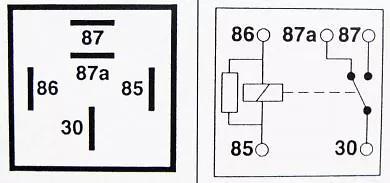
If a relay has two sets of contacts One NC & One NO they both cannot fail open. 😵‍💫
1732980791262.png
 
Top