DIY Synthetic Teak

Update

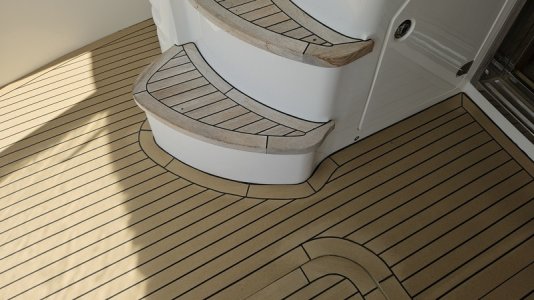
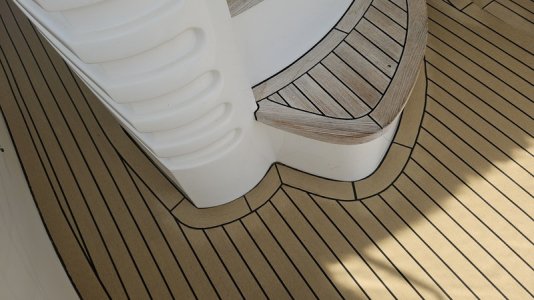
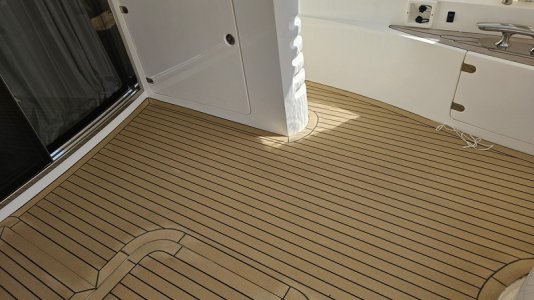
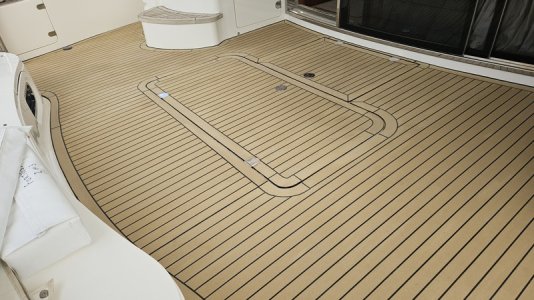
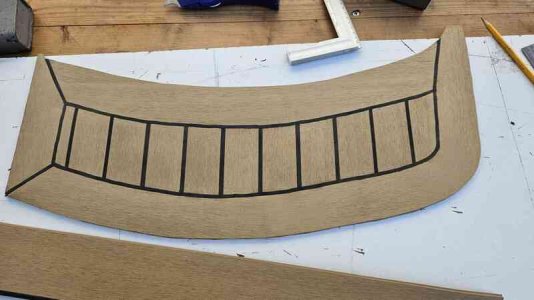
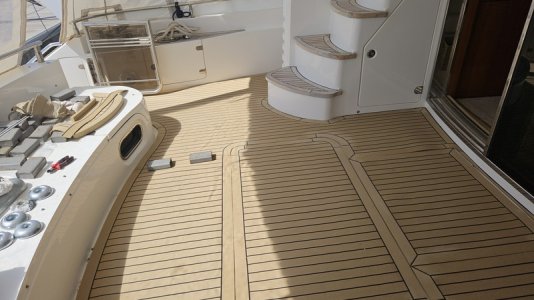
It took a couple of days longer than I thought to "cut in" the borders after making the panels at home over the winter months.
Weather was nice here in Spain most of the time so I set my workshop up in the open - on the pontoon.

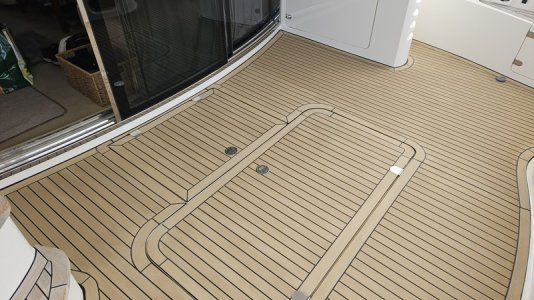
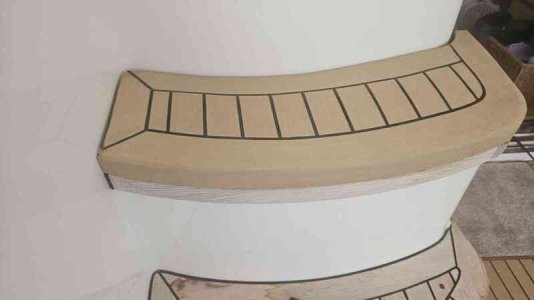
This is the result so far.
Dry fitted - yet to be stuck down after the GRP repairs and smoothing done.
20240403_124708.resized.jpg

20240403_124649.resized.jpg

20240403_124729.resized.jpg

20240403_124736.resized.jpg

20240403_124850.resized.jpg

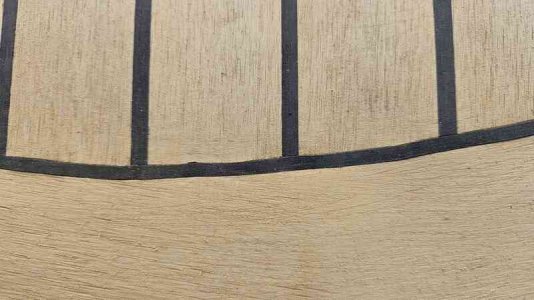
Top welding has come out OK.
The 5mm edges will be caulked after it has all been stuck down.
In the photos, you may see some lighter patches around the areas that I've sanded. These will "fade in" over time like the rest of the boat.

It is lovely to walk on - much smoother than the old wood teak - in fact as smooth as the wood teak was when it was new.
Plastic teak gets hotter than wood in the sun but it is really easy to keep clean.
And when you drop stuff on it (crisps etc) it just wipes clean.

I hope you find this thread interesting.
 
It looks great, please share your GRP preps too
OK - but it will only be photos from the cockpit security camera because I will be away when my local contractor does the work.
The repairs aren't that bad - mostly leveling the surface before the new plastic teak is laid.
One small area (about 6" square) needs to have a bit more attention but, even then, that probably only needs some epoxy filler.
 
Just adding the final pics after the cockpit has been fully fitted.
I'm really pleased with the result - really nice to walk on with bare feet.

View attachment 179784

View attachment 179785

Super nice work of you Hurricane! If you don't mind, I have a few questions:

1. What type of heat gun do you think is the best for this? A traditional gun model, a "straight" one or that type of heat station from your previous post?
2. Do you have any pictures from when you welded the steps?
3. What temperature did you have on the heat gun?
 
Super nice work of you Hurricane! If you don't mind, I have a few questions:

1. What type of heat gun do you think is the best for this? A traditional gun model, a "straight" one or that type of heat station from your previous post?
2. Do you have any pictures from when you welded the steps?
3. What temperature did you have on the heat gun?
Sorry for the delay in the reply - we were traveling out to the boat and I want to give a full reply rather than use a mobile phone.

Without a doubt this is the best heat gun to use:-
A Leister Hot Jet S
Leister HOT-JET S, 230V/460W, EU plug | 100.648 | Heat Guns

34819_preview.jpg


There are lots of different nozzles that can be used.
I can't remember exactly which one that I use but it is like this one from Leister:-
29357_preview.jpg
 
Sorry - I had problems with this forum software so continuing with a fresh post.

Steps
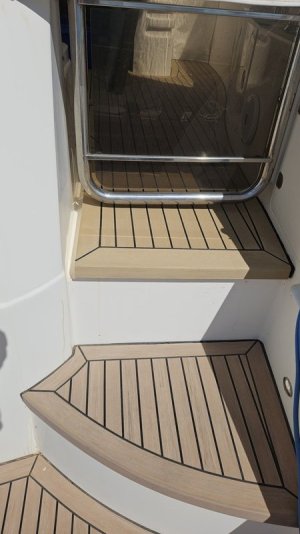
The steps from the bathing platform were done in Flexiteek - I didn't make them.
I haven't done the flybridge steps yet but I have done some mockups.

First mockup
I welded the step panel and then Top Welded the curves.
I was disappointed with that approach because it is very difficult to Top Weld a smooth line.
This was the result
20230604_111647().resized.jpg

20230604_111654().resized.jpg

You can see from the above pics that the Top Weld is al wiggly.
So, I tried a completely different approach.
I cut a 20mm strip off a factory machined edge.
And welded that into a new step panel using the "invisible" repair rod.
The idea is that a small 20mm wide strip can be flexed around a tight curve.
A lot of hassle but it worked.
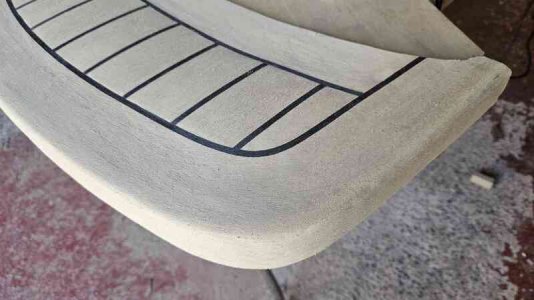
This is the result
20230605_165427().resized.jpg

I've only done one step - there is no rush to complete the flybridge steps - the old wood ones are still ok.
But this is a photo of that step laid in position.
I think I just now need to make some more!!
20240407_195344().resized.jpg
 
Last edited:
Following on from my last post.
Since making that step, I have been helping a friend with his bathing platform.
Between us, we have been working on a new technique.
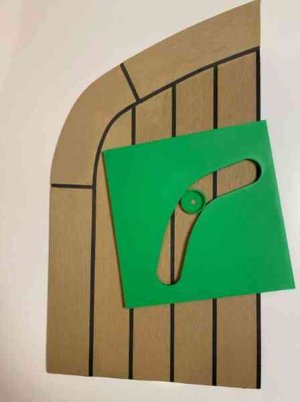
Using my 3D printer, I have been making various templates to help with Top Welding.
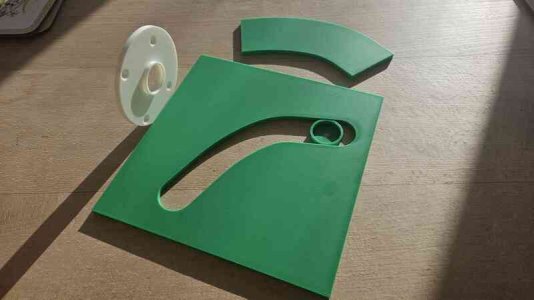
These are the kind of things that I've been printing with the 3D printer
20241214_112932().resized.jpg

The idea is that the 3D printer can produce smooth templates with smooth curves.
The slot on the big square piece fits the boss on the white piece.
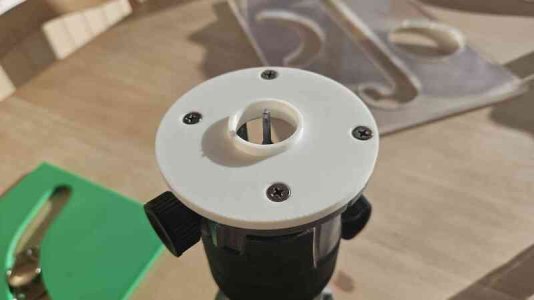
That boss screws onto a router that will then cut a nice smooth slot that can then be Top Welded.
Here is the boss fitted to a cheap palm router
20241214_114649().resized.jpg

The concept seems to work.
It is easy to cut a nice smooth slot but it takes time to make the templates.

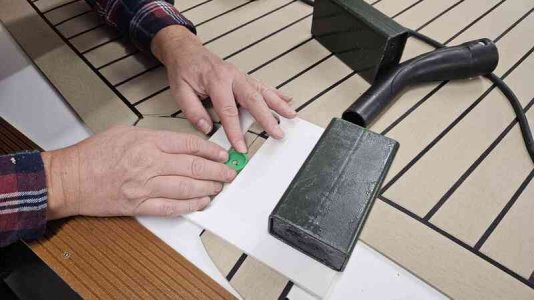
We used the small disk to align the template before routing.
20250214_150913().resized.jpg

This is the result from a mocked up corner piece
IMG-20241222-WA0002().resized.jpg

So, the concept seems to work

I hope these posts have helped.
 
Hurricane,

Great thread - thanks for sharing so much. I've been researching teak replacement for a while and had already decided on Trakmark as my preferred solution, then I found this thread which has helped increase my confidence in going forward.

I have one issue that I'm trying to work out best solution for before starting and wondered if you had any views.

My boat is an old sailing yacht - so I have various fittings on deck (deck tidies etc) and in particular mooring cleats, that are currently through deck bolted directly on to the teak decking, many of these take high loads - bolting on top of the trakmark will probably not work (trakmark will get squashed under load).

My thoughts are, can either cut template around cleats etc and mount them straight onto GRP under the teak, slight issue then that end up with reduced clearance vs current sitting on top of teak deck, alternatively put a hi modulus material as washer/gasket under the cleats to take compression.

As a motor boat your probably don't have the same issue, but wondered if you had any thoughts based on your experience working with Trakmark.

Thanks
Kevin
 
Until Hurricane replies I can tell you that all the fittings remain in place and the decking is applied around them. As you say everything would be "wobbly" if fitted on top of the decking. I can also emphasise that it is an easy job, just takes time and care.
 
Hurricane,

Great thread - thanks for sharing so much. I've been researching teak replacement for a while and had already decided on Trakmark as my preferred solution, then I found this thread which has helped increase my confidence in going forward.

I have one issue that I'm trying to work out best solution for before starting and wondered if you had any views.

My boat is an old sailing yacht - so I have various fittings on deck (deck tidies etc) and in particular mooring cleats, that are currently through deck bolted directly on to the teak decking, many of these take high loads - bolting on top of the trakmark will probably not work (trakmark will get squashed under load).

My thoughts are, can either cut template around cleats etc and mount them straight onto GRP under the teak, slight issue then that end up with reduced clearance vs current sitting on top of teak deck, alternatively put a hi modulus material as washer/gasket under the cleats to take compression.

As a motor boat your probably don't have the same issue, but wondered if you had any thoughts based on your experience working with Trakmark.

Thanks
Kevin
Actually it depends on the cleats so @PCUK 's point isn't always the case. Of course, Trakmark is softer than real wood but not enough to make a difference.
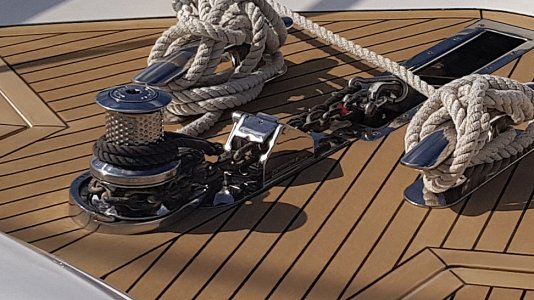
This photo of my foredeck shows our main bow cleats.

Windlass and Chain Stop.jpg

These cleats are bolted through the foredeck using two studs with s/s flat bar, washers and nuts underneath inside the chain locker.
I unbolted these cleats, fitted the Trakmark foredeck, drilled two holes through the Trakmatk to line up with the old holes and refitted the cleats.
There is no appreciable give (squash) in the Trakmark material.
I did that part of the deck in March 2020 and they have worked without any issues since.

So, if your cleats work the same way, I suggest that it would be easier and look better if you do the same.

BTW - the windlass and chain lock were refitted in a similar way but I cut round the old hawser pipe.

Thanks for digging up this old thread.
 
Until Hurricane replies I can tell you that all the fittings remain in place and the decking is applied around them. As you say everything would be "wobbly" if fitted on top of the decking. I can also emphasise that it is an easy job, just takes time and care.
Actually it depends on the cleats so @PCUK 's point isn't always the case. Of course, Trakmark is softer than real wood but not enough to make a difference.
This photo of my foredeck shows our main bow cleats.

View attachment 201467
Actually it depends on the cleats so @PCUK 's point isn't always the case. Of course, Trakmark is softer than real wood but not enough to make a difference.
This photo of my foredeck shows our main bow cleats.

View attachment 201467

These cleats are bolted through the foredeck using two studs with s/s flat bar, washers and nuts underneath inside the chain locker.
I unbolted these cleats, fitted the Trakmark foredeck, drilled two holes through the Trakmatk to line up with the old holes and refitted the cleats.
There is no appreciable give (squash) in the Trakmark material.
I did that part of the deck in March 2020 and they have worked without any issues since.

So, if your cleats work the same way, I suggest that it would be easier and look better if you do the same.

BTW - the windlass and chain lock were refitted in a similar way but I cut round the old hawser pipe.

Thanks for digging up this old thread.


These cleats are bolted through the foredeck using two studs with s/s flat bar, washers and nuts underneath inside the chain locker.
I unbolted these cleats, fitted the Trakmark foredeck, drilled two holes through the Trakmatk to line up with the old holes and refitted the cleats.
There is no appreciable give (squash) in the Trakmark material.
I did that part of the deck in March 2020 and they have worked without any issues since.

So, if your cleats work the same way, I suggest that it would be easier and look better if you do the same.

BTW - the windlass and chain lock were refitted in a similar way but I cut round the old hawser pipe.

Thanks for digging up this old thread.

Actually it depends on the cleats so @PCUK 's point isn't always the case. Of course, Trakmark is softer than real wood but not enough to make a difference.
This photo of my foredeck shows our main bow cleats.

View attachment 201467

These cleats are bolted through the foredeck using two studs with s/s flat bar, washers and nuts underneath inside the chain locker.
I unbolted these cleats, fitted the Trakmark foredeck, drilled two holes through the Trakmatk to line up with the old holes and refitted the cleats.
There is no appreciable give (squash) in the Trakmark material.
I did that part of the deck in March 2020 and they have worked without any issues since.

So, if your cleats work the same way, I suggest that it would be easier and look better if you do the same.

BTW - the windlass and chain lock were refitted in a similar way but I cut round the old hawser pipe.

Thanks for digging up this old thread.
 
Thanks, I can't just leave the fittings in place - the original teak was 10-12mm thick, and is still that depth under the cleats/winches etc (they don't make them like that any more!). If I just cut up to it - I'd have 5mm old teak exposed above the Trakmark - don't think that would be a good look. I'll have to either mount them direct on the GRP and caulk, direct onto the Trakmark, or somewhere I've seen a suggestion to use something like a 5mm nylon sheet to cut a template to take the load. Most of the high load items are similar mounting to your cleats - but don't have the bottom plate which will help spread the load across the trakmark (the two legs of the cleat bolt direct onto/through the deck so a much higher point load.

I figure if i make a washer/gasket that is say 5mm smaller than the footprint i could then cut the trakmark up to that - and visually it would look as neat as yours. I can't remember which but one of the other synthetic teak suppliers was very explicit about not bolting direct onto the synthetic teak.

Everyone thinks I'm crazy looking to do it myself, but I'm hoping it will be very satisfying if I get it right! As you say time and care, in reality whatever solution I go for, I'll be taking the old deck up and prepping myself (no way I could afford to pay someone to do that and I have a son in-law who's a carpenter and pretty handy/has all the tools), the incremental vs that to manufacture the panels/fit vs the money saved seems well worthwhile.
 
I disagree with Hurricane on fitting the cleats on top of the decking. But only from an appearances point of view. This shows how much flexibilty is available just from freedom of choice when designing your own deck. I would not fit anything on top of the decking but that is my choice as I think it looks better. I am sure Hurricane would agree with me that care is the main requirement when doing your own deck.
 
I figure if i make a washer/gasket that is say 5mm smaller than the footprint i could then cut the trakmark up to that - and visually it would look as neat as yours. I can't remember which but one of the other synthetic teak suppliers was very explicit about not bolting direct onto the synthetic teak.
Difficult to appreciate the problem without a photo but how about creating an elliptical stainless steel washer to locate under the cleats. Then remove all the old teak. Your cleat would then be at the same level as it is now but look like it is a taller cleat. I really think you can bolt through the new Trakmark without any structural issues. But it would be good to see a photo.
 
Top