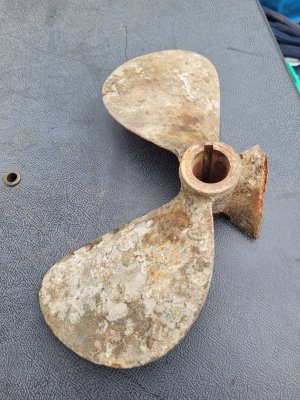
Damage to prop blade - is it serious

Adetheheat

Well-Known Member
Joined
14 Aug 2022
Messages
137
Visit site
I've got a ding on my propeller blade. Is it a serious issue that needs investigation - i thought these things were just normal things for a propeller?
Photo attached

1000011389.jpg
 
I have a few of them some of which are worse. Boat still works fine in forward and reverse..

I intend to straighten them out as best I can and grind it just to tidy them up.

I am more concerned with sticky sea creatures coming to live on the rough pieces whilst the boat is not being used and thereby making the prop very much more out of balance.
 
There are companies that repair propellers for about £100. When I was involved in survey work we would deliberately run the survey boat into shallow water with the props bouncing on the bottom for up to a mile. The extra payment for the survey work more than covered the cost of refurbished props. They were often really mangled but came back as good as new.
Your damage doesn't look too bad if it is a displacement boat so I would just beat it back into shape and use a file to smooth any irregularities.
 
I've got a ding on my propeller blade. Is it a serious issue that needs investigation - i thought these things were just normal things for a propeller?
Photo attached
View attachment 189030
Providing the the blade itself has not been deformed , some of us just might get couple of 10Ib flogging hammers and gently "dress" that little kink away .
Have seen a lot worse than that sorted with a few minutes attention., especially if away from home.
On one occasion a prop blade was bent sufficent to hit a rudder stock, prospect of a 8 hour return on single engine, encouraged a local lift out.
A session with two hammers proved good enough not to require further attention until the annual lift out the following winter.
 
Last edited:
Blimey - you want to see the prop on my 20hp Mariner O/bd ..... looks like something has bitten bits out and quite a few turned edges ... consequences of running aground on purpose with boat ...

Couple of hammers and she's good again ... one day I might put a new prop - but only if I have no more need to run aground !

When prop was in VGC - boat did about 14.5kts .... now she does about 14kts ............
 
The issue is prospective buyers have been looking at the boat and two of them have pointed out the tiny ding on the propeller as being an issue. I never even noticed it before
 
Couple of hammers - get it straight ....

Anyone comments ... just shrug shoulders and say boat does same today as it always has ...
^^ This. Actually, an anvil or large dolly block is preferred, but if you had those you would most likely have already fixed it. Not a big deal, I've done worse.

It's worth fixing, just in terms of reduced vibration and wear.
 
Just a complete fred drift here but if it were an aeroplane propeller in aluminium the real concern is starting fatigue cracks from a ding that can result in blade snapping off. (you are dead if this happens due to unbalance of prop and consequent loss of engine so loss of fore and aft balance)
The fix is to agressively file out the damage to a smooth curve with a round file. removes stress raiser. ol'will
 
Just a complete fred drift here but if it were an aeroplane propeller in aluminium the real concern is starting fatigue cracks from a ding that can result in blade snapping off. (you are dead if this happens due to unbalance of prop and consequent loss of engine so loss of fore and aft balance)
The fix is to agressively file out the damage to a smooth curve with a round file. removes stress raiser. ol'will

As a Model Air enthusiast - of course an air prop is a different ball game altogether ....

But the OP's prop is probably where its clipped a stone or maybe something while in marina / beaching etc. Its a small matter and unlikely to have any serious effect on prop if straightened out as suggested.

If that small edge sorted is a problem - then my prop should have failed years ago !!
 
Aluminium is considerably more susceptible to fatigue than 60/40 brass, assuming the one in the OP's photo is manganese bronze. 60/40 brass is not very ductile but it should be possible to hammer it straight without fracturing it. The risk of fatigue is pretty low in this construction.
 
Top