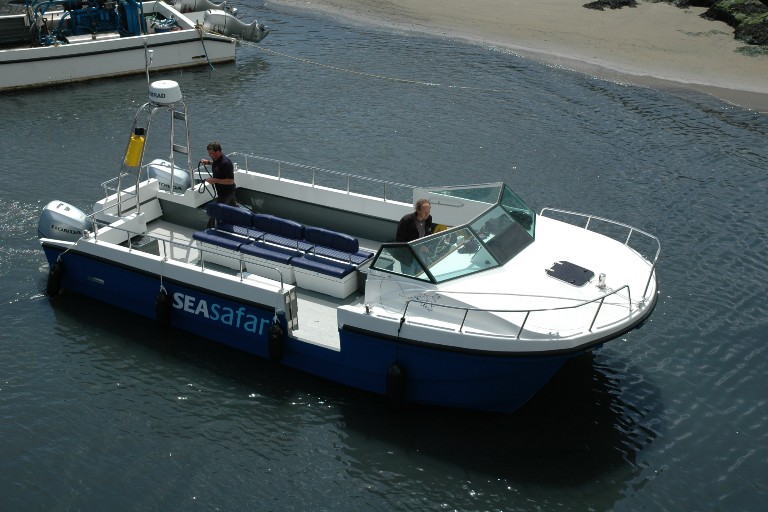
Cutting into the side of the boat/deck for a door. Structural ?

The only way I'd consider that is that the piece you cut out, would effectively hinge down and when access had been gained it locks back in place and basically becomes structural again. Oh, and waterproof too, as you are seriously lowering your freeboard. All of which would be very difficult and costly to engineer. Not impossible...airliners have doors in them...but this will be tricky.

I suspect your insurance company would want nothing to do with you either!
 
Well lots of thought on this, many thanks.

As i thought not for it as it will not be good for the boat at all.

I will talk to the chap who wants it done and let him think onand give other suggestion a sin the steps, may even a disability crane could be fitted. I have no idea of the ability of his wife and then though is room for storage.

If i did do it for him it would be suggested seriously braced up all around the opening.

One point i see that has not been mentioned unless i have missed it, a bit of a rush but i will read through all replies asap. Is that if the strake is cut then if there was an impact in that area the door would just fail.

Once again thank you for the input :)
 
probably going to be flamed, but nevermind...

Wayne, give us a value of the boat first.
Give us a section of the hull and height of the sides, if there are other nerves/ondulations to the waterline and an estimate of height from waterline to top. If it has chines, height from chine up.
Also give us a weight and length of the boat.

Unless you don't want to go platform and transom door route (maybe because you're increasing the length and mooring fees go up), I'd go ahead but only down to the rubbing strake. Wouldn't go lower.
I'd also (that's where the flaming will be...) do the same on both sides, for symmetry and to be able to enter with the same ease either way.

Finally, I'd get a few sq of heavy CSM and apply it from deck to the cut and from transom (where I'd turn it round to transom for .5m) to as far as you can get towards the bows (definitely 1.5m ahead of the cut) I'd add 2-3 layers. I mean INSIDE, not outside!

Structurally, replacing the cut with a piece that somehow "hooks" on the two sides is going to do bugger all as far as torsional stability (to the extend it's needed, not a structural engineer I'm afraid). The solution I'm suggesting is probably going to improve flexing around the sides (And tbh I doubt you'll even need that) I guess engine(s) are further ahead, so nothing really heavy back there, strops will be placed at least 1m+ ahead of the cut and if they are proper ones with xbars on top no squashing of the hull will happen.
A friend here has an old Fjord around 30ft and he simply CUT out all the transom from deck upwards. No reinforcement whatsoever, is going around the isles with his family every summer with no probs...

Of course all IMHO, legal blah blah blah to follow ;)

cheers

V.

ps. typed while you were replying W...
 
Last edited:
probably going to be flamed, but nevermind...

Wayne, give us a value of the boat first.
Give us a section of the hull and height of the sides, if there are other nerves/ondulations to the waterline and an estimate of height from waterline to top. If it has chines, height from chine up.
Also give us a weight and length of the boat.

Unless you don't want to go platform and transom door route (maybe because you're increasing the length and mooring fees go up), I'd go ahead but only down to the rubbing strake. Wouldn't go lower.
I'd also (that's where the flaming will be...) do the same on both sides, for symmetry and to be able to enter with the same ease either way.

Finally, I'd get a few sq of heavy CSM and apply it from deck to the cut and from transom (where I'd turn it round to transom for .5m) to as far as you can get towards the bows (definitely 1.5m ahead of the cut) I'd add 2-3 layers. I mean INSIDE, not outside!

Structurally, replacing the cut with a piece that somehow "hooks" on the two sides is going to do bugger all as far as torsional stability (to the extend it's needed, not a structural engineer I'm afraid). The solution I'm suggesting is probably going to improve flexing around the sides (And tbh I doubt you'll even need that) I guess engine(s) are further ahead, so nothing really heavy back there, strops will be placed at least 1m+ ahead of the cut and if they are proper ones with xbars on top no squashing of the hull will happen.
A friend here has an old Fjord around 30ft and he simply CUT out all the transom from deck upwards. No reinforcement whatsoever, is going around the isles with his family every summer with no probs...

Of course all IMHO, legal blah blah blah to follow ;)

cheers

V.

ps. typed while you were replying W...

Hi Vas

I have emailed the chap, one point to help would be if the floor is bonded into the boat structure. I am not sure on these boats,i have seen many but never been on one so i have asked him about that as that will be a help.

There is a lots of reason not to do it, more bad points than good.

I am confident in being able to do it, but i dont want him to say yes do it and i do it then he is not happy with it after a while as he discovers all the faults, like void insurance, structural loss.


I think as some have suggested the best would be a hinge down door so it acts as a step into the boat. To keep it waterproof will be a pain, just channels and run off but they are a real faff about. done them a few times on kit car hard top roofs.

Bear with i will keep you all posted. ;)
 
I would echo what a few others have said. Cut a door in the transom and fit a full width swim platform at pontoon hight. Transom doors are fairly common on motorboats, just look around any coastal marina for ideas. This arrangement will also enable access from either side of the boat. The swim platform could have a guard/hand rail along its aft edge. If its all done well I don't think it will devalue the boat at all.

It's an outboard powered boat, which would make your suggestion somewhat tricky.
 
I have emailed the chap, one point to help would be if the floor is bonded into the boat structure. I am not sure on these boats,i have seen many but never been on one so i have asked him about that as that will be a help.

There is a lots of reason not to do it, more bad points than good.

I am confident in being able to do it, but i dont want him to say yes do it and i do it then he is not happy with it after a while as he discovers all the faults, like void insurance, structural loss.

It looks like a Viking 23, and you said it was "vintage" (aka old), so I guess it's worth £10K or less. It's certainly possible to chop it about, but it will render the boat almost worthless when the owner wants to sell it. That may not worry him, if he just wants to find a way of getting a few more years' enjoyable boating with his wife. If you were to do the modification, it would be worth getting the owner to sign a document first, indemnifying you from any subsequent losses (you've already highlighted insurance and structural losses) before you take a saw to it.
 
There are many F/Vs with the transom cut out, and some with a gate in the side. They have an advantage in that the deck is bonded to the hull along the bottom of the gate. That is the nature of the stiffening I suggest in my first above.
Could there be a platform either or both sides of the outboard? Adding thickness to the GRP is not going to be as effective as fitting top hat or angular stiffening, box work round the cutout.
 
Just a few more thoughts. We see some 2door sedans where the roof is cut off. If it is done in production ie properly the car is a lot heavier due to the huge amount of reinforcing needed when there is no roof to provide that stiffening fore and aft and torsional. Not seeing the boat I wonder if it were not possible to build a solid roof high enough for him to get under but giving the stiffness to the hull when a section of top sides is removed. Also if the section is removed it might be useful to add powerful latching so that the section could be replaced in a structural sense. (partial at least) . olewill
 
with all respect, cutting 20% (in height and if so!) of the side of a boat is completely different to fcking completely the shell of car when you make it convertible reducing the structural side from 1m down to .1m (so removing 90% of the structural material albeit in only 5cm roof...).
Car has 4 points where all the weight goes down to the road and these are at the ends of the thing with a serious amount of load (the passengers) being exactly where they shouldn't from a loadbearing pov (in the weakest middle of it...).
Boat has a uniform area of the whole hull distributing nicely and evenly all the forces to the water. Further the main weight (if the engine of an outboard is considered so...) is not in the middle!
Too much discussion for nothing imho, although it does seem that there will be some difficulty in selling it and once a surveyor is involved (what's the point if value is so little??) things will be bad for the owner.

V.
 
If they can cut the side out of a yacht them I'm sure someone with Wayne's experience can cut the side out of the mentioned boat. I probably wouldn't cut passed the strake as I'm sure the seam there has a good part of the structural integrity.

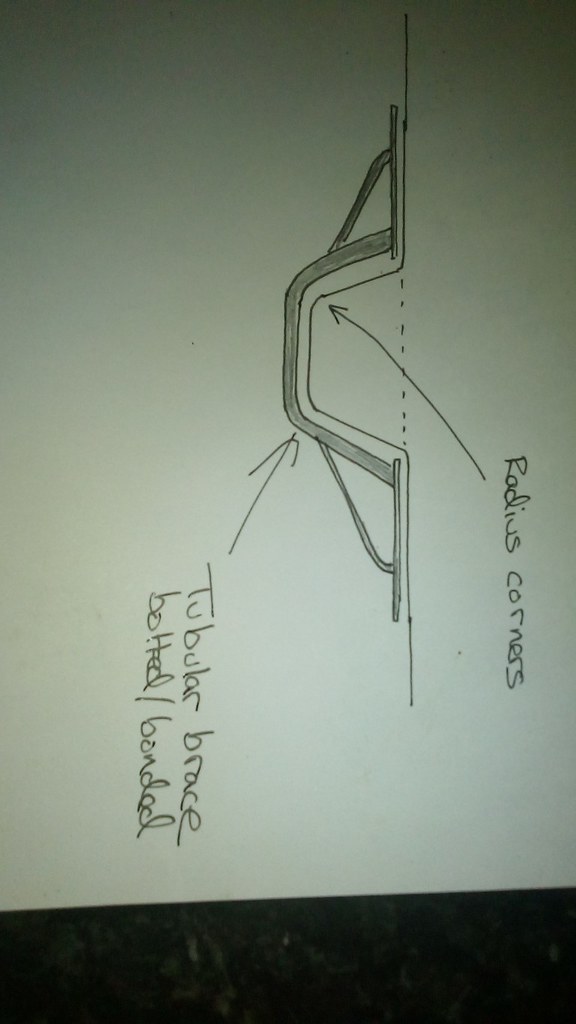
vk-cut-3-jpg.31462
 
Last edited:
If the cutout were to be removed and not replaced (ie a u shaped void in the hull) then there would be a need to significantly reinforce the cut out to preserve the overall strength of the hull. However, this is not the case: the intention is to create a hinged door which would be secured in place at all times except when it being used to access the boat. So, cut out the door, reinforce the margins of the cut out and the door and use some oversized latches to secure the door in place. That'll retain the longitudinal stiffness of the hull, both from a normal use point of view and when being lifted. Yes, it'll impact on the resale value but that's a decision for the owner to make.
 
The Cheetah is a good example, it has a deck across the bottom of the gate, a bulkhead fore side and there will no doubt be a top hat frame aft side extending below the deck.
 
with all respect, cutting 20% (in height and if so!) of the side of a boat is completely different to fcking completely the shell of car when you make it convertible reducing the structural side from 1m down to .1m (so removing 90% of the structural material albeit in only 5cm roof...).
Car has 4 points where all the weight goes down to the road and these are at the ends of the thing with a serious amount of load (the passengers) being exactly where they shouldn't from a loadbearing pov (in the weakest middle of it...).
Boat has a uniform area of the whole hull distributing nicely and evenly all the forces to the water. Further the main weight (if the engine of an outboard is considered so...) is not in the middle!
Too much discussion for nothing imho, although it does seem that there will be some difficulty in selling it and once a surveyor is involved (what's the point if value is so little??) things will be bad for the owner.

V.

Have to agree with Vas here, completely different.

They can be a lot for what they are though, more than you expect for an old boat.


Yep it is a Viking 23.
 
On the resale value being lost, if i was to see a boat with a door like this i would be interested. It would make boarding a hole lot easier fro most people when moored for a time. I like the idea......am i being lazy lol.

I am still happy to do it and confident to make it good and work well. I am not sure if he wants it done now as the downfalls out weigh the good points.

It is still in his hands though to choose and i am willing to do it.

I would of gone with a boxed in inner frame around the door opening and the door itself. 3-4 layers of 650gsm combo would be good with epoxy. Better still as solent clown posted a SS frame bonded in.

Watch this space and if it is a goer i will post up ;)
 
Top