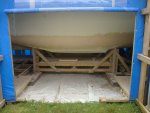
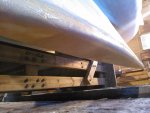
Cradle or stands for a bilge keeler

Fantastic. Nice work. Have you actually laid cloth over the join between the keels and the hull, and extended some of the moulding? I was thinking of doing the same.

Nice to meet someone with such high standards.

The uprights are, what, two thickness of 18mm ply?

The Centaur is a good bit heavier than mine.
 
Couple more images to show what i did, i had the keels on with it sat on the cradle for several moths before i thought to put some blocks underneath, the material cost of the cradle was sub £200 and took a couple of days to make. It was a modified version of a cradle i bought off a centaur owner down in Devon:

Original cradle:

Cradle 013.jpg

Keel (248).jpg

Keel (269).jpg

Cheers
 
Fantastic. Nice work. Have you actually laid cloth over the join between the keels and the hull, and extended some of the moulding? I was thinking of doing the same.

Nice to meet someone with such high standards.

The uprights are, what, two thickness of 18mm ply?

The Centaur is a good bit heavier than mine.

Cheers, i borrowed from the racing boys and faired the joint by staggering layers of cloth over encapsulated keels, that is i vac bagged each keel then bolted onto the stub with a joint line no thicker than a couple of mm's this after sheathing the hull in two complete layers of 450g bi-ax cloth then staggered cloth from 600mm over the horizontal keel hull joint line down to 100mm then tied in the ends with separate pieces.

Then there was the kevlar shoes i made for each keel and then faired the lot.

Yep the uprights i doubled up. The original cradle was a single piece front and back, i added another piece to that and put the corner reinforcing in.

A Centaur is a good bit heavier than a W22, that first picture i posted the banksman gave me a figure of 1850kg on the chains. The boat comprised of a hull, deck, internal moulding and nothing else.
 
Someone specifically warns against doing that on bolted on keels on a recent thread (mistakenly titled something about 'Encapsulated Keel').
I've heard it many times i've even heard of someone packing a Centaurs keel/hull joint to 10mm and letting sikaflex do the rest, i'm not keen on that personally but YMMV either way.
 
I've heard it many times i've even heard of someone packing a Centaurs keel/hull joint to 10mm and letting sikaflex do the rest, i'm not keen on that personally but YMMV either way.

As you wish, but it was a marine surveyor (Dom Buckley) who advised against glassing over bolt-on keel joints, and for the benefit of others the thread in which he said that is here: Encapsulated Keel Join Repair
 
Yeah i've read that thread, that looks like a keel that's grounded putting the front in tension (hence the gap) & rear in compression cracking the joint line in the process. I certainly wouldn't use CSM for glassing over that.
 
I've read many threads like this. The OP proposes a course of action which seems fairly impractical and not entirely necessary. People offer all kinds of advice which is usually rejected because it isn't what has been proposed.
Is this because the forumite has strong opinions on the required work which may not be based on experience, or is it because they are convinced that their schedule is better?

Whatever he chooses to do will hopefully prepare the boat for intensive use in the future. I do wish that the experience put forward by many would be taken into account. Putting the boat on a cradle would seem to be pointless unless it was intended to make removing replacing the keels possible.
I've scraped and antifouled several bilge keel yachts whilst they are standing on the ground. If the ground has puddles one of those mechanic's slider boards would be great. I wish I had thought of that.

Getting paint on the underside of the keel blade is a fool's errand. As others have pointed out it will not stick there. Surprising, but true :confused:
As the boat is already oldish and the blades have not corroded away yet, it seems pointless to start getting over-protective now.

I hope the best for the OP, but please stand back (literally) and put the importance of these issues into proportion.

.
 
I've read many threads like this. The OP proposes a course of action which seems fairly impractical and not entirely necessary. People offer all kinds of advice which is usually rejected because it isn't what has been proposed.
Is this because the forumite has strong opinions on the required work which may not be based on experience, or is it because they are convinced that their schedule is better?

Whatever he chooses to do will hopefully prepare the boat for intensive use in the future. I do wish that the experience put forward by many would be taken into account. Putting the boat on a cradle would seem to be pointless unless it was intended to make removing replacing the keels possible.
I've scraped and antifouled several bilge keel yachts whilst they are standing on the ground. If the ground has puddles one of those mechanic's slider boards would be great. I wish I had thought of that.

Getting paint on the underside of the keel blade is a fool's errand. As others have pointed out it will not stick there. Surprising, but true :confused:
As the boat is already oldish and the blades have not corroded away yet, it seems pointless to start getting over-protective now.

I hope the best for the OP, but please stand back (literally) and put the importance of these issues into proportion.

.

Fair point just showing whats possible after i was told back in the day i'd need to spend £1K a keel to get them rebedded! (100 ton crane, boat rotated in hoist etc and a special marine specialist using special sealants and special primers with pictures of boats on............err..... no thanks.) So built a cradle and a couple of sleds to drop the keels into to work on that area of my boat.

You're right though, there's no real need for a cradle unless removing the keels, infact one sleeper (2.4m) cut into four pieces (two placed fore and aft under each keel) would allow for work to be carried out on the keels foot, then with a trolley jack move said blocks to work on other areas along the keel.

As an experiment i once jacked my Centaur up on the port side by 300mm to see what would happen - nothing, no problems. I've even driven my Centaur around pushing it with one hand with 4 x 2 ton jacks set on the cradle top (heavily reinforced) to position it better on the cradle.

Definitely recommend a car creeper, they make working under your boat a doddle....................

Keel (298).jpg

This concentrated the mind: Over 2 tons of Centaur balancing on the cradles endplates whilst I laminated kevlar boots onto each keel, i got the job done very fast that day:

WP_000392.jpg
 
I've read many threads like this. The OP proposes a course of action which seems fairly impractical and not entirely necessary. People offer all kinds of advice which is usually rejected because it isn't what has been proposed.

I've been on many forums where I've seen the habituals come along and answer a different question to the one that was asked thinking it was better ... without knowing the full circumstances of *why* it was being asked.

We response to the kevlar boots above, an acquaintance with a *lot* of experience on some very fancy boots just finished building himself a full length keel protector for a classic, shallow beamed, clinker built boat that during the season is pulled up the beach as it was designed to.

Of course, if he'd listen to the above, he'd have just left it as it was because, hey, it's been good enough for the last 1,000 years, so why change now? Nice job it was too. Again, the boot will probably outlive him, so why did he bother? And we wonder why British manufacturing tanked in the 1970s.

Reading the surveyor's comment in that other thread, it's not clear that he was making a universal statement, but rather was address that specific boat and its problems.

What I'm seeing with this Centaur is not so much structural work attempting to bridge huge gaps, and certainly not essential structural, but more just "advanced fairing". Again, the naysayers can just respond, if you want to go faster, you can just but a faster boat, but I don't think that's the point.

I've seen a few twin keeled Westerly seep water into their keel bilges. Not a lot to be a threat, more of a slight irritation. The problem is, as Guardian points out, the value of those boats (not his), and the value of the sailing, does not warrant the effort and expense of "doing it properly". If it was just about the sailing, you'd be better chopping the boat up and buying another.

On the other, I can see the sense is a prophylactically sealing them, inside and out, to buy a few more useful years out of them, whereas the 0.3 knot improvement (figurative estimate) might not be worth it. (Actually it might be worth it if added up to all sorts of other incremental improvements, that's how race development works).
 
Factors you are not conceiving of, Mercury, as simple things like not being near to the boat, having limited time and energy, being limited in what I can drag back and forward to it, lack of secure dry storage etc etc, and others now enforced by this Covid-19 thing.

If the cost of hard standing includes a cradle for customers, which it does, why should I be forced to have to buy multiple trolley jacks, make up stands, pay for repeated temporary hoists, and on and on ... just because some yard guy has not seen it done before.

Actually, that's part of my ire ... that they are, in essence, forcing me to take a path that makes them more money rather than being the most rational or efficient.

That you naysayers can't imagine the easy and inefficiency of doing so, over bodged solutions and farting back and forward, says a lot to me about the way you work. "Just because that's the way it was always done".

In this Centaur, you see how it could be done and I'll bet you the owner will confirm it was far easier, far faster, and created the opportunity to a much better job on it. Doing properly.

Of course, if only I had a tree near by, I could just hoist it up from it by its nose, and work on it standing up, couldn't I? ... :whistle:

Tree mechanics.
 
I think if the keel joint has started to leak, you need to sort it properly, not tape over it.
There may be a danger of sealing the bolts in an ideal environment for crevice corrosion.

It can be as complicated, smooth and shiny as you like, but it doesn't make it a proper job.
 
Actually, that's part of my ire ... that they are, in essence, forcing me to take a path that makes them more money rather than being the most rational or efficient.

That you naysayers can't imagine the easy and inefficiency of doing so, over bodged solutions and farting back and forward, says a lot to me about the way you work. "Just because that's the way it was always done".

In this Centaur, you see how it could be done and I'll bet you the owner will confirm it was far easier, far faster, and created the opportunity to a much better job on it. Doing properly.

Of course, if only I had a tree near by, I could just hoist it up from it by its nose, and work on it standing up, couldn't I? ... :whistle:

Tree mechanics.

Hmm. You don't know what I have repaired/restored.

But do it your own way.

Remember the boatyard are there to make money. That's their business.
 
I think if the keel joint has started to leak, you need to sort it properly, not tape over it.
I appreciate the concern but that's not my problem nor what I'm trying to address.
Hmm. You don't know what I have repaired/restored.

Well then, if you have, you'd know the answer to my first question

Technically, are there any reasonable reasons why a bilge keeler cannot go in a cradle or typical stands? Obviously a cradle of a relative size. I"m scratching my head to think of reason why not, except they can't be bothered and think they can get paid just as much by doing nothing or resisting.

Which I'm getting a lot of.

I think Guardian has gotten to the point of some elegant and intelligence solutions there, but it shouldn't even be necessary to spend a few hundred on making custom stands, if available ones that are already included in charges exist.

I really didn't ask for general advice. I know all the options and dodges and how they did it in the Roman times etc, but I also have the best overview of my circumstances. For example, the shoe on the skeg is also up for replacing, so I really don't want to be farting around moving around the various three points.

Nor incurring additional costs to do so.

Remember the boatyard are there to make money. That's their business.
Sure, but they are still bound to reasonableness by the contract they have with their clients.

There's a lot of, indeed, I'd say an increasing amount of gouging going on in this business. It seems to be being geared more and more to ... oh, I better not write for the sake of being unkind and politically incorrect. But, let's say, people with more money than an understanding of practical processes; and the bigger and newer the boat the better.

"Oil filter dirty, why it's time to buy a new engine, sir!" kind of stuff ... (I exaggerate).
 
"sur-le-mer" .... TBH - I feel a little irritated by the way this thread has progressed.

You ask for advice / comments / suggestions ... you propose your thoughts. Because they veer of on different paths - you now develop a "why don't you listen to me attitude" ... when in fact everyone I see has taken what you posted and then answered from experience.
Many who posted have many years experience ... I don't say I know all answers - but I've been moving / propping up / standing all sorts of boats for most of my life ...

Lets be frank and honest - It is rare to see a Bilge Keel boat in a cradle. Full Stop.

If you wish to get to the underside of a bilge keel or skeg - then the jacks and wedges are the way and cost you far less than any yard will charge.

IF as you mention - Yard charges 'may' include a cradle - then why ask us ? I'm surprised if the yard include cradle for a BK boat ... usually most yards clause their contract that props / cradles are for 'single keel' boats...

I wish you luck ...
 
You ask for advice / comments / suggestions ...
I didn't actually ask for general advice/suggestions.

I'm just trying to address the dissonance between a cradle designer/manufacturer saying, "no problem" and a yard saying, "it can't be done".

I tend to believe the cradle manufacturer, especially when it happens to be the same one that supplied the yard. I'm trying to work out why and come back to them with a reasonable counter-argument for the yard. Seems most people here and more keen to defend them.

FWIW, as additional information just to make it even more blatant, there was a Centaur with its keels off in a cradle right next to me.
 
I certainly do not read anyone defending a yard - in fact the opposite in reminding you that a yard is there as a business to make money.

As to what your intent was with the original post - seems most took this opening comment from you and answered as I did :

As per title, I am wondering about people's experiences with boat cradles or stands for a bilge keeler .....

Maybe the word 'stands' means something different where you are ?

If you say that a boat is near yours in a cradle ... then why are you giving us grief ? Go back to yard and speak to the 'boss' ....
 
Top