Cracked beam under mast?

Lizman

Member
Joined
19 Nov 2014
Messages
36
Location
Mooring at Golant, Fowey
Visit site
Hello,

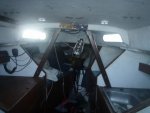
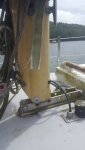
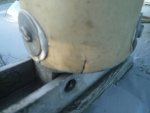
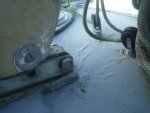
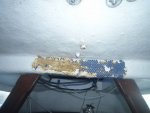
The beam under the mast of my Elizabethan 23 is cracked. I think it has been like it since I bought it 8 years ago. It was covered in a type of 'gauze' type material, hence my ignorance. The deck under the mast is also dished and about 12mm out of level under the mast. There is also a crack at the base of the mast, on the for'ard side, presumably because its taking all the downward force on that side. The plan to to is haul the boat out, drop the mast, and bolt some ss angle to the compression posts,one on either side of the beam. I am hoping that 50mm,4mm thick angle will do the job. Top side, I am planning to put a wedge-shaped hard wood pad under the tabernacle to restore the level under the mast. In addition I will have to saw about 15mm off the end off the mast. Initially, i was going to try to jack the deck up under the mast, but I think that would be futile and possibly counterproductive. The pictures should explain whats going on, just wondered whether the above sounds reasonable. Would anybody be kind enough to comment please?Cracked mast beam _close-up (640x480).jpgCracked mast beam _close-up (640x480).jpgCompression posts (640x480).jpgMast base (360x640).jpgCracks at mast base (640x480).jpg
 
Similar problem in a 28 foot boat. I used 50 by 100 5mm gauge alloy to reinforce the mast step, so your s/s should be fine. I would suggest you do try jacking up the deck, this would restore it to level, stop water pooling and restore the correct geometry of the rig. You will need to renew the fastenings in the mast struts. Maybe it's worth exploring what's under the cracked grp, though. No point in bolting reinforcement to it if the wood is rotten underneath.
 
I'm a long way from being an expert but I would be thinking of something with more depth than 50mm. It has to take the compression force from the mast several inches to the compression posts and the deeper the section you use the better the forces can be transferred. So I would be looking for a steel section at least as deep as the the existing beam.

For the same reason I think it would be better to return the deck to its original height to restore the curve of the beam.
 
There seems to be two problems. First of all the cracks in the beam. I agree with the others have said you really ought to consider jacking the deck up and restoring it to its original place. This will restore the geometry of the rig and put the boat back into its correct shape. Any decent cross-section of stainless bolted in with suitable padding above to spread the compression load would be suitable. You do need to check that the deck is solid and that any timber used in a sandwich construction deck moulding is solid and not rotten in any way.

The second problem is the cracks that are evident in the heel of the mast. There are several possibilities as to why this has occurred but they really need dealing with even if it’s only drilling a hole to stop them spreading. Ideally they should be welded up or doubled with suitable material around the mast riveted in place appropriately. The last is a bit of a bodge but I’ve seen it done and it will work. The ultimate solution apart from the new mast would be to craft a new section of Marston to make sure that there is no problem with cracks.

The cracks may be there because of water and corrosion. If they’re dissimilar metals in particular stainless steel in contact with aluminium you can get cracking.

All IMHO and perhaps worth only what you’ve paid for this advice!
 
It looks like those two near-vertical timbers were fitted to address the issue; It is perfectly possibly that they have done so and there will be no further cracking. Otherwise, what John said ^

You could jack the deck and fit a steel or other substantial crossbeam, but maybe why bother?
 
Thank you all so much for replying.

Penberth3: I don't know why the beam has cracked, but it is historical. All the signs were there when I bought the boat, but because this was my first 'hard-top' i didn't join-up the dots, and the previous owner had wrapped the beam in a type of gauze- I don't know what its called- but you can see the cross-hatched stain it's left.

Neil_s: If I use any more than 50mm it will come below the beam, and I don't want to scrape the top of my head (Ouch!). As far as jacking the deck up: this was my first thought, and i did approach a local marine engineer about it and he said it might not go back up, and I think he might be right because the mast compression has not only affected the deck under the mast its also travelled through to the saloon windows and side-decks, which have been clearly deformed. His solution was to cut out the deck under the mast and re-glass, but thats getting a bit technical, and inappropriate for an old boat. I don't want to spend lots of time and money which could be put toward a bigger boat if and when i retire in a couple of years.
The deck under the mast is encapsulated ply i think and doesn not look like it has been penetrated, and there is certainly no water coming in but if i do go in there and find thats its soggy...?

John_Morris_UK: the crack is on the leading edge of mast. I am pretty sure that its cracked here because its taking most of the load at this point due to the shape of the deck. The welding /riveting a cuff of some kind sounds interesting, although that would increase the the width of the mast at the base and stop it being retained by the 'shoe'.

I have included a close up of the deck under the mast, showing the rippling!?
 

Attachments

  • Rippling deck behind mast (640x480).jpg
    Rippling deck behind mast (640x480).jpg
    66.9 KB · Views: 49
Re the crack in the mast. Yes the pressure should be equal at front and back of the mast extrusion. A fix if it is convenient would be to level the base and cut off the bottom centimetre of mast. If that is not easy I would tend to ignore the crack. Just watch it.
The cracked beam and depression of the deck is far more of concern. I would start by jacking the under part of the beam up with a jack and pole extension. Reduce shroud tension of course. Just see what moves. This will show you where to go. As said fish plates either side of the beam will give it strength out to the supports. Are they original do you think? A good idea of course. Will the cabin sides etc return to original shape? (hopefully) Will the deck go back to level under the mast. (maybe) ol'wil;l
 
Looking at pictures and trying to guess what is there and what has happened, is close to making up stuff, but here are my thoughts. To me it seems like your mast has taken a serious blow, possibly in a grounding. To me, it looks like the mast has been forced forward and to port side. This transforms to a huge downward force on the mast foot.
Am I right, when I think I see that the mast tube has been forced past the rim that it is resting on, at the port side of the foot. Looks like there is a considerable bulge where the cracks are found.
The force on the mast has also cracked the beam under deck. The two supports look like they have been mounted to address this problem. The one that did this fix obviously could not laminate.
It is time to check the shroud attachments, both in the mast and at the lower end. Do also check the keel area for grounding damage.
The rippling of the deck behind the mast is also suspicious. My guess is that they hide cracked deck laminate, that is simply painted over.

I'm in favor of jacking up the deck and either repairing the broken beam or gluing and bolting in a sister beam.
If the wood support is strong enough, then I guess your plan may also work fine. I did not really get how you would put the steel. A weak point in the present construction is the attachment of the wooden supports, just a couple of screws, as far as I can see. I guess your steel angle is supposed address this problem.
 
The ‘gauze’ looks like woven GRP cloth. If I were you I would be grinding out all the broken GRP, then scarfing back and glassing back to the original thickness before adding a couple more layers of woven cloth. It will look much neater than plates bolted on and make it stronger than when it was built. Before doing any new GRP, just make sure you’ve removed any rot in the wooden stringer (assuming it’s wood and not foam), and making sure the deck is forced up to its original height with a suitable prop.
if you look at other pictures of E23s you’ll see the angled supports are original design, not later strengthening.
 
This is quite a common problem in boats without a proper central compression post down to the keel.On the AlbinVega the solution was to fit two stout posteither side of passageway well bolted to the bulkheads with a metal angle spanning the passage.Definatelyreinstate original deck line befoestarting
 
This is quite a common problem in boats without a proper central compression post down to the keel.On the AlbinVega the solution was to fit two stout posteither side of passageway well bolted to the bulkheads with a metal angle spanning the passage.Definatelyreinstate original deck line befoestarting
It seems on the face of it monumentally stupid not to support the foot of the mast internally. The compression loads are huge. My 'compression strut' is built into the heads compartment corner, no idea what it is, but the corner is about 150mm sq. Even a Mirror dinghy has a compression strut. You could have some sort of ring, I guess, if it were correctly designed and made of suitable material, basically a carbon version of those 2 stout posts and the bridge. But there's no point in doing half a job here, if it's gone once, it'll go again unless you change something.
 
My mast had similar cracks and I cut 10mm off the base and it has been fine for the last 30 years. The problem was corrosion of the bottom plug caused by rainwater inside the mast as the drain hole was blocked. Refit the bottom plug with some insulating sealant and keep the drain hole clear and you won't have further problems.

Boats similar to mine have had problems with the beam under the mast rotting. This may be caused by drilling holes for mast lights or VHF coax too near the mast base and allowing water to penetrate to the beam. Repairing the beam is a serious operation so it is probably easier to add external reinforcement. A U section beam would have more strength than the same sized stainless angle.
 
Looking at the photos ....

That beam needs to be jacked back up and then sorted. Either by a new beam or doubler beam either side to get deckhead back to correct form.

The Mast deck fitting - is that original Liz 23 ?? Seems to have overhang that's been resined under instead of a full length hardwood pad. I would be wary as that may have been part of the reason beam cracked ....

The two wood posts .... UGH !

Me ? I would look at this as a major job and not one to cobble metal to ...

As I posted - I would jack up the deck. Get it back to correct form.

Remove mast fittings and the deck pad / resin ..

Cut back into deckhead to remove the beam or to be able to re-inforce with doubler beam of hardwood.

Get rid of the two wood posts and tidy up.

Measure up and have made a full area hardwood pad to carry the mast mount properly and spread the load on deck.

As to mast - I would find a Rigger / Mast service guy and let them do their magic ...

I would not consider cutting mast or adding depth .... to me - that is not solving the cause ....
 
Hello, the two wooden posts, are compression posts and are an integral part of the design. Sometimes they are turned, sometimes stainless. Presumably there to help tranfer the load to the bulkhead.

I am not quite sure what the beam is made of, because i don't want to start probing until i have the mast down, but i'm guessing its encapsulated hard-wood of some kind.

Hi eilerts, Its not been hard-grounded in my time. I think its more likely due to an inherent design flaw as suggested by Wansworth, but you are right - the base of the mast has been forced over the retaining 'shoe', and there is a bulge at this point,

Hi ansarkit: i take your point about corrosion, but i don't think corrosion is an issue here.

Hi Refueler. The mast-deck fitting looks original to me - just a hard-wood pad under an alloy tabernacle, with the mast pivoting on a retaining 'foot'. The boat feels like its a time-capsule of sorts from 1974. I get very little sense that things have been modified- Dear old thing! I want to do right by her, but i don't want to spend lots of time and money doing it.

Get the mast down, see if I can restore the shape of the deck with jacks, and then take it from there...
 
You might get some advice from the Elizabethan owners association. If it's happened to yours, it's no doubt happened to others. My friend's Elizabethan 29 had a similar problem, I can't remember what he did but a sledge hammer was involved.
 
mmmm regarding the two posts ..........

Here's a Liz 23 :

5.jpg
 
Another ... with a compression post ... interesting.

yT9Ws45.jpg


Liz's were not designed or built by some backyard people - but respected design and builders. Webster & Thomas - renowned designers.

The mast foot as well is not same ...

O2kdqkH.jpg


I've looked at quite a number online up for sale and all show similar beam, no posts and different mast fitting. It is accepted that in latter years of the Liz - many boat were home completed - but the structural was by Websters Lymington ...
 
Last edited:
Top