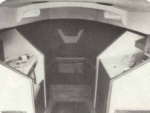
Cracked beam under mast?

Another ...

493927-444464.jpg
https://boats-from.co.uk/sites/default/files/products-images/2021-01/493927/493927-444464.jpg[/img]

Liz's were not designed or built by some backyard people - but respected design and builders. Webster & Thomas - renowned designers.
Even so grp was still not appliedscientificlly hence many boats has excessive hull thickness,wasa stress calculation made on that mast beam or was it a calculated guess with a bit extra added on?
 
Given the pedigree of Webster and Thomas as designers ... I think they may have known something about boat design ...
Maybe, but why the mast compression probs? And the added props?
Looks like he needs to jack it up , slowly, to get the cabin top curve back. Then re-enforce it. Rather than a bit of angle, some SS square, or rectangular tube. Easy and tough. Then glass in the bits to spread the load to the curved deck moulding.
 
Another picture from the original brochure:
1654541284795.png
and this note:
1654541421339.png
I think it would be relatively straightforward (but messy) to cut out the old beam with a multitool and make up a new one of laminated wood, perhaps with a steel insert plate. or carbon fibre covering. If it was slightly larger than the original it would cover the mess from the cutting operation.
 
No knowing the boat Iassumed it had a bulkhead with a gap for access forward,my idea of posts etc wouldn’t work,I was thinking more ofthe Albin Vega which has a similar problem of too much compression from themast
 
Maybe, but why the mast compression probs? And the added props?
Looks like he needs to jack it up , slowly, to get the cabin top curve back. Then re-enforce it. Rather than a bit of angle, some SS square, or rectangular tube. Easy and tough. Then glass in the bits to spread the load to the curved deck moulding.


I still think that the mast deck fitting is part of the reason the beam failed ............. and its not uncommon for owners to overtighten mast stays and over time - then beam can fail.

One of the photos shows that mast fitting as being too long for the deck pad - it has what looks like a resin built up as extension ... that will give discontinuous support - sorry but that will be a wood pad that is designed to take the original fitting - then this longer one has had a solid / unforgiving resin addition ...

I'm still of the cut out the old beam ... replace with a decent hardwood beam after deck has been jacked back up... or better still a metal Dural or similar light but serious strength beam that is then glassed over. But a decent beam is going to be work and cost to do. I would not use steel unless full stainless .... but then its heavy.

OK - lets be blunt about it : ALL deck stepped masts can cause slight compression of deck - it is virtually impossible to prevent. But tensioning mast as should be - is the name of the game. I can over tension mine and then the bog door is stiff !! there's nothing wrong with my deck or inner structure. In fact because I've had the boat so many years .. that bog door is a good sign of when its right !!
 
As DownWest writes, jack it up slowly. I would say use a day, a warm and sunny type will help more. GRP that has been deformed for a long time does not necessary spring back when the load is gone. If you feel that you are lifting the whole roof instead of bending back the deformation, stop and wait for several hours. From the pictures it looks like you should detach the wooden supports from the beam before jacking. Use good size plywood plate to spread the load from that jack.

If you have not done a lot of GRP lamination before, I recommend that you get skilled help. It is upside, so it will be messy and more difficult than otherwise, and it needs to be strong (even stronger than it was, if you want to get rid of the posts).
 
Just a quick opinion from a design point of view. Those support posts either side do provide a lot of support if properly attached at the top and load spread at the base. (to the hull) I don't think they impede access top the fore cabin so much and should provide a great support compared to a curved unsupported beam. The space between the tops of the supports if smaller provide more support if wider give possibility of beam sagging between the supports. I say keep them. ol'will
 
Hi Ghostlymoron,

That sledgehammer got my attention. I did once see a friend cut up a boat with a chainsaw- it was many years ago - early eighties? I would rather let it go cheap as a project before i do anything like that, but it is an option. Would it all go in a skip i wonder?

About the Elizabethan owners club: I have tried to contact him in the past, and he he only replied to my email once. My impression is that the club is semi-comatose.

Refueler: those pictures were a surprise. Was one of them a mark 2? - I don't know. Certainly looks like it has a chunkier beam. Mine's not much more than batten-sized, once you account for the grp.

Putting in a whole new beam is beyond me technically, and i certainly wouldn't want to pay someone to do it. Mend and make-do will be my approach.

Hi Wanswworth: so jack the thing up -slowly slowly catchy monkey - preferably on a sunny day- - detaching the compression posts before i do it? BTW, these do not hinder access forward, and are very useful to grab hold of when the boat is pitching about- very useful IMHO.

The point about glassing in and under the reinforcement is noted. I was wondering about how to pad that out.

Maybe i should use slightly larger hard-wood pad under the mast to help spread the load. I do have a nice piece of old teak i inherited from my late father, which could be put to use.

Now to go and pick the brains of my local marine engineers with regard to the grp work...
 
I’m wincing slightly at the thought of teak being used. It’s not that the teak isn’t good for the purpose but a good marine ply thick enough or several pieces of ply bonded together would be just as good and it would save the teak which is in short supply. I’d even consider giving you the ply to save the teak! If you want hardwood then I’ve got some oak as well or I’ve got a big chunk of Sapele.
 
Just a quick opinion from a design point of view. Those support posts either side do provide a lot of support if properly attached at the top and load spread at the base. (to the hull) I don't think they impede access top the fore cabin so much and should provide a great support compared to a curved unsupported beam. The space between the tops of the supports if smaller provide more support if wider give possibility of beam sagging between the supports. I say keep them. ol'will

Look closely and you can see what appears to be screw heads above the 'furniture' securing those posts ........... I hope they don't just use the 'furniture' as support.

But anyway - a proper job and those posts can be assigned to their rightful place - bin !
 
I’m wincing slightly at the thought of teak being used. It’s not that the teak isn’t good for the purpose but a good marine ply thick enough or several pieces of ply bonded together would be just as good and it would save the teak which is in short supply. I’d even consider giving you the ply to save the teak! If you want hardwood then I’ve got some oak as well or I’ve got a big chunk of Sapele.

Oak or Elm I would use ... if not then a fall back on good quality marine ply built up in a laminated form by using multiple layers ... laminated using good quality Epoxy.

With laminating ply - the curved form can be created easily ...
 
I’m wincing slightly at the thought of teak being used. It’s not that the teak isn’t good for the purpose but a good marine ply thick enough or several pieces of ply bonded together would be just as good and it would save the teak which is in short supply. I’d even consider giving you the ply to save the teak! If you want hardwood then I’ve got some oak as well or I’ve got a big chunk of Sapele.
There is an argument that ply would actually be better in this situation. Natural wood has a grain and hence different strengths along and across the grain. Ply is designed not to suffer from that issue (the grain in alternate plies is at 90 degrees). In fact, plywood was developed specifically to address that problem.
 
Lizman,
if you are fine with the wooden supports, then keep them. I were thinking they limited the access to front.
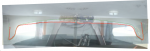
There seems to be a striking difference in the curvature of the beam in your boat compared to the other boats above, but since the perspective is slightly different it is not that easy to compare. With the help of the graphic functions in MS word I have tried to align the picture of your boat with that of the closest looking one, and put them on top of each other. The lower edge of the beams are highlighted with red and green line. I have tried to align the lower end knees at sides.Comparison.png
You may not agree that this is accurate, but it suggests that your beam (red) is depressed about half of its height, and most important, it is not a local thing around the mast foot. Extending the hardwood under the base will not make much difference. The problem is the beam and the supports.
If I'm not fooled by the slight different perspectives in the pictures, it seem like the wooden supports has been added after the damage has occurred, or the fixing points at the lower end has given away. The wooden supports are fine, but they need to be securely fixed at both ends. Otherwise you risk that your rig collapses.

By the way the mess around the break at the middle of the beam is not woven roving, it looks more like someone has glued rubber foam anti skid for floor mats on the beam to soften the blow when knocking the head in the sagged beam. I suggest also gluing a 10 euro bill to the floor to trigger automatic bending down.
 
There is an argument that ply would actually be better in this situation. Natural wood has a grain and hence different strengths along and across the grain. Ply is designed not to suffer from that issue (the grain in alternate plies is at 90 degrees). In fact, plywood was developed specifically to address that problem.
I agree 100%.
 
We will have to differ on the ply/solid wood. My take is from growing up with ply boats and later working with wooden aircraft. A wing spar would have ply as the web, but the tension and compression elements, top and bottom, are solid wood, usually spruce.
In this case, a number of laminates of, say, 8mm thickness, glued up with epoxy, would not be too difficult to do.

( A friend is building a 20 ft sharpie in ply. The plans are totally without notes or detail, so we have frequent chats about it. Last week was the beam under the mast step and it now has a laminated oak one. The step is just ahead of the cabin front, so the ply contributes to the beam considerably. No room for a prop, as it is above the double berth. Also, gaff rig, so loads a bit less than bermudan.)
 
Whatever is used - the consensus seems to be coming round to replace that beam once deck is jacked back up.

Regarding using Spruce or similar as capping to any ply beam ... I would not personally. I cannot see any reason to cap with a soft / medium wood. If the laminated ply or hardwood beam is epoxied well - there should be no reason to cap it. With laminating the beam - the curvature and form can be made without need for a shaped cap.
 
Whatever is used - the consensus seems to be coming round to replace that beam once deck is jacked back up.

Regarding using Spruce or similar as capping to any ply beam ... I would not personally. I cannot see any reason to cap with a soft / medium wood. If the laminated ply or hardwood beam is epoxied well - there should be no reason to cap it. With laminating the beam - the curvature and form can be made without need for a shaped cap.
The spruce bit was referring to wing spars. For a boat, any decent hardwood.
Going back to ply. The upper and lower laminates in a beam are the ones doing the work, the middle ones just keep them apart and stable, so ply would be ok there.
 
Top