Charging starting battery from solar?

I was about to reply that i would need another controller and I have been too mean. That said the price of a PWM controller is now dirt cheap so worth a thought thanks both

 
I was about to reply that i would need another controller and I have been too mean. That said the price of a PWM controller is now dirt cheap so worth a thought thanks both
If you're going to buy a PWM controller, have a look at this one, for just over £40 including rather expensive postage:

https://www.sunstore.co.uk/product/ep-solar-duo-battery-solar-charge-controller-12-24v-10a/

It handles two batteries. You set it to charge one, then when that one is full, it charges the other.

As a cheap and cheerful way to get solar power on a boat with modest needs, I don't think you can do much better. It's what We had on our Snapdragon - with 2 20w panels, same as you, and it worked perfectly for many years. I set it to charge the starter battery first, because dim lights aren't a problem, until you can't start the engine. In practice, it meant that both batteries were fully charged when we arrived. Even in the middle of winter, a weekend's consumption working aboard - lights, radio, phone charger..., would be replaced by the following weekend. In the summer, it kept up with our consumption at anchor, provided we didn't run the cold box too much.
 
I was about to reply that i would need another controller and I have been too mean. That said the price of a PWM controller is now dirt cheap so worth a thought thanks both

My Dual PWM controller was about 20 quid .... in fact with one Solar Kit I bought ... said to be 40W - but lucky if it gives 20 .. that came with a Dual PWM.

I know someone is going to say - No No .. stay away from them .... well - the Dual has been quietly doing its job on my boat for a couple of years or more and fine ...
 
I know someone is going to say - No No .. stay away from them .... well - the Dual has been quietly doing its job on my boat for a couple of years or more and fine ...
Buying a cheap PWM controller is usually more sensible than buying a cheap MPPT controller. If you want the benefits of an MPPT controller, it is worth purchasing a reasonable quality “name-brand" product (the popular Victron controllers are very good).

There are some limitations of PWM controllers:

They cannot be used with high-voltage panels.
The electrical energy harvested from the panels will be less than with a good MPPT controller.
The voltage set points are often limited to a few presets. (There are some PWM controllers that give the user full control of the charging set points, but they are less common.)

Providing you are happy with these limitations, they can be a good choice.
 
A 30 amp pwm can be had from a uk store on ebay for as little as £6.99
A dual battery output for £15 . You can often set what percentage of charge goes to each battery bank
 
Buying a cheap PWM controller is usually more sensible than buying a cheap MPPT controller. If you want the benefits of an MPPT controller, it is worth purchasing a reasonable quality “name-brand" product (the popular Victron controllers are very good).

There are some limitations of PWM controllers:

They cannot be used with high-voltage panels.
The electrical energy harvested from the panels will be less than with a good MPPT controller.
The voltage set points are often limited to a few presets. (There are some PWM controllers that give the user full control of the charging set points, but they are less common.)

Providing you are happy with these limitations, they can be a good choice.

OP has two 20W panels ... which would never stress any PWM controller ...

I agree that if he had much higher Wattage - then MPPT to get as much benefit as possible ...

My PWM have LCD displays with user variable settings .... nothing special - but at least I can have some decision in the working.
 
OP has two 20W panels ... which would never stress any PWM controller ...

I agree that if he had much higher Wattage - then MPPT to get as much benefit as possible ...
Do not be concerned about "stressing " a PWM controller even with large panels providing the voltage and current limitations are not exceeded. Even very inexpensive PWM controllers are available with a capacity of well over 20 A so this is not an issue providing you stick to "12V" panels with a 12V battery system. PWM controllers have quite simple electronics so even cheap “no-name" units are usually reliable.

The lower energy harvest from PWM controllers is not dependent on the solar panel size although with very small panels the higher self-consumption of MPPT controllers can be a factor to consider. It is often more practical to increase the size of the solar panels when installing a small system and this can often be more cost-effective if you have the room.

So fitting a 45-50W solar system with a PWM controller may produce a similar amount of total energy to a 40W solar system with a good MPPT controller. The PWM option is often a lower total cost.

My PWM have LCD displays with user variable settings .... nothing special - but at least I can have some decision in the working.
All controllers have a range of preset voltage set points, but few PWM controllers allow the user to adjust the voltage set points to exactly what their battery recommends or to make adjustments for situations such as long periods when the boat is unused. If your PWM controller does have infinitely user variable set points , can you list the model number? This is a feature I would recommend and it is becoming harder to find reasonably priced PWM controllers with this ability.
 
"noelex" ... my controllers are not that sophisticated .... they have settings but they are rudimentary only.

Unlike the expensive one I removed from the boat I bought ... which only had a couple of tiny LED lights !! Swapped for a cheapo Chinese unit. Now I can read IN - OUT ... has USB out as well ..
 
"noelex" ... my controllers are not that sophisticated .... they have settings but they are rudimentary only.
OK, thanks.
It is a pity that it is becoming harder to find PWM controllers offering the ability to accurately adjust the charging profile.
 
thanks all for really good input. Dual pwm controller seems the way to go for my low level needs and this victron is only a fiver more than Stemers suggestion

BlueSolar PWM DUO-LCD&USB 12/24V-20A​

 
Before installing a victron mppt, I had 2 cheap pwm from aliexpress, the classic blue plastic controller with the LCD screen. Problem is that even though you could set the float voltage manualy( I had it at 13.8v) there was no float charging happening. Controllers would always always give 14.4v.
 
thanks all for really good input. Dual pwm controller seems the way to go for my low level needs and this victron is only a fiver more than Stemers suggestion

BlueSolar PWM DUO-LCD&USB 12/24V-20A​

If you can get that for around £45, the USB outputs are well worth the extra, even if it isn't any cleverer than my suggestion, which would surprise me coming from Victron.
 
I started a thread a year ago where I bought a Renogy 200W "briefcase" panel primarily to use with my ePropulsion solar controller charger. I bought a Victron MPPT charge controller to connect and use the panel to also charge the house battery.

A recent accident in strong wind at anchor saw the panel which was lying on deck fly over the guard rails and fall into the sea. I hosed it down but it didn't work afterwards. A bit of investigation, it turned out it had just pulled on one of the connections in the trailing MC4 connector lead and retracted the pin. All working again now so top marks to Renogy for durability.

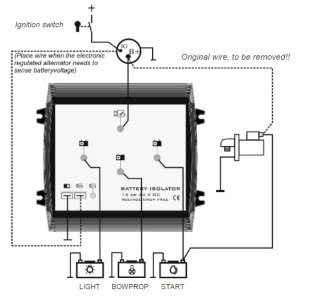
A tech question though. I connected the MPPT output to the alternator connection on the Cristec electronic battery isolator/charge distributor so that the solar would charge in priority determined by the Cristec. I can't see any priority switching mentioned in the Cristec manual so I assume it just distributes across the batteries according to their charge state.

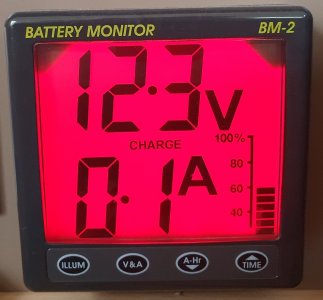
I assumed since cars are normally wired without such a thing that it would be OK for the solar charger to present 12/13v to the alternator terminal when the engine wasn't running. It seems to work OK and the NASA BM2 shows the house batteries charging nicely (generally get about 10-12A from the panel lying flat on the deck in sunny weather).

My question, should I connect the Victron MPPT charger output to the house battery connection or alternator connection on the Cristec? If I move it to the house battery pin, the solar won't charge any of the other batteries so I just want to run my method of using the "incomer" alternator connection as a suitable method?

cristec_switch.jpg

cristec_switch2.jpg

RCE electronic battery isolators - CRISTEC on board energy
 
I started a thread a year ago where I bought a Renogy 200W "briefcase" panel primarily to use with my ePropulsion solar controller charger. I bought a Victron MPPT charge controller to connect and use the panel to also charge the house battery.

A recent accident in strong wind at anchor saw the panel which was lying on deck fly over the guard rails and fall into the sea. I hosed it down but it didn't work afterwards. A bit of investigation, it turned out it had just pulled on one of the connections in the trailing MC4 connector lead and retracted the pin. All working again now so top marks to Renogy for durability.

A tech question though. I connected the MPPT output to the alternator connection on the Cristec electronic battery isolator/charge distributor so that the solar would charge in priority determined by the Cristec. I can't see any priority switching mentioned in the Cristec manual so I assume it just distributes across the batteries according to their charge state.

I assumed since cars are normally wired without such a thing that it would be OK for the solar charger to present 12/13v to the alternator terminal when the engine wasn't running. It seems to work OK and the NASA BM2 shows the house batteries charging nicely (generally get about 10-12A from the panel lying flat on the deck in sunny weather).

My question, should I connect the Victron MPPT charger output to the house battery connection or alternator connection on the Cristec? If I move it to the house battery pin, the solar won't charge any of the other batteries so I just want to run my method of using the "incomer" alternator connection as a suitable method?


RCE electronic battery isolators - CRISTEC on board energy
If it works on the B+ it will be fine, as long as the Victron controller can sense the battery voltage.
 
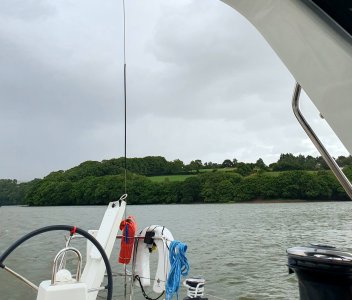
Pretty impressive getting c 2-3A off the panel in grey overcast conditions this morning. A tiny bit more sunshine and I won't need to run the engine to replenish the batteries.

(Solar off shows discharge 2-3A for radio, fridge, WiFi etc)

20250715_083944.jpg

20250715_084001.jpg
 
Top