

You are using an out of date browser. It may not display this or other websites correctly.
You should upgrade or use an alternative browser.
You should upgrade or use an alternative browser.
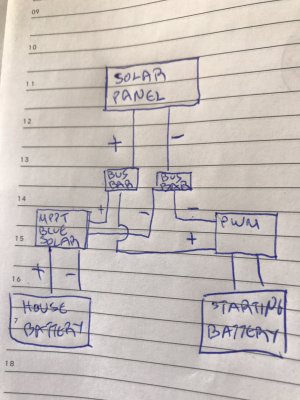
Charging starting battery from solar?
- Thread starter Akestor
- Start date
[70521]
Well-Known Member
Have you considered a Voltage Sensing Relay switch?
Input voltage >13.8 volts and the solar charges both banks. <13.0 volts and the starter battery does not receive any charge.
Input voltage >13.8 volts and the solar charges both banks. <13.0 volts and the starter battery does not receive any charge.

Refueler
Well-Known Member
mmmmm makes me feel uneasy .... you basically have paralleled two different format controllers ..... which makes me wonder if any conflict may occur.
I would have considered either the relay as Sandy says - or swap out for a dual output controller designed for the job.
I would have considered either the relay as Sandy says - or swap out for a dual output controller designed for the job.
Refueler
Well-Known Member
I have a Dual Output Controller on one boat .... which works fine, been installed nearly 2yrs ... its PWM - so nothing expensive ...

Boater Sam
Well-Known Member
Why would you want to charge the starter battery by solar when it gets charged in short order by the engine every time you start up?

PaulRainbow
Well-Known Member
Your usual throwaway comment, based on zero knowledge of the OPs circumstances.Why would you want to charge the starter battery by solar when it gets charged in short order by the engine every time you start up?
PaulRainbow
Well-Known Member
This is a typically sensible optionHave you considered a Voltage Sensing Relay switch?
Input voltage >13.8 volts and the solar charges both banks. <13.0 volts and the starter battery does not receive any charge.


Malish
Well-Known Member
and link the house and starter batteries together via a manual parallel switch so that if the worst happens you can start from the house battery... switch clusters incorporating isolating & parallel switches and a VSR are readily available.Have you considered a Voltage Sensing Relay switch?
Input voltage >13.8 volts and the solar charges both banks. <13.0 volts and the starter battery does not receive any charge.

noelex
Well-Known Member
It would be an interesting experiment to try, but I don’t think the MPPT controller will work correctly.
The MPPT controller needs to adjust the output voltage of the solar to select the maximum power point. The PWM does not have the ability of the MPPT controller to change the voltage. Unfortunately, the solar panel cannot be at two voltages at the same time.
In short, the connection of the PWM controller will prevent the MPPT controller from working correctly, and you will end up with the equivalent of two PWM controllers, or in some situations, the PWM controller may prevent the MPPT from reaching its start-up voltage (+5v over battery voltage).
The MPPT controller needs to adjust the output voltage of the solar to select the maximum power point. The PWM does not have the ability of the MPPT controller to change the voltage. Unfortunately, the solar panel cannot be at two voltages at the same time.
In short, the connection of the PWM controller will prevent the MPPT controller from working correctly, and you will end up with the equivalent of two PWM controllers, or in some situations, the PWM controller may prevent the MPPT from reaching its start-up voltage (+5v over battery voltage).
[70521]
Well-Known Member
As you asked.Why would you want to charge the starter battery by solar when it gets charged in short order by the engine every time you start up?

In the UK the weather can be sh1te. From time to time it can be weeks or even months between starting the engine. In that time, for all sorts of reasons, the voltage in your starter battery can go from an at rest voltage of 12.7 volts to 12.2 volts and might not have enough energy to start the engine. To mitigate that issue you trickle charge it.
Refueler
Well-Known Member
Why would you want to charge the starter battery by solar when it gets charged in short order by the engine every time you start up?
That's fine if you are using boat often and regularly .... but as many find - its so easy to end up with low voltage on batts and a starting problem.
With such a simple solution of trickle into batts ... what's to not like ?
PaulRainbow
Well-Known Member
And if it's low it won't "gets charged in short order by the engine". So you end up with a constantly undercharged battery, leading to a very short life.As you asked.
In the UK the weather can be sh1te. From time to time it can be weeks or even months between starting the engine. In that time, for all sorts of reasons, the voltage in your starter battery can go from an at rest voltage of 12.7 volts to 12.2 volts and might not have enough energy to start the engine. To mitigate that issue you trickle charge it.
Akestor
Well-Known Member
But isn't the voltage changed after the controller? In my mind at the input side of both the mppt and the pwm , the voltage will be the raw value the panel gives at the moment, for example 16,5 volts. The mppt just reads a voltage it isn't aware a pwm is connected also. Or am I wrong?It would be an interesting experiment to try, but I don’t think the MPPT controller will work correctly.
The MPPT controller needs to adjust the output voltage of the solar to select the maximum power point. The PWM does not have the ability of the MPPT controller to change the voltage. Unfortunately, the solar panel cannot be at two voltages at the same time.
In short, the connection of the PWM controller will prevent the MPPT controller from working correctly, and you will end up with the equivalent of two PWM controllers, or in some situations, the PWM controller may prevent the MPPT from reaching its start-up voltage (+5v over battery voltage).
Akestor
Well-Known Member
Sounds good! I assume the only drawback is that temporarily the house battery will also feed the starter motor as it will be connected to the starting battery ? Until the voltage drops bellow 13?Have you considered a Voltage Sensing Relay switch?
Input voltage >13.8 volts and the solar charges both banks. <13.0 volts and the starter battery does not receive any charge.
PaulRainbow
Well-Known Member
That's not normally an issue.Sounds good! I assume the only drawback is that temporarily the house battery will also feed the starter motor as it will be connected to the starting battery ? Until the voltage drops bellow 13?
If you are quick this just popped up in the for sale forum : https://forums.ybw.com/threads/durite-140-amp-voltage-sensitive-relay.616139/

vyv_cox
Well-Known Member
I have the same. It has been in use for well over 20 years, completely reliable. Lower output than an MPPT controller would give but that is rarely a problem in Greece. Dual battery charge controller, by SunWorks. For motorhomes and boats.I have a Dual Output Controller on one boat .... which works fine, been installed nearly 2yrs ... its PWM - so nothing expensive ...

Stemar
Well-Known Member
I had one of these for years on my old boat.
EP Solar Duo-Battery Solar Charge Controller 12/24v 10A. £33.30
I set it up so it would charge the starter battery first, then when that was fully charged - usually not very long, it went to work on the domestic battery. The batteries were linked by a 0-1-2-both switch which controlled which battery started the engine, and a simple cube relay operated by the field terminal on the alternator, so it only made the connection when the alternator was charging. Not as good as a VSR, perhaps, but VSRs were a lot more expensive years ago when I did it.
EP Solar Duo-Battery Solar Charge Controller 12/24v 10A. £33.30
I set it up so it would charge the starter battery first, then when that was fully charged - usually not very long, it went to work on the domestic battery. The batteries were linked by a 0-1-2-both switch which controlled which battery started the engine, and a simple cube relay operated by the field terminal on the alternator, so it only made the connection when the alternator was charging. Not as good as a VSR, perhaps, but VSRs were a lot more expensive years ago when I did it.
Last edited:

bergie
Well-Known Member
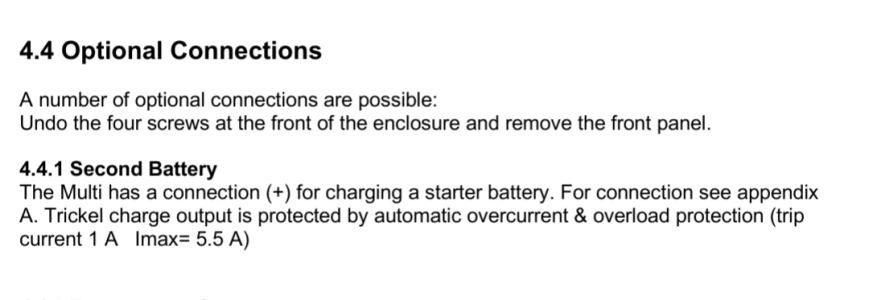
We're using the trickle charging feature of our MultiPlus. It supplies some power to the starter battery whenever the house bank is charging, whether via shore power, solar, or the hydrogenerator.
Last edited:
noelex
Well-Known Member
A MPPT controller works by adjusting its input voltage (the voltage of the solar panel) to the optimal value where the panel can deliver the maximum power. It then converts this higher panel voltage to a lower voltage suitable for charging the battery.But isn't the voltage changed after the controller? In my mind at the input side of both the mppt and the pwm , the voltage will be the raw value the panel gives at the moment, for example 16,5 volts. The mppt just reads a voltage it isn't aware a pwm is connected also. Or am I wrong?
A MPPT controller and a PWM controller will select similar output or battery voltages assuming the charge algorithm is similar; it is the input or solar panel voltage that is different. With a "12V" panel, a MPPT controller may be keeping the solar panel around 17-18V to extract the maximum power from the panel. With a high voltage panel, the input voltage may be 50V or more. A PWM cannot perform this voltage conversion, so the solar panel needs to be at a much lower voltage.
A single solar panel can only have one voltage at any particular instant so trying to implement both of these options simultaneously is problematic.
Last edited:
William_H
Well-Known Member
I would be concerned re using a VSR simply because the current wasted in operating the relay both in sensing and actual relay coil current may be significant to the total solar current available. Of major concern with a small panel. In fact another small panel just for the engine battery would be the simplest option. Possibly without a controller. ie less than 10 watts.
The proposed circuit may be ok if we consider that at low battery voltage and smallish panel the PWM controller will in fact look like straight through connection.
This means that via diodes panel would be in effect connected to 2 batteries. Only when batteries are charged and there is significant solar panel current available would one controller begin to pulse off and on leaving more current for other battery until it too pulses. Might be ok might get strange effects. ol'will
The proposed circuit may be ok if we consider that at low battery voltage and smallish panel the PWM controller will in fact look like straight through connection.
This means that via diodes panel would be in effect connected to 2 batteries. Only when batteries are charged and there is significant solar panel current available would one controller begin to pulse off and on leaving more current for other battery until it too pulses. Might be ok might get strange effects. ol'will
Other threads that may be of interest

- Replies
- 1
- Views
- 205

- Replies
- 4
- Views
- 135

- Replies
- 27
- Views
- 967


- Replies
- 5
- Views
- 228