Chain winch

We used to (and I am sure they still do) use lever hoists (or come along) tirfors and occasionally chain hoists in underwater construction. Tirfors tended to get clogged with sand and mud if used on the seabed, chain hoists infrequently as they are heavy and unwieldy but lever hoists a lot. However they did need stripping down regularly as they are not really designed for long term exposure to salty environments
 
A chain hoist on a boat is about as useful as a wheelbarrow, I'd have thought.
They are very heavy, greasy unwieldy things and the chain would knock seven bells out of your gelcoat.
If you want to lift weights on a boat (other than engines in and out) why not just use a standard, suitably sized nautical handy-billy? What's the attraction of chain?
 
It astonishes me how people did gigantic projects 100 years ago. Digging the Panama Canal or Suez Canal didn't daunt them


At that time a lot of it, and for thousands of years before that all of it, was done by men and women with picks and shovels, aided by horses, donkeys, camels or oxen to move the material.

They weren't afraid of hard work in them days! (Or at least those with power weren't afraid of demanding an awful lot of hard work from their employees/slaves/subjects.)
 
Last edited:
At that time a lot of it, and for thousands of years before that all of it, was done by men and women with picks and shovels, aided by horses, donkeys, camels or oxen to move the material.

They weren't afraid of hard work in them days! (Or at least those with power weren't afraid of demanding an awful lot of hard work from their employees/slaves/subjects.)

Most of the canals in the UK were dug by hand as you say with the aid of horses, donkeys.

They were called navvy short to navigators I believe. The navvies were mainly irish and hence the irish labourer are still called navvies

image.jpg
 
They were called navvy short to navigators I believe. The navvies were mainly irish and hence the irish labourer are still called navvies

Interestingly, when I was living in Ireland a few years back a big road construction project in the area was being built mainly by Turks, who were living in temporary accommodation camps on site, rather like their Irish navvy predecessors had done in England.
 
I'm amazed at Thinwater's comment

'They have not made these in at least 75 years.'

Given that Coopec illustrates a string of them for sale and that much loved store 'Bunnings' I am sure hold them in stock (possibly made in China). Considering what they do, in Coopec's post - lift 3t for just under A$100 for a finger tips effort - they are amazing. How else do you, easily, get 100m of 8mm chain out of the back of a car?...

I did not mean to imply we don't have chain hoists. Of course we do. I thought you were asking about the specific style with pulleys at each end. These are no longer distributed here, as far as I know. They are more awkward to store and set up than the more modern variety. I have never seen one newer than about 1940. But every rigger will have racks of mechanical chain falls/hoists.
 
I'm amazed at Thinwater's comment

'They have not made these in at least 75 years.'

Given that Coopec illustrates a string of them for sale and that much loved store 'Bunnings' I am sure hold them in stock (possibly made in China). Considering what they do, in Coopec's post - lift 3t for just under A$100 for a finger tips effort - they are amazing. How else do you, easily, get 100m of 8mm chain out of the back of a car?
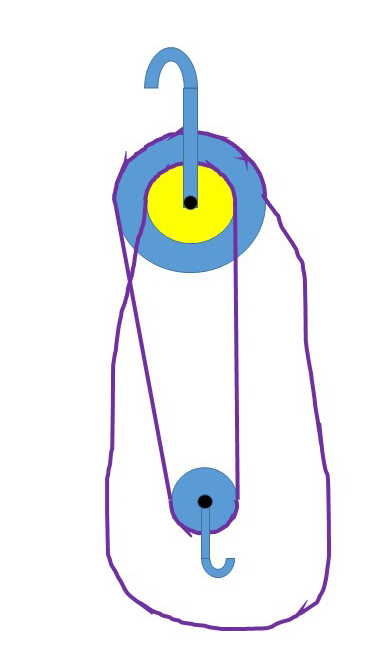
I see that thinwater has replied, but you need to look a little more closely at his photo. It shows two chain wheels of different diameters, the larger one being a double with a smaller one hidden in the photo. The chain is a single length. Because of the difference in wheel size, hauling the chain either raises or lowers the other single wheel. This is a very clever, simple design, extremely compact for the weight it can carry. I had one many years ago but do not remember what happened to it. I now have one like the ones shown by Coopec, and used it only last week to lift an engine in and out. It is heavy and can be rather imprecise in direction change, not so with the thinwater version.
 
Vyv

The chain block having gears will be self locking where as the twin chain wheel one will not self lock just like and rope blocks on a handy billy of some main sheet arrangements.

This why this twin chain hoists are not made any longer

I have an old 1 ton chain block which is quite heavy and a new 500kg from china which is a lot lighter.

I have my heavy chain block on a trolly running on a RSJ been but it could be on a goal post type frame that can be wheeled around

My small chain block I purchased to lift my engine in my boat from the roof of my wheel house. I have to remove my propshaft every 4 years for safety inspection.
 
Vyv

The chain block having gears will be self locking where as the twin chain wheel one will not self lock just ....

Nonsense, having used the chain hoist in the image since I was 12. I have used them for pull-testing knots and splices as well, right up to full hoist capacity, and they will sit right there for hours.

They are very smooth up and down. The biggest limitation is that generating purchase above one-ton requires impractical wheel diameters. They are also awkward to use horizontally. In the image I needed ~ 1400 pounds, and you can see I used a winch to pull the fall, since my feet were sliding on the gravel. Very smooth. And no, it did not release when I took the tension off the winch. I had to pull the chain.

Mostly, they are just awkward to haul around and store. and limited purchase.
 
Vyv

The chain block having gears will be self locking where as the twin chain wheel one will not self lock just like and rope blocks on a handy billy of some main sheet arrangements.

This why this twin chain hoists are not made any longer

I have an old 1 ton chain block which is quite heavy and a new 500kg from china which is a lot lighter.

I have my heavy chain block on a trolly running on a RSJ been but it could be on a goal post type frame that can be wheeled around

My small chain block I purchased to lift my engine in my boat from the roof of my wheel house. I have to remove my propshaft every 4 years for safety inspection.
Not true. The chain goes around the two fixed wheels in opposite directions. It is always locked.
 
Our local boatyard uses them all the time for lifting boats on and off the travelling cradles. Here they have to take them down the hard and wait for the tide to float them, rather than most yards where they can be lifted in with a crane or Travelhoist.
 
In an idle few minutes I knocked up a diagram of its function. For automotive engine lifting this was an excellent tool.


Never came across one even during my time working a G W King in Stevenage who used to make lifting equipment, chain hoists and conveyor equipment.

Geo. W. Kings
 
Last edited by a moderator:
Never came across one even during my time working a G W King in Stevenage who used to make lifting equipment, chain hoists and conveyor equipment.

Geo. W. Kings
As thinwater said, not made for many years. Not ideal for many purposes, it took a lot of chain movement to lift/raise the hook through any distance. But really good for short lifts such as engines out of cars. I recall using one at work in the 1960s.
 
As thinwater said, not made for many years. Not ideal for many purposes, it took a lot of chain movement to lift/raise the hook through any distance. But really good for short lifts such as engines out of cars. I recall using one at work in the 1960s.

I can see that.

It also looks very easy to get the chain tangles if laid on the ground just like a multi part block and tackle or tayckle if you prefer.
 
I can see that.

It also looks very easy to get the chain tangles if laid on the ground just like a multi part block and tackle or tayckle if you prefer.
I remember rattling the chain through at high speed to lower the hook for the next lift. I guess tangles are possible but I don't remember it being a problem. My relatively modern type is certainly not immune from tangles and catching on protrusions.
 
If you lay them out neatly and then attach the 2 hooks such that the assembly is not loose they work perfectly well horizontally - as Thinwater illustrates with his photo. You do need to tension them with all the chain running parallel to each other, as they would be if arranged as they are designed - vertically.

Jonathan
 
Top