Cast iron keel prep. Detail questions.

Photos of our nice holiday or photos to prove the job gets done thoroughly?:)
Or purely for the benefit of this forum, which of course would be a good thing to do:)
 
My advice? Unless you organise the atmospheric conditions to your advantage, and are prepared to put the time in to fill and rub down the keel as necessary, just do a patch job for the time being.

Totally agree with this.

I did this to the point where i could adjust temps and RH - wont bore you with the in's and out's but its doable and IMO only doable with lasting results if you can control these variables.

I went:

Needle de-scaler, back to 'clean' iron, all paint systems removed from substrate.

Then multiple hot chemical baths with POR 15 'marine clean"

Then acid etch with POR 15 'metal prep' now called 'metal ready'

Then whilst the iron was still black, dried with a myriad of IR heaters

Then painted in POR 15 rust preventative paint

The above was done within 48 hours.

Then scrubbed in West systems epoxy (neat no filler additives) with 40grit sandpaper.

Then the hard work started...........................(clue: they don't call them torture boards for nothing.):encouragement:

Cheers
 
Thanks Roger, your ears must have been burning, just watching you with Dylan thrashing up North.:), and "I am aware of your work" (History sketch, Newman and Badiel) ie your fab restoration of your Centaur.
In truth I will probably do a patch job and see what happens, but Vyv is probably right that the top surface of the keels is the source of the problem. A season on the boat will give me so much more to go on......
 
Good trip that was. In all honesty just taking the rust back and being methodical with the right weather will give half decent results , i'm trying all manner of ideas on mine to see if i can achieve the holy grail of no maintenance on the keels ..............well at least for a few years.

All the best.
 
2015-03-24 13.23.49 (2) (1024x768).jpg2015-03-24 13.23.41 (2) (1024x768).jpg

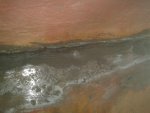
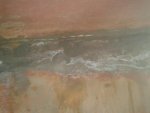
Apols if the photos are not too clear (only had my phone) but I have started on the rusty bits with the flap wheel. And then I googled Westerly keels and came to Vyv's website (once more:). So I have a fair bit of porosity, ie slag pockets in the cast iron. As Vyv's website says the slag itself is not rusty but causes the rust adjacent by galvanic action. I have ground out as much as I can without a needlegun or shot blasting as I plan to do the job properly at a later stage. I have put on the fertan rust converter. The next bit I am unsure of, this is whether to fill and fair with epoxy the voids and then apply the primocon, or go the other way and apply some primocon before the epoxy filler, in order to reduce the galvanic action ( and then do more primocon after the epoxy to act as a tie coat before anti fouling).
I am only treating the worst patches but want to get the best results given that.
Secondly I have looked at the keel bolts and my conclusions are not conclusive. There is a hint of rust in places but nothing that worries me unduly. However the area around them has been repainted at some point. But also the windows have leaked at points (1979 Konsort) and that could be the cause of damp that has made the very minor amount of rust. I will see how things go over the summer.
So as usual I am very appreciative of further comments, particularly in the order of epoxy then primocon, or primocon epoxy then primocon again. Many thanks in advance ......
 
I just antifoul mine every two years, no rust, no scraping, no grinding, no priming.

Deep joy of a lead keel! :-)
 
The next bit I am unsure of, this is whether to fill and fair with epoxy the voids and then apply the primocon, or go the other way and apply some primocon before the epoxy filler, in order to reduce the galvanic action ( and then do more primocon after the epoxy to act as a tie coat before anti fouling).
Given that this is an interim rather than definitive procedure, why bother with the epoxy? I would Fertan, Primocon and antifoul.

Alan (1980 Konsort)
 
Thanks Alan, fair point. I guess my answer is I don't know how long the interim might last. The photos don't show it very well but the deepest point of the voids is 15-20mm maybe , so a sizeable hole. Plus I am curious to see how well I can do the repair as I have never done a keel repair before, and will learn by the experience. You are right though, I could leave the epoxy out of the equation.
 
You cannot epoxy over Primocon, the adhesion will fail. Best adhesion for it is over freshly ground/abraded metal, then Primocon over the top. I have some doubts over either way for longer term, my experience of Primocon on steel is far from good.
 
Thanks once again Vyv. Much appreciated and primocon issue noted. And if anyone is still reading this then I would add that my experience of the voids/slag is that the flap wheel exposed them and cut into them a bit, the wire brush on a drill was pretty poor, thus nothing was very good at completely clearing them out, so they will remain "galvanic hot spots" for the time being.
 
The only real way to remove rust is to grit-blast. The surface of most metals is quite rough - particularly if seen through a microscope - So trying to clean, and then coat this rough surface is very difficult, grinding only removes the high spots, the lower parts are not touched.
Grit blasting will - or should depending on skill and quality of the grit - enter these small 'nooks and crannies' and clean them out, leaving a perfect surface for re-coating.
I agree with Vyv that the amount of rust around the top of the keel intimates a break down of the seal between hull and keel and should really be fixed as soon as possible.
So when the keel is off why not take it to your nearest grit blasters and have it blasted and primed by them - much cleaner and should be much,much cheaper than having the keel blasted 'on sight'
Needle gunning can tend to drive rust particles back into the metal, certainly not suitable for your problem.
 
Hmm, lots of advice recently on doing the best job. If you want to go sailing in the near future, suggest you fill the voids with epoxy filler, rub down, fill again the bits you missed or dislodged, rub down again and then get going with the primer and antifouling.

It won't be perfect but it should get you afloat for the season.
 
Top