Cast iron keel prep. Detail questions.

FairweatherDave

Well-Known Member
Joined
28 Sep 2009
Messages
2,089
Location
Solent
Visit site
Been studying the old threads and still can't decide whether it is worth hiring a needle gun for my cast iron keels. I have an angle grinder so could use something on that instead. I have the fertan and primocon ready to go. But the needle gun? Some are electric and some used compressed air. The HSS electric one says it can only be used for 15 mins before needing 15 mins cool down, brochure says it is only good for light use? Do keels that take a full day to go over constitute light use?
I am tempted just to use an angle grinder on the bad bits and then just cover those patches with fertan then 5 coats of primocon and see how well the patches do over the season.
If I was just to do patches with the angle grinder it seems that a flap wheel is good for the flat areas and a wire brush fitting is good for the craters and then the fertan converts what is left and any flash rusting. Final question is can I use ordinary West epoxy in the craters before primocon, the West handbook only refers to lead keels?
Obviously shot blasting is the ideal method but that is for the future, unless I am persuaded I am simply wasting my time and should do a light rub down and anti-foul to last this summer season, and save the expensive primocon and fertan until then. Some guidance would be appreciated and I know it is an annual subject but some of you will now be wiser after your own experiences a year or more ago:)
 
Shortly after having my keel grit blasted and epoxy coated I Coppercoated it , launched and within a day had sailed over a submerged fishing buoy made from polystyrene blocks tied together with cable. This put a deep gouge in my new finish. At the beginning of the following season I angle ground an area of about 24 x 4 inches back to bare metal, West epoxied it and Coppercoated again. Some five years down the line the grit-blasted areas have the odd rusty pinhole whereas my angle-ground repair is A1.

My experience of Primocon is pretty poor. Last autumn I ground back a steel plate rudder to bare metal and gave it five coats of Primocon. I put it back on the boat on shore in December and already there are rust stains on it, not even launched yet.
 
I used a combination of flap wheels, 40 grit emery discs on a hook and loop disc holder and wire brushes on my keel three years back. No significant reappearance of rust apart from one place which turned out to be a void in the casting, which I ground out the following winter. I used a Greek rust converter, followed by two coats of 2 part primer, followed by 3 coats of epoxy paint. Then antifoul primer and the antifoul itself. Pleased with the result, but it was two days hard work to get the keel back to bare metal. And the weather was hot and dry: had it been in UK I'd hav done it but by bit, applying the rust converter as I went to stop surface rusting.
 
Last edited:
Apart from creating the barest metal you can, priming with as much thickness of paint is the key, the more coats the better because electrolysis can occur through paint.. I recommend Chlorinated Rubber. I've also used a vinyl marine primer that was good as well, I'm sure epoxy is OK too.
 
Last edited:
Yikes Vyv, the best plans .... and well since I have the primocon I will be using it and will make sure it is five warm days with low humidity......
But I will take that as a vote for the angle grinder and maybe patching. As I have not used my angle grinder for this purpose what kind of discs/ fittings do you use?
I'm slow thanks Graham and savageseadog.
 
Last edited:
Apart from creating the barest metal you can, priming with as much thickness of paint is the key, the more coats the better because electrolysis can occur through paint.. I recommend Chlorinated Rubber. I've also used a vinyl marine primer that was good as well, I'm sure epoxy is OK too.

Yes, chlorinated rubber is excellent stuff. We used to use it to protect the cut edges of panels in salt spray and weathering cabinets, where it rarely failed. I also used it when my original keel epoxy gave up after a winter afloat. It was a horrible sight when we hauled out in April but chlorinated rubber kept it reasonably rust free for the season.

I used a normal metal disk in my angle grinder but since then I have seen how good flap sanders are in an angle grinder, so now I would probably use that. Especially good if you have speed control on the grinder, which prolongs their life.
 
There was a thread on using a needle gun (http://www.ybw.com/forums/showthread.php?388419-Needle-Scaler), and the consensus was that while it does a good job of removing thick rust, it leaves a thin layer of rust and can pound rust into the surface. Certainly photos posted on the thread showed a surface that wasn't suitable for overpainting.

I think it may be horses for courses. Vyv has had good results, but it sounds as if his keel is in good condition to start with. I had my cast iron keel blasted, and in many places it was badly pitted, and the worrying thing is that in a few places the pitting didn't show until the blaster had removed the surface layer to expose underlying corrosion and porosity. I ended up having to fair the keel with epoxy and filler. I am quite sure that a grinder or needle gun wouldn’t have done a good job; grit blasting took me back to grey iron everywhere, but with very irregular surface in places because of the pitting.

However, if your keel is in better condition than mine, a grinder might well be fine.
 
One of the variables with blasting and epoxy coating cast iron is the quality of the cast iron. I've seen some very poor quality castings where you can never get a uniform surface because 'inclusions' of slag and the like keep appearing.
 
Thanks AntarticPilot. You illustrate my dilemma. I have a Westerly keel which is probably in "average" condition. I have the choice of doing nothing until the end of the season (is that a very bad thing?) and then doing a proper blasting job, or doing a holding job, seeing how well it does, and probably just keeping at it annually. (I associate hiring a needle gun with doing better than just a holding job)....

(And just to give some background detail on my priorities, our Konsort is new to us and my thinking is to spend time with the boat on the water without investing heavily until we know what is really important. We are gentle bumbling Solent caravaners just trying to protect our investment not trying to shave a quarter of a knot of our cruising speed)
 
One of the variables with blasting and epoxy coating cast iron is the quality of the cast iron. I've seen some very poor quality castings where you can never get a uniform surface because 'inclusions' of slag and the like keep appearing.

So I'm not saying my keels are poor quality, but if they were below average, which way would you proceed? The implication is it would be better to keep treating annually as a posh job would not last. Have I got that right?
 
. . . which way would you proceed?

If you are new to the boat and are just going to be pottering around the Solent, then I would patch it up and get out and use it. You will have lot's of other things to concentrate on at the moment.

Then, when you think it's time to 'do it properly', I would research a place that will allow dry blasting and has a good 'mid summer' lift out deal.

Then take a long weekend when it's dry, warm and sunny, lift on a Thursday and start pressure washing and scrapping and grinding. It seems odd to do this before blasting, but the idea to to get rid of as much salt as possible. Then when it's dry, get it blasted on Friday while the air temperature is still rising. Also the keel has a lot of heat capacity, so it might need some warm air heating (even in summer) to make sure it is at air temperature and there is no risk of condensation.

The moment it is blasted, smother it in your epoxy of choice.

Then on Saturday and Sunday, fill fair and coat with further epoxy layers, each alternate one coloured differently to ensure coverage. Antifoul and splash back into the water.
 
I did a bit of bodge job last season and used one of those heavy duty 'pan scrubbers' on an angle grinder. Took the rust off to bare metal very easily and I filled the quite deep pits and depressions with gel coat filler, because that's what I had on hand. I'm going to dry out against the wall to touch up the antifoam and I'll see how it survived a season. But the angle grinder scrubber did work very well.
 
I've done the job three times in 30 years. The first time, angle grinder and Primocon when the boat was a year old, but the builder's priming had failed here and there, I did in the winter months and this lasted quite well, apart from some minor annual patching. The second was perhaps 10 years later, by which time the Primocon formulation had changed, and I did with an ordinary power drill and various flapwheels and other sanding attachments, and lasted much longer. Significantly I think, I did the job in in early summer after the boat had been ashore for the winter. And I did it again a couple of winters ago, with an angle grinder and Primocon again.

I think this latest time has been the least successful. Two reasons: the weather earlier in the year was not good enough for keel painting, too cold and humid with the result that condensation was a problem, and I did not spend the time I did previously in making good casting flaws etc with epoxy filler.

My advice? Unless you organise the atmospheric conditions to your advantage, and are prepared to put the time in to fill and rub down the kelel as necessary, just do a patch job for the time being.
 
My advice? Unless you organise the atmospheric conditions to your advantage, and are prepared to put the time in to fill and rub down the kelel as necessary, just do a patch job for the time being.

Probably good advice. My initial grit blasting and epoxy was done in North Wales, not sure about the weather at the time but I think OK. It lasted ten years. Subsequent ones, including my repair, were done in Greece.
 
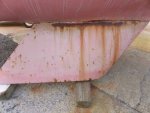
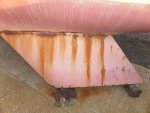
keel piks

P1010054.jpgP1010055.jpg

Finally I have photos of the keels. The boat has been out of the water since October so the rust runs look dramatic. Based on what has been said I plan only to attack the top 10 per cent of each keel (ie just under the keel joins) with the grinder and flap wheel attachment and a wire brush for any deep pits, make that as good as I can and see how that fares over the season. I will probably also attack any other bad patches. Any further comments very welcome
 
View attachment 50179View attachment 50180

Finally I have photos of the keels. The boat has been out of the water since October so the rust runs look dramatic. Based on what has been said I plan only to attack the top 10 per cent of each keel (ie just under the keel joins) with the grinder and flap wheel attachment and a wire brush for any deep pits, make that as good as I can and see how that fares over the season. I will probably also attack any other bad patches. Any further comments very welcome

Looks may be deceiving, but discounting the rust runs as merely cosmetic, your keel looks worse than mine was, especially near the top. And when mine was blasted, it removed a lot of seemingly solid material that was porous, rusted material.

A wire brush won't get into deep pits, I don't think - they are very stiff.

If I were looking at that I'd only consider blasting as a reasonable means of getting to a sound surface. That's with hindsight - I was following similar thought processes to yours before we had the hull blasted.
 
While agreeing with Antarctic Pilot, I suspect that some of that rust is coming from between the hull and keel. Confirmed strongly if there is rust around the keel bolts inside the boat? I think I would consider getting the keel off and spending a bit of preparation time on the top face and upper parts, as he suggests.
 
Thanks Vyv. I will take another look at the keel bolts. I guess that as the keels have not been dropped as far as I know and the sealant ultimately fails whatever, this would be the time to drop the keels, get them blasted and treat all the surfaces while exposed and seal up with fresh sealant.That sounds costly as much of that would be beyond me (although I know some do take it on). If anyone wanted to PM me suggestions of yards local to Chichester/portsmouth they would recommend to do the job and possible costs I would be interested. There is a period in the summer when the boat won't be used that could work for me. But I expect this to be more expensive than I'd like......
 
Top