Can someone explain radar to me please...

Im not talking about AIS, and I’m giving up there as you seem uninterested in understanding or moving forwards with the technology

I'm all ears if you want to explain concretely what specific function your talking about.
 
Can somebody put this in terms that I can understand?

Do the new systems recognise and track targets, thereby calculating a CPA/TCPA solely using the radar data?
If they simply pull that data from the AIS, then that's not exactly a huge upgrade on what I already have.

This morning, I've just had a sports fishing boat zoom past me in <1/4 mile visibility. He was easily doing 20kts. He wasn't on AIS.
Yes they do, extremely well. You can track within zones and at differing ranges (i.e. further out in front). There is a limit to number of objects tracked but it would be hard to reach it if sailing sensibly.

This is entirely unrelated to AIS which is a separate system. AIS will often overlay on the radar info but most systems will treat them as distinct plots.

Modern radar would have shown the vessel as a plot, just like AIS but with less accuracy and information. It would have given you speed, course and CPA for the vessel while also showing your and their boat on the chart, optionally with a track and an estimate of where each will be in a given timespan. Mine is usually set to 10 minutes in the future unless we’re offshore or somewhere big and empty, then its 30 minutes.
 
Yes they do, extremely well. You can track within zones and at differing ranges (i.e. further out in front). There is a limit to number of objects tracked but it would be hard to reach it if sailing sensibly.

This is entirely unrelated to AIS which is a separate system. AIS will often overlay on the radar info but most systems will treat them as distinct plots.

Modern radar would have shown the vessel as a plot, just like AIS but with less accuracy and information. It would have given you speed, course and CPA for the vessel while also showing your and their boat on the chart, optionally with a track and an estimate of where each will be in a given timespan. Mine is usually set to 10 minutes in the future unless we’re offshore or somewhere big and empty, then its 30 minutes.
You're talking about MARPA (Mini Automatic Radar Plotting AID) or ARPA (Automatic Radar Plotting Aid), which I've mentioned in almost every post.

This is nothing new; commercial radars started to get this function in the 1980's and I had one on a yacht already in 1999 (Raytheon Pathfinder).

It's a very useful system, since it doesn't rely on the target broadcasting anything. HOWEVER, it depends on having accurate heading and other data from your own boat (as I wrote before). And in general doesn't work nearly as well as it does on ships because of the poor bearing discrimination of our little radars. Still, very useful.

But there are cases when you need to have the skill to use a radar display.
 
As I’ve said in nearly every post, you clearly don’t have experience of this so please for the love of god stop pushing misinformation about this tech.
The rest of us are happily using it and have been trying to help OP with genuine understanding of the differences. You have been confusing the issue in your many posts insisting that legacy techniques are still required when they simply arent. Anyone who has done the RYA radar course and then used a modern set knows this, the course is utterly pointless. Even the instructors on this forum have said so on many occasions.

Yes, ARPA identifies the target, no its not the reason this is better. The plotter actually plots the absolute position of the object on the chart. Thats not ARPA, thats plotting and was a huge step change.
 
Do the new systems recognise and track targets, thereby calculating a CPA/TCPA solely using the radar data?
If they simply pull that data from the AIS, then that's not exactly a huge upgrade on what I already have.
Correct. You can see an example in my screenshots in post 81. The green vector is what the radar is calculating based on its data, the red vectors are from the AIS data. Notice how it's not precisely overlaid on the AIS position, and that it takes time to update because just as in traditional hand plots, it's calculated based on changes in the target's position over time.

A few other notes:

1. Checking the manual for the B&G setup I'm used it, it indicates a max of 10 targets. That should be plenty for most people.
2. You generally need to manually select the targets of interest. (I expect some systems allow the option to auto-acquire.)
 
Last edited:
1. Checking the manual for the B&G setup I'm used it, it indicates a max of 10 targets.
per virtual radar. The Halo has two virtual radars so the total would be 20 but i agree thats more than sufficient when set up with zones.
 
As I’ve said in nearly every post, you clearly don’t have experience of this so please for the love of god stop pushing misinformation about this tech.
The rest of us are happily using it and have been trying to help OP with genuine understanding of the differences. You have been confusing the issue in your many posts insisting that legacy techniques are still required when they simply arent. Anyone who has done the RYA radar course and then used a modern set knows this, the course is utterly pointless. Even the instructors on this forum have said so on many occasions.

Yes, ARPA identifies the target, no its not the reason this is better. The plotter actually plots the absolute position of the object on the chart. Thats not ARPA, thats plotting and was a huge step change.
I have Garmin radar and a Garmin MFD,

"The radar system automatically tracks
the tagged object and provides you with information about the object, including the range, bearing, speed, GPS
heading, nearest approach, and time to nearest approach. MARPA indicates the status of each tagged object
(acquiring, lost, tracking, or dangerous), and the chartplotter can sound a collision alarm if the object enters your
safe zone."

It will also show "ghost trails", a faint line showing a vessels past track.

It's not hard to use it for collision avoidance when just showing the radar display. It's virtually idiot proof when overlaid on the MFD.

I often have the radar on just to keep me familiar with it, how it works, how it looks and how it treats other vessels.
 
As I’ve said in nearly every post, you clearly don’t have experience of this so please for the love of god stop pushing misinformation about this tech.
The rest of us are happily using it and have been trying to help OP with genuine understanding of the differences. You have been confusing the issue in your many posts insisting that legacy techniques are still required when they simply arent. Anyone who has done the RYA radar course and then used a modern set knows this, the course is utterly pointless. Even the instructors on this forum have said so on many occasions.

Yes, ARPA identifies the target, no its not the reason this is better. The plotter actually plots the absolute position of the object on the chart. Thats not ARPA, thats plotting and was a huge step change.
Sorry, but this is completely wrong. What you are describing is a basic ARPA (called MARPA when it doesn't pick up the target automatically) function, the same function which has existed since the 1990's. Nothing more, and nothing less. Already in the early 1990's, Kelvin-Hughs introduced radar overlay including plotting ARPA targets onto their ECDIS systems, and on yachts, Raytheon Pathfinders used with RL80 MFD's had radar overlays and could do this, too. I know because I owned one.

There is nothing fundamentally new in this technology since the 1990's, or if you think there is, please name it specifically.

How does it work? Completely differently from AIS. ARPA uses ownship position from GPS, and calculates the position of the radar target based on range and bearing to ownship. Unlike AIS, which plots the target on the chart display based on the target's own broadcast position, based on data from its own GPS. So as I wrote before, the accuracy of this is extremely sensitive to any inaccuracy of your heading data.

ARPA calculates CPA and TCPA by comparing a series of range and bearing measurements over successive radar sweeps, deriving from that course and speed, and then doing a basic vector calculation using ownship's course and speed. It calculates position of the target based on range and bearing to the target measured by the radar, with the compass bearing based on ownship's heading. It was always so, and the only changes to the ARPA algorithm since the 1990's have been some mathematical refinements such as using Kalman filters; the basic principles are just the same now as they were then.

So current equipment does this exactly the same way as your old Pathfinder from 1999; indeed the same with big ships. There have been different innovations in yacht radars in the mean time, but none of them affects the basic principles of ARPA or MARPA function. Doppler functions in the radar are useful because they allow targets to be colour coded if range to them is decreasing -- that's useful information -- but this data is not part of ARPA algorithms.

And I say again, overlay of ARPA targets on a chart display is useless for collision avoidance, other than relieving a lazy or disoriented operator from switching to the radar display where relative motion is directly presented.

Also, the position of an ARPA target is not useful for collision avoidance, because it has nothing to do with relative motion with the target. The primary function of ARPA is to calculate CPA and TCPA, which all ARPA system have done in the same way since the dawn of time, since before GPS or chart overlays.

If you are incapable of using radar for collision avoidance without ARPA working, if you are completely dependent on ARPA, then you are missing really valuable functions of radar. Professional mariners are specfically warned in their training not to be dependent on ARPA. And besides that, ARPA doesn't work all that well on our very small radars with poor bearing discrimination (5 degrees or even 7 degrees with an 18" antenna, and beam-sharpening helps only slightly). I'm only taking the trouble to write all of this because I would hate for a lot of people reading this thread to think that remaining wilfully ignorant of radar technique is a good or seaworthy thing. Radar is a powerful tool, but it takes knowledge to use it to its full potential.

This is exactly analogous to just driving the dot on a chart plotter without understanding anything about navigation. Going to sea is not a video game. Neither navigation, nor radar operation.
 
Sorry, but this is completely wrong. What you are describing is a basic ARPA (called MARPA when it doesn't pick up the target automatically) function, the same function which has existed since the 1990's. Nothing more, and nothing less. Already in the early 1990's, Kelvin-Hughs introduced radar overlay including plotting ARPA targets onto their ECDIS systems, and on yachts, Raytheon Pathfinders used with RL80 MFD's had radar overlays and could do this, too. I know because I owned one.
Mine can be set to automatically acquire targets.
 
Mine can be set to automatically acquire targets.
Then it's ARPA :thumb:

I acquired my first ARPA-capable system when I installed B&G Zeus 3S's and a Halo24 radar last year. Before that I had only had MARPA sets, where you had to manually select the targets.

My previous system was based on the first gen Zeus MFD's and 4G radar. I liked the 4G radar very much, but the MARPA function was terrible, almost comically bad. Much worse than that of the Raytheon Pathfinder which preceded it.

I didn't think I would care that much about ARPA vs. MARPA, but I'm finding it's just night and day now compared to the system on the old Zeus. You need really good compass data for it to work really well (I'm using a satellite compass), but I'm very pleased with it.

Is yours a B&G?
 
Then it's ARPA :thumb:

I acquired my first ARPA-capable system when I installed B&G Zeus 3S's and a Halo24 radar last year. Before that I had only had MARPA sets, where you had to manually select the targets.

My previous system was based on the first gen Zeus MFD's and 4G radar. I liked the 4G radar very much, but the MARPA function was terrible, almost comically bad. Much worse than that of the Raytheon Pathfinder which preceded it.

I didn't think I would care that much about ARPA vs. MARPA, but I'm finding it's just night and day now compared to the system on the old Zeus. You need really good compass data for it to work really well (I'm using a satellite compass), but I'm very pleased with it.

Is yours a B&G?
Mine is all Garmin, i wouldn't have B&G as a gift.

According to Garmin ;

Acquiring MARPA Targets Automatically
You can acquire MARPA targets automatically based on MotionScope, guard zones, or boundaries.

https://www.garmin.com/en-GB/p/596974/pn/K10-00012-19/#overview
 
Probably not, most of the work is done by the MFD.

BTW, i saw you mention 7" Axiom in another thread. A 7" screen is tiny, i wouldn't go smaller than 9".
I think I can squeeze in a 9" (no sniggering at the back).
Any larger than that will require a complete rethink.
 
Mine is all Garmin, i wouldn't have B&G as a gift.

According to Garmin ;

Acquiring MARPA Targets Automatically
You can acquire MARPA targets automatically based on MotionScope, guard zones, or boundaries.

https://www.garmin.com/en-GB/p/596974/pn/K10-00012-19/#o verview
Right, I should have remembered about your Garmin.

If you acquire targets automatically, then your system will be at least functionally equivalent to ARPA. Garmin might not call it that (MARPA is not IMO defined unlike ARPA) just because it did not go through IMO certification.

The main requirements for ARPA are: 1. automatic target acquisition 2. ability to track at least 20 targets at once 3. display of range, bearing, course, speed, CPA, TCPA of each tracked target 4. CPA/TCPA alarms 5. vector lines for each target 6. automatic acquisition by zones. My Navico system does all that, and I bet your Garmin system does too. If Garmin don't call it ARPA it's probably just a matter of certification.

Maybe it's wrong of me to be using the term "ARPA" this way, since it may imply certification.
 
Last edited:
There you go...


You can probably ignore the bit about your last act before abandoning ship being to destroy the set...unless you feel you need revenge, I suppose.
 
Axiom 9 question...
Is it realistic to use this to control the autopilot, in a useful, practical way?
As part of my revamp I'll be moving the existing instruments from the helm to the bridge deck, freeing up space for the Axiom. But I think it's essential to be able to hit a button at the helm to disengage the AP. Not sure whether I want to rely on a relatively small touchscreen for this.

Keeping the existing AP head at the helm would be a bit annoying because it means keeping the pod that currently also houses the depth and wind. But I think I already know the answer...
 
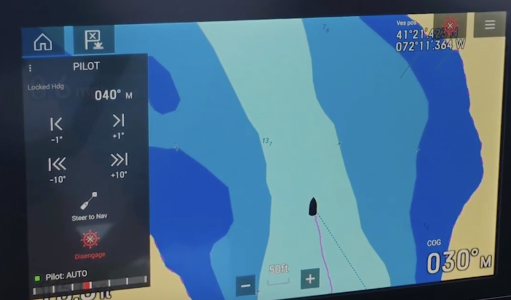
This screencap shows what I'm used to with Axiom displays for autopilot control: control via the sidebar, and you can also access the autopilot controls via the "wheel" icon in the upper right. I took it from this video, which also describes how to open and reconfigure the sidebar, something I'm not sure I was fully aware of before.
1751649112363.png
 
Update. It looks like a digital radome is out of my budget after all. I was under the impression that anything starting with the letters 'RD' was digital. In fact the needs to be a second D after the number. So RD218D would be a Raymarine radome, 2kw, 18", digital.

The ones I've been eyeing up for sub $300 are actually the older analogue model, which I don't believe is compatible with a brand new Axiom MFD.

This leaves me in a bit a quandary. I don't have the budget to just buy everything new. The Axiom on its own was pushing it. But given that it would also address the WiFi requirement, I thought it was worth paying for.

If I was to snap up one of these very tempting cheap radomes, I'd have to pair it with an already obsolete MFD. That doesn't sound that great an idea, and leaves me needing a separate WiFi module.

Argh. It was all looking quite achievable. I should have known it was too good to be true!
 
Top