Can heat exchangers be flushed on the water ?

aerobat

Well-Known Member
Joined
6 Apr 2025
Messages
204
Location
Germany
Visit site
Hi !

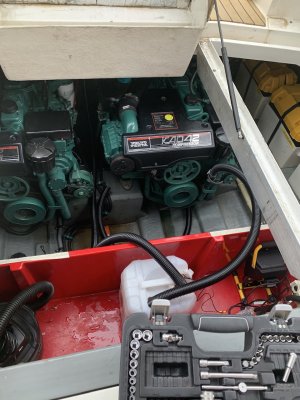
my kad44 run on plane a touch north of 90 deg c , the port ( connected to the water heater ) ~91 , the stb ~93 . No overheat alarms and no issues but still a bit to warm for comfort imho . Reducing to hull speeds temps drop quickly to ~82

The impellers came new last spring but i guess the heat exchangers were never flushed .

Some questions :

I want to ir gun the tstat housing to verify the temps . Some questions

-Is the ir gun pointing at the housing accurate enough ?
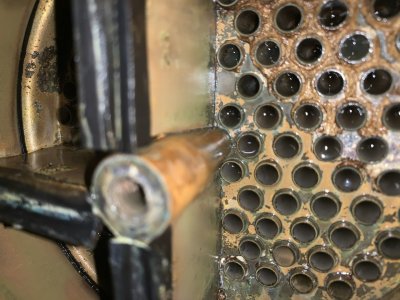
- can the heat exchngers be flushed on the water ?
-only the very expensive rydlyme or can or are there other good desclers on the market ?

Thanks for hints
 
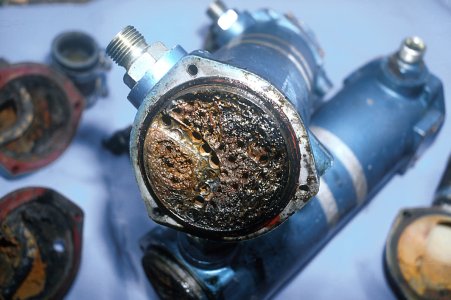
Following, need to back flush the starboard engine, seems that there is a bit of restriction either in the gearbox oil cooler or the turbo intercooler.

Stbd. engine gets hot if you put the engine under heavy load, up to 1200rpm or so it stays around the 80c 1500rpm it is touching 90c. Port engine flows a lot more raw water than the Stbd. no problems with the port engine, it sits at 85c at 2000rpm.

My strainers come well above the waterline so there is no problem opening them, I did run a hose into the oil cooler and back through the intercooler and then into the strainer, I could not see what came out but my wife did say she could see black stuff come out and into the strainer and then out the seacock, going to have another go at it tomorrow when I have a bit more time.

Engine is a Perkins HT6.354M
 
Engine can be flushed with the boat afloat. Disconnect the intake hose, after the pump, and connect it to a pond pump (or similar) output. Disconnect the hose that goes to the exhaust elbow and fit a hose that goes to a container of Rydlyme or similar. Put the pond pump in the container, just off the bottom. Turn the pump on and it will circulate the Rydlyme around and around the engine. Leave for a couple of hours, reconnect hoses and run the engine for a while.

The above may differ slightly with the connections on some engines/transmissions.
 
Engine can be flushed with the boat afloat. Disconnect the intake hose, after the pump, and connect it to a pond pump (or similar) output. Disconnect the hose that goes to the exhaust elbow and fit a hose that goes to a container of Rydlyme or similar. Put the pond pump in the container, just off the bottom. Turn the pump on and it will circulate the Rydlyme around and around the engine. Leave for a couple of hours, reconnect hoses and run the engine for a while.

The above may differ slightly with the connections on some engines/transmissions.

Great information ! So you recommend normal flow and not reverse flow ( exhaust elbow in - intake hose out for reverse ) ?

Drain the heat exchanger first or just use its water for dilluting the rydlyme ?

I,m a bit fearsome not to damage the gaskets on the end caps of the heat exchanger but hope to not .
 
Great information ! So you recommend normal flow and not reverse flow ( exhaust elbow in - intake hose out for reverse ) ?

Drain the heat exchanger first or just use its water for dilluting the rydlyme ?

I,m a bit fearsome not to damage the gaskets on the end caps of the heat exchanger but hope to not .
No need to drain anything. Normal flow has always worked for me.

You can't damage any gaskets if you don't pull anything apart, which there should be no need for if you are flushing as above.
 
Ok ! The hose of the sewater strainer must be above waterline so no risk to sink . Otherwise an impeller change would also be impossible on the water .
 
Ok ! The hose of the sewater strainer must be above waterline so no risk to sink . Otherwise an impeller change would also be impossible on the water .
I think I used a 22 or 24 mm 1/2" socket - and undone the jubilee clamp then quickly disconnected the pipe form the impeller housing and then lifted slightly higher (above the water line and place the socket into the pipe and used the jubilee clamp to hold it in place.
as a side note the square end of the socket was taped up to stop water ingress.
then was able to work on the system - in my case remove the impeller pump to change the seal (Kad 300)
 
I know its a different engine - but principle is usable :

I have modified the intake part of heat system by fitting a 3 way valve .... that way I can supply from sea .. or from a container ... the only part I have not modified is the exhaust ...
 
IR temp guns ... great tools but cheap is cheap !! I have a few .. basically checking e-motor temps when pushing the limits.

Its not actually necessary to be spot on the exact spot of temp needed ... but as long as you are close to and consistent with same spot ... you run up engine ... till you get it at its usual temp ... then IR gun the spot you've identified ... maybe a few degrees different to your gauge - normal. Note the readings. Now clean / modify whatever .. then do test again in same positiuon etc ... you will see both gauge and IR gun change in readings ...

The matter is that a) usually the gauge is ok to warn of over-heating ... b) the change of reading is what you want to see and success of the cleaning / modification.
 
Top