Calorifier maintenance

Overandunder

Well-Known Member
Joined
22 Aug 2016
Messages
71
Visit site
Hi all. I recently posted asking a few basic calorifier questions (which is a new feature to me, the used AWB I bought earlier this year has a factory installed one).

I have a lot of documentation for nearly all the boats equipment - but nothing for that unfortunately. Having just emptied the cockpit locker to finally access it - I can't see any manufacturers label to be able to Google very much either.

The unit is much larger than I was expecting - it's roughly the size of a beer barrel. It sits in the corner of the locker formed by the heads bulkhead to one side (no access) and the engine compartment partition (again no access).

The pipework to and from the engine I can access however from the back of the engine - so would that be the only way of draining it ? Perhaps answering my own question !?

Also how should the PRV take off pipe be routed ? At the moment it's attached to a clear piece of pipe just led loosely into the cockpit locker (which doesn't seem right at all).

One last please - should the black rubber pipes to and from the engine that supplies it be insulated - or really no point ?

Thanks for any replies / tips and advice.
 
Hi all. I recently posted asking a few basic calorifier questions (which is a new feature to me, the used AWB I bought earlier this year has a factory installed one).

I have a lot of documentation for nearly all the boats equipment - but nothing for that unfortunately. Having just emptied the cockpit locker to finally access it - I can't see any manufacturers label to be able to Google very much either.

The unit is much larger than I was expecting - it's roughly the size of a beer barrel. It sits in the corner of the locker formed by the heads bulkhead to one side (no access) and the engine compartment partition (again no access).

The pipework to and from the engine I can access however from the back of the engine - so would that be the only way of draining it ? Perhaps answering my own question !?

Also how should the PRV take off pipe be routed ? At the moment it's attached to a clear piece of pipe just led loosely into the cockpit locker (which doesn't seem right at all).

One last please - should the black rubber pipes to and from the engine that supplies it be insulated - or really no point ?

Thanks for any replies / tips and advice.
I assume your engine is indirectly cooled with a heat exchanger so the " coolant" from-to the engine contains the correct "antifreeze" therefore that part needs no maintenance or draining. No point in insulating those black hoses unless they are very long. You need to be able to inspect them for chaffing.

The clear hose from the PRV is often just run into the bilge by boatbuilders but not ideal (its the cheapest option! ). I run mine into a 1litre plastic bottle and empty it occasionally.

Unless you are in a country where sub zero temperature never happen then you definetly need to locate a way of draining the fresh water. Mine has a drain tap specifically for this.

Also, I added extra insulation to the whole calorifier which made a big difference to the retained heat the following morning for a shower.
 
Last edited:
The importance of ensuring that the engine antifreeze is kept in good condition cannot be over-emphasized. I know of several calorifiers whose coils corroded through due to poor coolant condition. The coil could not be repaired so the calorifier was scrap. There can be quite a mixture of metals here for which good inhibitor is essential.
 
I assume your engine is indirectly cooled with a heat exchanger so the " coolant" from-to the engine contains the correct "antifreeze" therefore that part needs no maintenance or draining. No point in insulating those black hoses unless they are very long. You need to be able to inspect them for chaffing.

The clear hose from the PRV is often just run into the bilge by boatbuilders but not ideal (its the cheapest option! ). I run mine into a 1litre plastic bottle and empty it occasionally.

Unless you are in a country where sub zero temperature never happen then you definetly need to locate a way of draining the fresh water. Mine has a drain tap specifically for this.

Also, I added extra insulation to the whole calorifier which made a big difference to the retained heat the following morning for a shower.
I also drain the PRV to an old bottle in the bilge. Can’t remember ever actually having any water in it. I’d be interested in what extra insulation you put around your cylinder ?
 
I assume your engine is indirectly cooled with a heat exchanger so the " coolant" from-to the engine contains the correct "antifreeze" therefore that part needs no maintenance or draining. No point in insulating those black hoses unless they are very long. You need to be able to inspect them for chaffing.

The clear hose from the PRV is often just run into the bilge by boatbuilders but not ideal (its the cheapest option! ). I run mine into a 1litre plastic bottle and empty it occasionally.

Unless you are in a country where sub zero temperature never happen then you definetly need to locate a way of draining the fresh water. Mine has a drain tap specifically for this.

Also, I added extra insulation to the whole calorifier which made a big difference to the retained heat the following morning for a shower.
Thanks - yes I have fw cooled engine. One of my tasks this winter is to remove and descale the heat exchanger and replace the a/f mixture. Salt water pump had signs of a leak past the water seal so I've already stripped and rebuilt it.

Thinking again about the safety PRV line I was thinking of perhaps tee ing this in to one of the overboard drain hoses (which all leave from the starboard qtr which are the same side as the locker anyway). Any drawback to this - it would be a slightly 'uphill' route but if the pressure was getting high enough the water would still have an escape route ?
 
Thanks - yes I have fw cooled engine. One of my tasks this winter is to remove and descale the heat exchanger and replace the a/f mixture. Salt water pump had signs of a leak past the water seal so I've already stripped and rebuilt it.

Thinking again about the safety PRV line I was thinking of perhaps tee ing this in to one of the overboard drain hoses (which all leave from the starboard qtr which are the same side as the locker anyway). Any drawback to this - it would be a slightly 'uphill' route but if the pressure was getting high enough the water would still have an escape route ?
Depends what that overboard drain hose does. Bilge pump?
 
If the PRV is the type that has a knurled plastic knob, you should turn it at least once a year. I think about one quarter turn (can't remember which way) until it 'clicks'; apparently it stops the thing seizing up.
 
I also drain the PRV to an old bottle in the bilge. Can’t remember ever actually having any water in it. I’d be interested in what extra insulation you put around your cylinder ?
My "cylinder" is actually encased in a metal box which I cannot easily remove to see what the original insulation is like. I have added 50mm of Celotex type insulation board on top, two old polyester fibre pillows insulate two sides and the back (at least 50mm thick), 13mm of expanded foam bonded to the front face (tricky due to all the fittings) and the whole lot sits on a sheet of plywood.
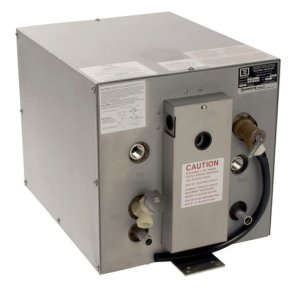
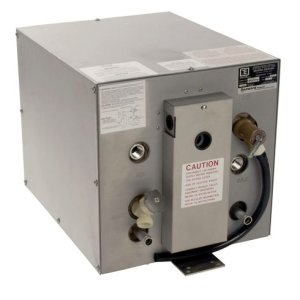
whale-seaward-6-gallon-hot-water-heater-wfront-heat-exchange-galvanized-steel-240v-1500w.jpg
 
Thanks - yes I have fw cooled engine. One of my tasks this winter is to remove and descale the heat exchanger and replace the a/f mixture. Salt water pump had signs of a leak past the water seal so I've already stripped and rebuilt it.

Thinking again about the safety PRV line I was thinking of perhaps tee ing this in to one of the overboard drain hoses (which all leave from the starboard qtr which are the same side as the locker anyway). Any drawback to this - it would be a slightly 'uphill' route but if the pressure was getting high enough the water would still have an escape route ?
my drain tap is near the bottom left corner in this picture:
whale-seaward-6-gallon-hot-water-heater-wfront-heat-exchange-galvanized-steel-240v-1500w.jpg
 
If the PRV is the type that has a knurled plastic knob, you should turn it at least once a year. I think about one quarter turn (can't remember which way) until it 'clicks'; apparently it stops the thing seizing up.
Thanks for the tip - there is an old one in the chart table so presumably the previous owner had problems and replaced it. It looks very similar to the ones fitted to some combi gas boilers tbh.
 
Thinking again about the safety PRV line I was thinking of perhaps tee ing this in to one of the overboard drain hoses (which all leave from the starboard qtr which are the same side as the locker anyway). Any drawback to this - it would be a slightly 'uphill' route but if the pressure was getting high enough the water would still have an escape route ?
If the hose from the PRV goes up hill then the water trapped in it may start growing algi or something, or more important, you will have to draining in the winter in case it freeze. Also, where you propose to T it into the bilge pump hose discharge, that hose heeds to be going down hill to the skin fitting otherwise the water will just run back into the bilge.
 
If the PRV is the type that has a knurled plastic knob, you should turn it at least once a year. I think about one quarter turn (can't remember which way) until it 'clicks'; apparently it stops the thing seizing up.
You're right, but have a spare handy as they often don't reset. Made to a price not a specification.
 
A few points. As already stated, it is not a good idea to have an upward section of the drain from the PRV. Keep it simple and if you don't want water in the bilge, direct it to a catching bottle. I use a 5 litre bottle (that I recycled from the marina skip) that had previously held drinking water. Tesco I think. The PRV really shouldn't release any water and the one in my last boat didn't. But this one releases some every time the engine heats up the cylinder or the immersion heater is turned on. The problem can be avoided if I remember to turn off the water pump and depressurise the system. I have also tried to solve it by putting an extra expansion chamber in the hot water line as there is a NRV on the feed pipe to the calorifier. The problem could also be caused by the pressure setting of the pump being higher than the PVR will allow. It doesn't leak all the time, just enough to release the over-pressure caused by the expansion of the heated water. It seems to be common in Westerlies and I found the bottle solution in an article in the Westerly Owner's Association magazine.

In my experience, calorifiers ( and many other things that are essential) are not often fitted by the bodybuilder. On a new boat they are usually request before delivery and fitting is arranged locally by the sales agent. As such, the brand of the calorifier is whatever the fitter can access cheapest. Apart from being designed for horizontal or vertical mounting they are all much the same anyway and the only documentation available is probably the installation instructions.
 
Last edited:
A few points. As already stated, it is not a good idea to have an upward section of the drain from the PRV. Keep it simple and if you don't want water in the bilge, direct it to a catching bottle. I use a 5 litre bottle (that I recycled from the marina skip) that had previously held drinking water. Tesco I think. The PRV really shouldn't release any water and the one in my last boat didn't. But this one releases some every time the engine heats up the cylinder or the immersion heater is turned on. The problem can be avoided if I remember to turn off the water pump and depressurise the system. I have also tried to solve it by putting an extra expansion chamber in the hot water line as there is a NRV on the feed pipe to the calorifier. The problem could also be caused by the pressure setting of the pump being higher than the NRV will allow. It doesn't leak all the time, just enough to release the over-pressure caused by the expansion of the heated water. It seems to be common in Westerlies and I found the bottle solution in an article in the Westerly Owner's Association magazine.

In my experience, calorifiers ( and many other things that are essential) are not often fitted by the bodybuilder. On a new boat they are usually request before delivery and fitting is arranged locally by the sales agent. As such, the brand of the calorifier is whatever the fitter can access cheapest. Apart from being designed for horizontal or vertical mounting they are all much the same anyway and the only documentation available is probably the installation instructions.
The fresh water pump is before the NRV so if the pump pressure was less than the "NRV will allow" (which will be a very low pressure just to open the one way valve) you would never get hot water out of the tap. As you do not get water out of the PRV all the time then obviously your pump pressure is less than the PRV setting, as it should be. Some calorifiers have an air picket above the fresh water which allows for some expansion of the water before the PRV activates so you will get some variability in the volume discharged between designs of calorifier. A small amount of water coming out of the PRV occasionally could be regarded as a bonus as it shows the valve is working. Also, some PRVs in calorifiers are activated by pressure or temperature. This is my one, now 24 years old, 1XL - Watts
 
Last edited:
Hi Plum. I got the valves mixed. Now corrected. The added expansion tank was to allow for expansion in the cylinder after the NRV. Either it is not big enough or the PRV is opening at too low a pressure. However as you say a bit of leakage is better than it not working.
 
If the PRV is the type that has a knurled plastic knob, you should turn it at least once a year. I think about one quarter turn (can't remember which way) until it 'clicks'; apparently it stops the thing seizing up.

You're right, but have a spare handy as they often don't reset. Made to a price not a specification.

In my experience, they tend to leak after rotating the plastic knob, so as Plumbob suggested, have a spare handy.

Also, my drain valve used to go into the bilge which meant it was occasionally wet down there, particularly if the PRV is leaking, I simply changed mine by adding an outlet fitting to the hull. The only downside is I can no longer easily inspect if it is leaking due to the location.
 
Top