
Building the Ultrasonic Antifouling Kit from Jaycar

Not true, decks are often foam sandwich or balsa cored, and many boats have foam sandwich above the waterline, but most AWBs by Beneteau, Jeanneau, Bavaria et al are plain and simple fibreglass layup below the waterline.

True, my 5 year old Jeanneau 35 is old fashioned plain layup. Also, my deck is a one piece low pressure grp injection moulding, very impressive.
 
True, my 5 year old Jeanneau 35 is old fashioned plain layup. Also, my deck is a one piece low pressure grp injection moulding, very impressive.

Are you sure? I know for sure that Dufour Classic Dufour Grand Large and Bavaria Cruisers are foam sandwich. I do not see how it could be just fiberglass it just would not be strong enough! I thought that every decent boat had foam sandwich where the difference across builders was only in the foam composition.
 
It's getting more tempting by the day. My eyesight has gone downhill again over the last year so might have to invest in one of those illuminated magnifiers on a stand. One remaining uncertainty, mentioned earlier, is how performance would be affected by encapsulated keel - although why should this be different from a bolt-on.
 
Are you sure? I know for sure that Dufour Classic Dufour Grand Large and Bavaria Cruisers are foam sandwich. I do not see how it could be just fiberglass it just would not be strong enough! I thought that every decent boat had foam sandwich where teh difference across makes was only in the foam composition.

Those boats may have foam sandwich construction, but where? The Dufour Grand Large range have a balsa or foam cored deck, but are just described as having an "Inner moulded hull bottom, structural grid laminated to the hull." No mention of any foam in the hull, though an inner moulding may obstruct fitting ultrasonic anti-fouling, unless there are places where you can access the actual hull moulding. The latest Bavaria yachts also appear to feature an inner hull moulding, but I can find no references to foam cores below the waterline. Most other makes rely on the tried and tested method of making a hull moulding into which is laminated a structural grid. My own 12year old Jeanneau has that system, and access to the inside of the hull can be had over most of its area.
 
Are you sure? I know for sure that Dufour Classic Dufour Grand Large and Bavaria Cruisers are foam sandwich. I do not see how it could be just fiberglass it just would not be strong enough! I thought that every decent boat had foam sandwich where the difference across builders was only in the foam composition.

I have driiled holes everywhere. I am sure.
 
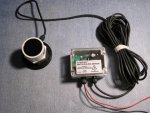
Both units now complete and tested

The photo shows one unit temporarily connected to a 12 volt supply from a jump starter. Both have been tested this way. The cable supplied by Jaycar has been left uncut, and will be reduced to correct length once I have positioned the transducer and driver in the boat.

tn_IMG_1288.jpg
 
Last edited:
How are you planning to fix the mounting nut to the hull and do you have to put some oil in it to get a seal between the transducer face and hull? Again excellent article really enjoyed it.
 
the only thing i can say is that we might have a possible ultrasonic antifouling system for the price of hailing out + jetwash :D

you did just fine of building yours with great pictures.

i still do play with electronics as i'm a freelance sound engineer and also like modifiying things (like mod a scanner to make it an ais receiver). even still have my 40mhz hameg scope!

a shame that i couldn't be more helpfull when you started building yours as i was off this forum over christmas / new year.
Ooh, how do you make an AIS thingy out of a scanner please? I know that it transmits on channel 70? 72? so if you receive the burst of data, what happens then?
Stu
 
this is the box;
P1010579.jpg
 
How are you planning to fix the mounting nut to the hull and do you have to put some oil in it to get a seal between the transducer face and hull? Again excellent article really enjoyed it.

Thank You! Jaycar supply JB Weld two part epoxy to glue the nut to the hull, and specify non hardening silicone grease to ensure that there is no air between the potted transducer and the hull. They recommend a product called Fix-a-Tap which I think is this stuff and not available in the UK as far as I know. I plan to use this which actually comes in a 50ml tube.
 
From a newbie

Now a question for the electronics wizards here. Should I make sure that components like resistors and capacitors stand a bit clear of the PCB, if so, by how much?

Like you, I used to dabble in electronics when it was all discrete components and the closest to semi-conductors back then was the newly developed MOS-FET (remember them?).

To your question - you should always stand components off the board by a small amount (say half a mill - 20 thou) to aid cooling. It's just good practice. This practice could help you elsewhere also. When you have built your device, you could test it for correct function. As I guess you know, electronics generally either fail within a short time, or go on working for a long time (provided all the components are operating within their "quiessent point"). Thus established, you could then consider encasing the unit within resin, with an aluminium foil back plate to extract any heat (although it doesn't look like an energy hungry device). This will protect it from a salty atmosphere, which sure as anything will give rise to premature failure.

Given the cost of anti foul paint (and its obvious drag coefficient on a hull) I am keen to see how this works for you.
 
Got mine on the gas stove warming up waiting for the kit to arrive:D

You may well jest. I have a small soldering iron on the boat that I heat on the gas stove. It beats frigging about with one of those 12 volt ones! Not sure about using on PCBs but it might do with care.

(tip for using 12 volt soldering irons ... run the engine to boost the volts!)
 
Gas soldering iron

We use a gas soldering iron .. Maplins / RS .. Very quick to heat up .. Just watch the exhaust from the side of the tip . Will solder most jobs and can be used anywhere . Alternative is a cheap 240v iron and replaceable tips . Nothing complicated about soldering if everything is clean and the soldering iron is hot .
 
Top