Bow thrusters

Well I can happily say that a combination of bow thruster and suitable use of engine will enable me to turn our 41.5 foot boat in very nearly its own length through over 180 degrees or more in one continuous controlled movement and at slow speed.

Like to see you do that without one but it just does not happen in my boat!

If my thruster failed or was unreliable or not working I would have to reverse into my dock berth from outside the lock gates like my twin engined mobo friend with a similar sized boat.

Our local RYA training boat only warps their slightly shorter Hanse around requiring a crew of at least three a virtually impossible single handed task.
 
Why do people presume that anyone using a bow thruster can't handle a yacht without one? That seems a bit daft to me.
I wouldn't go so far, but from my own observations, much of it in Continental locks, there is quite a high proportion of boat owners who can't handle their boats even with a bow thruster. The temptation is there for those with limited experience to acquire boats that are outside their normal range of competence on the basis that a bow thruster will make them more manageable. It was certainly the case with the two owners I mentioned above that they tended to become more careless when they had thrusters available to them.
 
There’s a Dutch man on YouTube who toodles about the canals in his fairly large twin engined yacht with a bowthruster.Enjoyable watching him maneuver ,nothing wrong with bow thrusters we must be less Luddite in our reactions.There is also a woman who controls her narrowboat I and out of the locks,saving her climbing up and down the lock walls,it Hasán bowthruster and normal stern set up…..she does it via an app…….
 
I learnt how to use a bow thruster while working on an ex-arctic stern trawler used for seismic work. Engine, rudder, and bow thruster controls were duplicated in a small cabin right in the stern overlooking the ramp so that we could back the ship as it recovered about one mile of cable. At that time thrusters were unknown in even medium sized yachts. Now bow and stern thrusters are almost standard on commercial vessels and stern thrusters are appearing on some mobos.
Such is progress and as private owners we have a choice to buy and use them or not. Like everything else we put on our boats other than nav lights and shapes there is no right or wrong, just what an individual chooses to spend their money on, be it a set of thrusters, a particular type of anchor, or a schooner rig and painted on gun ports.
 
Last edited:
Well I can happily say that a combination of bow thruster and suitable use of engine will enable me to turn our 41.5 foot boat in very nearly its own length through over 180 degrees or more in one continuous controlled movement and at slow speed.

Like to see you do that without one but it just does not happen in my boat! …

Turning a yacht 180 in its own length, without a bow thruster, is very easy to do. I have done this with numerous sailing boats, hull types. It was / is taught by sailing schools. It does have limitations, such as only being able to turn in the direction opposite to prop walk.

A bow thruster is a great aid, both for the boat user and neighbours. However, learn how to use it. I have seen a few manoeuvres over the years where clearly the user did not understand the forces on the boat as they berthed (with or without a bow thruster).
 
We see it so many times a yacht or nice motor boat approching a dock or pontoon in orderly manner but for some strange reason chaos sets in with shouting and arm waving,having served in small coaster probably the fault lies in lack of practice,going out once a week interaction with the shore doesn’t come happily probablyactually practicing could be a good idea,boat handling in confined waters is very satisfying
 
Turning a yacht 180 in its own length, without a bow thruster, is very easy to do. I have done this with numerous sailing boats, hull types. It was / is taught by sailing schools. It does have limitations, such as only being able to turn in the direction opposite to prop walk.

A bow thruster is a great aid, both for the boat user and neighbours. However, learn how to use it. I have seen a few manoeuvres over the years where clearly the user did not understand the forces on the boat as they berthed (with or without a bow thruster).
Er only if turning the bow away from any strong breeze. At least with mine.
 
If you’re in a Marina with ‘Mediterranean moorings’ a bow thruster can be very helpful.😀

Especially if the channel between the pontoons is narrow….and if there’s a bit of a ‘breeze’.

With moored boat‘s bow-lines stretching out at 45 degrees into the (already narrow) channel
ready to catch your rudder or prop whilst ‘Reversing’ into your berth….sometimes a little burst
of bow-thruster can be quiet useful.
 
Turning a yacht 180 in its own length, without a bow thruster, is very easy to do.

. . . on some boats!

I can turn many boats from stationary in a space just a few inches longer than the boat. Others I can't.

It depends. Long keelers, in particular, are generally more resistant to it, especially if the prop is in a rudder cut-out (and hence just blasting into space when the rudder is hard over), but there are others that won't do it, either.

Some boats will be powering forward (or aft) long before any rudder or prop-walk takes effect. Some boats have the prop aft of the rudder, or offset from the rudder, rendering it useless for such manoeuvres. Some it takes too long to shift between forward, neutral and reverse. With many long-keelers you need to be moving astern at some pace before they can be steered . (I recall even Saint Tom of Cunliffe being defeated in attempting to demonstrate (for a YBW video?) how to manoeuvre a forumite's long-keeler (Twister?) in astern!)

Patience, familiarity with the boat, awareness of all the factors affecting how it moves and turns (or doesn't), lots of practice and good insurance cover will will usually suffice, but when wind, space and crew limitations or absence conspire against you, a bow thruster may well come in handy. (Of course, they're no substitute for skill - twice I've been hit by other boats while berthed in marinas, and in both cases the boats were perfectly manoeuvrable types, but the skippers clearly weren't!)

I am practised at warping boats (including quite big and heavy ones) around, and have often done that, but that can be challenging single-handed, especially if there is limited space, if there aren't convenient cleats/bollards, or with other boats moving around not understanding what you're trying to do, etc.

I've sailed long keelers, and others with challenging prop/rudder configurations, for years with no mishap beyond embarrassment, but it's often often caused me significant anxiety.

I have now had a thruster fitted in my mere 27 foot long-keel boat. I am hoping it will reduce the heart in mouth moments, save me having to ask for a relatively accessible berth (whether permanent or visitor), and ease my intended visits to continental canals.

If others don't want them, or want to think that all who have or use them are unseamanlike wusses, they are welcome.
 
Does it matter if a boat can be turned in a specific space without a bow thruster? It's easier with one, and sensible people will accept any help they can get while others wait until they're three feet into the neighbour's boat before admiting they were wrong.

While tools can sometimes help people without all the skills achieve something, people with all the skills can't do everything without the required tools. If you've never been in a situation where your skills fell short then by definition you've not got much experience. Going out in a F3 every Saturday in the sunshine and returning without a bow thruster is not evidence that you could do it in any boat in any weather and conditions.
 
It does annoy me to see a motorboat with two engines boat entering a marina fairway, then steering it just using the bowthruster. With any forward motion, a thruster loses considerable turning power, so all you can hear is the noise of it constantly being used to keep the boat in a straight line. Grrrr! (but then why should it matter)
 
"If the channel between the pontoons is narrow", a previous poster mentions.

I've sailed for too many years to contemplate, I've even sailed into marina berths in the Hamble... Turning 360 degrees on the spot under power is easy when there's no wind, but add wind and it doesn't happen.

The trouble is, many marinas are putting larger boats into berths that seem designed for smaller boats these days.... and I'm usually taking out novice crew, so although prevaricating for many a year, I installed a thruster last winter (under cover of darkness).

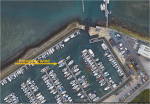
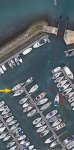
Imaging having to leave my berth (pictured below) each week, with novice crew and a kick to starboard in astern and a prevailing wind from the west...

20230205_201947.png

Overlaying the boat (copy/paste) onto the fairway, you can see there isn't room for any 360.

Screenshot_20230205-182624_Gallery.jpg

I forgot to mention that the rising tide can flood in through the cill (top of picture) pushing the bow further downwind.

With the thruster, I do now have the option to reverse and head out of the fairway on one go, instead of back and forth countless times. Oh and for the people (like me) who never liked the on/off sound of the thruster, I installed a Vetus BowPro that has proportional speed control. No more sudden on/off, it can give just the power required and is much quieter.

I'm not convinced it's necessary, but makes going out for a sail much less fraught (and to be honest, the back and forth manoeuvres under engine probably got as many watchers as a thruster sound would have done).
 
Oh and the red green lines on my pictures just represent the way the boat is turning and to try and show a common route out of the berth. They do not necessarily indicate wheel/rudder position.

I do know that with the wheel turned fully to port, with judicious use of forward and reverse power, I can turn on the spot.

With a bit of wind pushing the bow off, it doesn't happen... and well, ending up all the way back down the fairway and warping off is always a last resort.
 
Oh and the red green lines on my pictures just represent the way the boat is turning and to try and show a common route out of the berth. They do not necessarily indicate wheel/rudder position.

I do know that with the wheel turned fully to port, with judicious use of forward and reverse power, I can turn on the spot.

With a bit of wind pushing the bow off, it doesn't happen... and well, ending up all the way back down the fairway and warping off is always a last resort.
Have you ever tried going out astern up to somewhere near the middle of your yellow arrow, then going ahead to the entrance?

Just a thought.
 
I don’t see why they are so hated
Bow thrusters in themselves I do not care, each to his own, but I definitely hate bow thruster users who leave at 0600 in the morning in perfectly windless and tideless moments and must absolutely use their BT port-starboard-port-starboard-port-starboard-port-starboard-port-starboard to perfectly align their boat centerline to a 1° tolerance before leaving an otherwise empty pontoon or even anchorage, meanwhile waking up everyone who is sleeping onboard in a 50m range. :mad:
 
Last edited:
Have you ever tried going out astern up to somewhere near the middle of your yellow arrow, then going ahead to the entrance?

Just a thought.

Prop kicks to starboard, and with any tide coming in through the cill, if I did just let the boat hang strern to wind I'd likely end up crabbing to starboard (more than to port) until I reach the car park.

I can't afford to crab perpendicular to the fairway because we'd touch fore and aft at some point.
 
It does annoy me to see a motorboat with two engines boat entering a marina fairway, then steering it just using the bowthruster. With any forward motion, a thruster loses considerable turning power, so all you can hear is the noise of it constantly being used to keep the boat in a straight line. Grrrr! (but then why should it matter)

It does annoy me to see boats using engines to manoeuvre. People had managed for millennia using oars/sweeps, warps and sails. Grrr! ;)
 
Top