Boat

, but I can see ahead just fine by sitting on the windward seat. But then I have no spray hood and the hatch always leaks ;0)...

In the summer on the Centaur I'm normally trying to dodge dinghies inside Chichester harbour and I'm 5'10 and don't have a spray hood either.... but I am an anxious soul! (I'm at SYC on the hard for the winter btw....Shoreham)
 
We used sail and manouver with the spray hood down and visibility is OK. We are using it more for shelter now we are on the sea.

My main problem is that the top of the sprayhood is just on my eye line, I could do with a 2" block to stand on when I'm stood steering with the tiller between my knees, or use the tiller pilot more.

Sitting on the coaming isn't so comfy, but vis is much better, I use a tiller extension for that especially if I'm trying to hide behind the spray hood.
 
what watch pattern - I fancy trying the four hour watches

I am sure the Navy tried all sorts of combinations before setting on four hour watches

As I said upthread, I've used the traditional watch pattern (with dog watches) for up to three weeks on a sailing ship. That was with three watches (we called them Red, White and Blue) and it worked pretty well; after a couple of days adjusting I never felt especially tired. You only get one really broken night in three, when you take the middle watch (0001-0400). Otherwise you either do the first watch, and get to sleep from midnight to breakfast and then go back on watch at 0800, or you do the morning watch and get a full eight hours from 2000 to 0400 and then get to watch the dawn.

Not certain how well it works on a yacht as opposed to a ship, but with three guys it seems like a reasonable place to start.

Pete
 
Mast lowering

Poleringscropped.jpgHello Dyalan and yes I am glad the madness of building a well has gone .
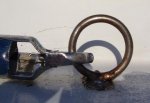
In a previous post Dug748 wrote a little about mast lowering. He is a little misleading in that the A frame or poles used to improve the angle of pull when raising or lowering mast must pivot exactly inline with the mast pivot. This is not true, any approximation to the base of the mast is fine. I use spin poles so pivot for the poles is aft of the mast base by a foot or so and on deck. The picture shows my purpoose built rings to take the poles.
If you fit something like this you might consider fitting a palte of SS or ali under the ring for the wooden posts to rest on. You might consider a slot in the end of the post to go over the ring and put a radius in the end of the post so that it can pivot from horizontal to vertical while under end pressure. There is some significant end pressure on the poles as a friend witha 30fter had deck cavein under the rings from end pressure and soggy deck.

The mast base pivot fitting you have is excellent as it has a narrow width at the pivot so it will be able to accomodate some side swing better. A wider base means more tenedncy to break lugs off it the mast swings sideways. Of course you will need to keep the mast central as it goes down.
I think what doug748 was aluding to is that with a boat with chain plates exactly abeam the mast you can extend the chain plate up to a point where the stay pivots in exactly the same palne as the mast. (both in height and fore and aft.) this means that as the mast pivots down the cap shroud remains tensioned and so holds the mast central.
This can be done with a flat plate or tube extension of chain plate which is stayed at 45 degrees forward to the deck to keep the extension vertical under load.
A crude alternative can be to put a clamp on the sidestay about in line with the mast pivot and rope or stay that go forward to the deck to hold the shroud forward as she goes down. However less power to hold mast central.

Much depends on how often and under what circumstances you will be lowering the mast. If it will be a rare occurence then just be careful and have lots of helpers.
On the other hand I have an acquaintance old retired witha 40 fter who regularly lowers his mast for bridges single handed while under way. he is just well organised with good gear to do the job. So if you expect to lower the mast for bridges often then get it organised and practice it lots first.

if it is only for occasional mast top maintenance then you still need helpers and gear. You need a crutch at the transom to support the mast when down. This should be as high as you can reach while standing to lift the mast up (above your head). The crutch should be well suported in the fore and aft direction.
So to actually work on the mast top you need to lower it into the crutch then disconnect the pivot bolt and lift/slide the mast forward in the crutch until the top is over the cockpit then lower it from the crutch to where you can work on it. Much easier if you can moor next to a high wharf and with the aid of a step ladder swing the lowered mast over the wharf to work on top.
It all takes care experience and practice so good luck with that. PM me if you want help/advice. Around here we almost all lower masts for bridges so we are familiar with problems. I have loads more comment/advice on this subject if you want.
re sagging head lining can you make a small hole(s) in the lining to inject a glue then push it back into place witha pole or similar untill glue hardens? (no experience here)
good luck olewill
 
Last edited:
Thanks Will

thank you for this - very useful

I shall have to make a film of lowering the mast

I will sit in the cockpit and drink and think

I was wondering about using 2 x 2 timber for the A frame

It will only be an occasional job - maybe just a one off

I am planning to take the boat around to Thornham Marina if Jeannette will have me for a couple of months

I have a collection of bits of advice from people about mast lowering

I did see a Centaur on the broads set up for it with a permanent A frame

he could have done it under way too

but I shall not be attempting that

the mast is a real bunna compared to Katie L

D

as for well madness - we will not know until some-one else finds themself in the same situation - in which case they might go down the same route

it would have worked out fine
 
Last edited:
I also find the sprayhood on my chums' Centaur is exactly on my eye-line; I'm 5'9".

It would be too much faff and possibly damaging to the window to keep raising and lowering it, fortunately the owner is a lot taller.

Dylan, I mentioned this to someone on another thread working on his Volvo inboard, but one easy thing well worth checking is the core plugs.

I had one of these corrode through just when I needed the Volvo inboard in another boat I had, in a calm at the top of Alderney Race.

Araldite cured the leak, but a check onshore and new plugs would have been preferable; that was a 1981 Volvo 13hp ( I forget the mark ) in 1988, so not terribly old.
 
Ok for a one off lowering. You need the 2 2x2 timber to have holes near the ends. Tie or shackle in some way the ends to the toe rail or near to it. Put some ply under the ends so that sharp corners don't dig into the deck. The other end needs to be shackled or tied together and to the forestay. I hope you can lift the furler drum up to expose some forestay wire. A clamp around the wire is a good idea to allow a connection for the tackle and the poles. This allows you to use the tackle to pull forestay down to enable clevis pin to be released. With or without a bottle screw.
If you have enough people one man on each side of the mast standing on the cabin top should be able to keep the mast central. Given flat water or on the hard.
You will need a crutch. More 2X2 crossed with a bolt about 20cms from the top to make a cradle for the mast. tie these really tightly to the stern rail sitting on the deck. Make sure they are well tied to stop them swinging forward.
When the mast is caught in the crutch at the back you need to release the pivot pin. It should be loose try it first. You may need some down pressure on the mast base because it is top heavy out over the stern. Then with helpers lift/slide the mast forward sitting the base on (or under the bow rail on a rope cradle).
Do your work on the mast. Replace at least the shrouds top and inner if not all if they are of an unknown age or more than 12 years. The bottle screws may well be fine provided they turn OK. good luck olewill
 
Ok for a one off lowering. You need the 2 2x2 timber to have holes near the ends. Tie or shackle in some way the ends to the toe rail or near to it. Put some ply under the ends so that sharp corners don't dig into the deck. The other end needs to be shackled or tied together and to the forestay. I hope you can lift the furler drum up to expose some forestay wire. A clamp around the wire is a good idea to allow a connection for the tackle and the poles. This allows you to use the tackle to pull forestay down to enable clevis pin to be released. With or without a bottle screw.
If you have enough people one man on each side of the mast standing on the cabin top should be able to keep the mast central. Given flat water or on the hard.
You will need a crutch. More 2X2 crossed with a bolt about 20cms from the top to make a cradle for the mast. tie these really tightly to the stern rail sitting on the deck. Make sure they are well tied to stop them swinging forward.
When the mast is caught in the crutch at the back you need to release the pivot pin. It should be loose try it first. You may need some down pressure on the mast base because it is top heavy out over the stern. Then with helpers lift/slide the mast forward sitting the base on (or under the bow rail on a rope cradle).
Do your work on the mast. Replace at least the shrouds top and inner if not all if they are of an unknown age or more than 12 years. The bottle screws may well be fine provided they turn OK. good luck olewill

jolly good - the 2 x 2 works for me

D
 
Or 'park up' dried out and aligned fore n aft under a tree/pole/lamppost/another mast , wants to be about spreader height to keep the leverage sane, lower away on a front facing halliard ..

( I have ahem used a bridge once. Needs must and all that)
 
Practice before Precept.

"Hello Dyalan and yes I am glad the madness of building a well has gone .
In a previous post Dug748 wrote a little about mast lowering. He is a little misleading in that the A frame or poles used to improve the angle of pull when raising or lowering mast must pivot exactly inline with the mast pivot. This is not true, any approximation to the base of the mast is fine. I."


I had a number of years to refine my tactics. With an A frame you have a greater latitude for error.

A single pole is nice cos you can carry a length of 2 * 2 on board, you may even have a suitable pole. You are advised to support this arrangement with lines port and starboard. If these are not on the pivot line they will either go tight or loose. This is stressful because the reality strikes when the spar is halfway down. The lever arm is huge.

I would prefer to have this geometrical truth in view whichever method is chosen.
 
With an A frame and stays attached between points about two metres up the mast and shackles on its axis of rotation the whole operation becomes quite relaxed. You can even stop halfway to reposition the roller furler or whatever. The other thing I use is a stand with a big roller on it (actually two trolley wheels) at the stern of the boat to support the mast above the rear edge of the cabin and allow me to roll it forwards or backwards when the foot isn't pinned down.
 
With an A frame and stays attached between points about two metres up the mast and shackles on its axis of rotation the whole operation becomes quite relaxed. You can even stop halfway to reposition the roller furler or whatever. The other thing I use is a stand with a big roller on it (actually two trolley wheels) at the stern of the boat to support the mast above the rear edge of the cabin and allow me to roll it forwards or backwards when the foot isn't pinned down.


Yes. Now I think about it, I never did use an A frame. Can't think why, I didn't stow the pole and stuff on board.

Despite what I said about a single pole, I am converted. The whole arrangement should be steadier and more forgiving.
 
Yes. Now I think about it, I never did use an A frame. Can't think why, I didn't stow the pole and stuff on board.

Despite what I said about a single pole, I am converted. The whole arrangement should be steadier and more forgiving.

regarding 2 x 2s for the aframe

how long do they need to be and can I use a simple hole drilled near the end to hold the blocks

if so, how far back from the end

I have experience with stern crutches - and Harmony has a bridge

D
 
Last edited:
I have a gin pole that go's on the mast pivot bolt and I fix the other end to the roller reefing just above the bottle screw and the pole has two cables to connect to two bridles one port and one starboard at a centre line with the mast pivot then I fit a pulley to the end of the gin pole and to the for-stay at the deck tension it up release the roller reef and lower away


Last edited:
Top