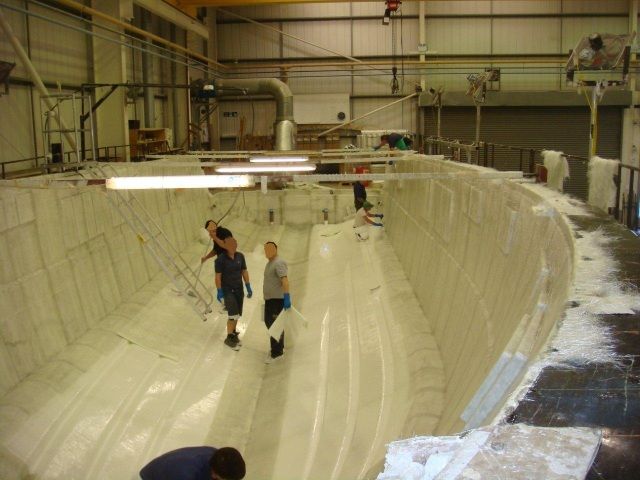
Boat in build pics (2013 Fairline Squadron 78)

how will they fare after being in the water for 10 years or so and perhaps having suffered a few knocks?
Not much worse than any other part of a GRP hull which would have suffered a few knocks by then, I reckon... :D

But it sounds like a large modern shaft driven boat has so many holes in the hull that a few more won't make much difference.
It's not just that a few more don't make a difference, it's the type of holes that matter.
If it's a bomb proof hull you're after, aside from having one in steel to start with, you would want ZERO salt water running through seacocks anywhere, which means keel cooling for the engine(s) and genset(s), with dry stacks for their exhausts, among other things.
Then you could have a point in avoiding 25mm holes for u/w lights.
Oh, and needless to say, outdrives are the last thing you would want on such boat! ;)
 
Not much worse than any other part of a GRP hull which would have suffered a few knocks by then, I reckon... :D

It's not just that a few more don't make a difference, it's the type of holes that matter.
If it's a bomb proof hull you're after, aside from having one in steel to start with, you would want ZERO salt water running through seacocks anywhere, which means keel cooling for the engine(s) and genset(s), with dry stacks for their exhausts, among other things.
Then you could have a point in avoiding 25mm holes for u/w lights.
Oh, and needless to say, outdrives are the last thing you would want on such boat! ;)

Fair enough!
 
However, said spare is rubber or some fancy polymer, and is say 6yo, and has sat cooking for say 2000 hours in a slow cooker also called an engine room. For the same reason you should never keep your spare impellers and belts in the engine room, it might not be as supple as when new. The manufacturers don't comment on this, afaik.

Wouldn't have considered this - how green I am :o
 
They are wifi Colin. Pete, the stem goes through the hull; 25mm hole
LUM-THX120-CCP-2_WithController.png
Ah, I see now!

Unfortunately our internet filtering at work means that I don't see any images within posts! Unbelievable I know!
 
Petem, i just chuckled at your comment on another thrread about me speccing a boat from a comfy armchair and having to make important decisions like how many u/w lights. I know you were pulling my leg but it made me curious enough to look at my boatbuild folders on the PC to see how the scoresheet is coming along. Aside from the original spec document (380 line spreadsheet, each line being a customisation) and er choosing cushion fabrics, I have >600 technical emails (about 50% each direction) with the engineers, not Essex Boatyard sales with whom I obviously have lots too. And just over 90 drawings/photoshops that I've prepared and sent to Fairline. And zillions of their drawings that I've edited or commented on. So far. I'm not expecting any sympathy Petem (:D) but i just wanted to retort by letting you know (and warning anyone who might be thinking about doing same...:)) how addictive/complex a semi-custom build is, if you're an addicted geek. 2 hours a day, most days, for sure. It's a world apart from putting ticks on an options list. You can do it the box tick way, but you don't get as nice a boat. Below are my rag bag of pics to Fairline just from today's emails :-). MASSIVE respect to Vas though with his project- for me (as opposed to the Fairline/Essex team) my project does as you say mostly operate from a comfy armchair

s78-92upperdashFINALwithlegendsr.jpg

s78-92moodlightsprewiremastercabin-1.jpg

guestcabinslidebeds.jpg

s78-92moodlightsprewiresaloon.jpg
 
Last edited:
JFM, sorry to refer back to your painted dash post but I have to say that job is stunning and a credit to EBY. The finish looks silky smooth and to compare it with the automotive world, it’s a dam sight better than the "orange peel" finish that is pretty much the norm from BMW/Audi/Merc these days unfortunately.
 
Below are my rag bag of pics to Fairline just from today's emails
The 'two way switching' label made me thinking: didn't you consider speccing a bus-based electrical system?
This way, they could have wired just the bus (twisted pair cables) to any switches, with the flexibility of configuring them to turn on/off (and dim) ANY light from ANY switch, build scenarios, etc. - all just by mean of programming the system via software (and possibly modifying it afterwards, whenever you'll please, with no need to snake new wires etc.).
As always, there's a trade-off between the somewhat higher complexity of the domotic components required and the (much) higher flexibility, but it seems to me that on a boat as complex as M2 it could have been worth a thought.
 
jfm, Your last post showing all the detailed thought, time and effort going into this M2 build were a revelation.

I often wondered quite how it worked in terms of the communication of what you wanted, and this really explains it superbly.

Fantastic stuff. To repeat what others have multiple times over, many thanks for sharing. It feels like a privilege just to read all about it.
 
JFM, sorry to refer back to your painted dash post but I have to say that job is stunning and a credit to EBY. The finish looks silky smooth and to compare it with the automotive world, it’s a dam sight better than the "orange peel" finish that is pretty much the norm from BMW/Audi/Merc these days unfortunately.
I agree Whopper. EBY's team have done a fantastic job with the paint. These guys do the OEM hullpainting for Fairline if you order a Targa with a silver hull. The paint is Awlcraft 2000, an Awlgrip product. They spray a matt silver basecoat then several coats of a clear top finish. It's properly mirror smooth when you feel it. I'll get more pics later. The prep was fantastic - the flat sufaces that they have cut n shut are all ripple free. They said part of the trick it to use identical resin when doing the cut n shut. The work cutting was done when the original dash mould was about 1 week old and quite "green" so they collected resin from Fairline and mixed identical mix so it didn't cure and pull differently, as would have happened if they used another make of resin.

As you can imagine, I'm totally delighted with this bit of the project. Dealing with EBY and their depth of resources and "can do" attitude is a world apart from dealing with normal boat dealers for whom retrofitting electronics, hifi and tender chocks is their engineering limit. I'd urge people to shop at EBY - just pick a stock boat and say you'll buy it if they spray it silver (or whatever)as part of the deal. They wont blink, and it'll be ready next Friday :-)
 
The 'two way switching' label made me thinking: didn't you consider speccing a bus-based electrical system?
This way, they could have wired just the bus (twisted pair cables) to any switches, with the flexibility of configuring them to turn on/off (and dim) ANY light from ANY switch, build scenarios, etc. - all just by mean of programming the system via software (and possibly modifying it afterwards, whenever you'll please, with no need to snake new wires etc.).
As always, there's a trade-off between the somewhat higher complexity of the domotic components required and the (much) higher flexibility, but it seems to me that on a boat as complex as M2 it could have been worth a thought.

I had that gear in my last house (specced by me, so nicely OTT not done to a builder's budget) and to be honest the cost/complexity was barely worth the huge cost, though it was pretty sexy. On Match 2 I do not have that and don't want it but I have something slightly more advanced than traditional lighting wiring, sort of. The pic above represents function, not actual wiring runs. The lighting uses gadgets made by your countrymen Cantalupi. There is a little dimmer driver for each light circuit (LED, so the "dimmer" is actually a high speed switching transistor and dimming means changing the frequency). Two of the terminals on the driver are joined momntarily to turn the lights on, then joined momentarily again to turn them off. So for 2,3,4, -whatever - way switching you just connect multiple momentary lightswitches to those two terminals. But I cannot program, say, the bedside lightswitch to turn on, say, the galley lights.

The ceiling lighting is all Cantalupi LED as well - a significant cost upgrade over the standard Foresti Suardi stuff. I'm hoping for nice results but you never know till you actually see it... :-/
 
+1 on the flexibility of a BMS,
I've worked together with a greek company doing such stuff, installed at my own house in 2005 (that is designed/wired/connected/programmed myself) and I'm very happy (wife not that much, kids v.happy, but wont get into details)
What MM says is absolutely true and I'm sold to this tech in general (currently setting up a UG course for my students to start getting into grips with all that stuff and not go on designing jazzy stuff with 20ies (as in 1920s!) technology on them!

What you're using is a half cook (excuse the expression!) system where you use pushbuttons/toggles to signal your intentions to the device right? But there's no method to make intelligent overall decisions on various hypothetical/real scenarios.
Hm, maybe I should explain in detail what I'm doing in MiToS at this front...

cheers

V.

PS still no explanation on the aftdeck below w/l outlet JFM :p
 
Hm, maybe I should explain in detail what I'm doing in MiToS at this front...
Please do, I'm curious.
But I must admit that while the idea popped to my mind while looking at jfm pics, I actually understand his decision of not implementing a full domotic system onboard. Aside from the potentially horrendous costs, also reliability might be an issue in a salty environment, I suppose.

That said, I also decided to go that way when I built my house, back in 2006. But I did as a DIY job, sort of.
I asked the electrician to prepare just all the cabling, and I took care of selecting and installing all EIB-KNX component. But the real fun started when I had to dig into the ETS software to program the stuff: it took me quite some sleepless nights to understand the software first, and then program all the functions I had in mind.

But it does work nicely, and I had zero faults in the components so far, touch wood...
Besides, the possibilities are endless. I can also connect remotely and check/operate anything - lights, awnings, alarm, you name it...
 
Top