boat features that give good pointing

Other way round. The sheeting angle reflects the pointing ability of the boat, it doesn't define it. Sheet too close on a boat that can't point, and you're just stalling out the jib. Sheet to wide and you're just giving away height.

Windward ability is determined by the aero-hydrodynamic efficiencies of the hull & foils, and the rig. They have to work together, and for absolute best performance you need the best efficiency of both sails and hull & foils.

In all monohull restricted racing classes which limit sail area, but give you freedom on how to arrange it (Thames A raters, Bembridge Redwings, International 14s, 18' skiffs, NS14s, Nat 12s, Merlin Rockets etc), the answer for rig efficiency is a high aspect ratio rig, without overlapping sails.

In probably the best pointing boats around - ACCs (which, AUIU, could squeeze down to tacking angles under 60), the final hullform shows the answer for the most efficient hull - narrow, with a deep keel with lots of lead at the end of a high aspect, short chord foil (with a trim tab). Of course, having world class sailors to drive these foils does help, as average Joes like me would be stalling them out all the time, and spending a lot of time going sideways.

Light rigs (carbon where allowed) and heavy keels give you more power, which means you go faster, & can reef later.

Of course, while ACCs point like a badger, in terms of absolute VMG, they would be left for dust by the current AC45 cats. The cats might be tacking through bigger angles, but they're going a lot faster....
Keen, He asked what to look for and its a bit of chicken and egg with sheeting angles as in which comes first? Hopefully the designer of the boat will have sorted out what is going to work and what isn't. What is certainly true is that a boat with wide sheeting angles is never going to be close winded. Therefore I suggested that one thing he might look for is narrow sheeting angles as a sign that the thing might be close winded.

eg In the realm of everyday sailing and cruising yachts one might look at, Island Packets are never very close winded as their shrouds come out to the gun'l and the sheets lead outside. Even if they were built with fantastic hulls and fantastic high aspect rigs etc , they will be never be very close winded as you can't get the headsail in enough.
 
Not necessarily "silly nonsense"! Just because modern racing yachts don't have long keels doesn't mean long keelers can't point well - it just means that when considering overall performance on all points of sailing, long keelers are not competitive any more. It's a bit like saying that streamlined racing cars that minimise wind resistance are bad because you never see a current F1 car that's particularly streamlined. They have big wings and lousy drag figures because the downforce the wings generate provides a greater overall benefit.

I guess you could prove your point by organising a race which solely consists of a windward leg.

I remain skeptical of the long keel for pointing however. As others have said it is all about maximising hydrodynamic lift and minimising drag. Admittedly a large lead bulb on the bottom of a high aspect keel adds drag, but such keels are still more efficient for pointing than a long keel with all its surface area.

And the large lead bulb gives other advantages too.
 
Hopefully the designer of the boat will have sorted out what is going to work and what isn't. What is certainly true is that a boat with wide sheeting angles is never going to be close winded. Therefore I suggested that one thing he might look for is narrow sheeting angles as a sign that the thing might be close winded.

In theory, yes. In theory, there's no difference between theory and practice. In practice, there is. So yes, you can look at sheeting angles to try to get an idea about pointing ability, but it's probably easier to just look at the whole boat. A wide hull, limited draft, stumpy rig with big overlapping sails won't have the pointing ability of narrow/tall/non-overlapping. Stand back and look at the big picture.

And in particular, you can't necessarily just improve a boat's pointing ability by narrowing the sheeting angle.
 
Last edited:
Not necessarily "silly nonsense"! Just because modern racing yachts don't have long keels doesn't mean long keelers can't point well

Certainly they can point, but not well in modern terms. A long keel cannot be an efficient foil and an efficient foil, as found on the current crop of race-oriented boats, produces lift to windward. Not a lot, maybe, but sufficient to allow it to climb above a long-keeler.
 
Certainly they can point, but not well in modern terms. A long keel cannot be an efficient foil and an efficient foil, as found on the current crop of race-oriented boats, produces lift to windward. Not a lot, maybe, but sufficient to allow it to climb above a long-keeler.

If by "lift to windward", you mean zero or even negative leeway, well....no. No symmetric foil can generate lift at negative or zero angles of attack (leeway angle = the keel's angle of attack). AIUI, boats with CBTF systems or assymetric daggerboards and canting keels may be able to operate in a "negative leeway" mode, but generally don't as it's very slow - too much drag.

Every boat that has the ability to sail to windward has the ability to generate lift from the hull and any underwater appendages. Beating is impossible otherwise.
 
If by "lift to windward", you mean zero or even negative leeway, well....no. No symmetric foil can generate lift at negative or zero angles of attack (leeway angle = the keel's angle of attack). AIUI, boats with CBTF systems or assymetric daggerboards and canting keels may be able to operate in a "negative leeway" mode, but generally don't as it's very slow - too much drag.

Every boat that has the ability to sail to windward has the ability to generate lift from the hull and any underwater appendages. Beating is impossible otherwise.

I don't think we are disagreeing fundamentally, but what I was taught seems not quite to line up with your interpretation.

Going to windward, the sail is an aerofoil. The angle of attack is the boat's heading to the apparent wind. Lift is produced perpendicular to the sail with both forward and sideways-to-leeward components. The foils (keel and rudder) resist some leeward movement and allow the sails' force to be translated (mostly) into forward movement. So far, so elementary.

Going to windward, the keel is a hydrofoil. The angle of attack is the boat's leeway. Lift is produced perpendicular to the keel, sideways-to-windward (because the angle of attack is coming from the opposite side as the angle of attack on the wind). Thus, an efficient hydrofoil produces a small but useful degree of lift to windward. Enough to offset some (but not all, obviously) of the leeway. The more efficient the foils, the less leeway and the better the pointing angle.

A full keel cannot be a hydrofoil (or at least not without some very, very clever profiling) but only a brake on leeway, and a long keel cannot be as efficient a hydrofoil as a deep narrow chord keel.
 
Last edited:
I'm probably getting out of my depth here, but I think the difference is that the sails are an asymmetric foil but the underwater surfaces are not. I accept that the keel and rudder can generate some sort of "lift" by virtue of the leeway, but to actually drag a boat to windward, they'd need to be asymmetric and would need some sort of power source (which, of course, would be self-defeating as the power required to do so could only come from the sails in the first place). I think a long keeler can resist leeway better than anything with a narrow chord keel because both are (I think) acting only as a "brake".

That said, in the course of this discussion I've started wondering whether "pointing" is the same thing as "making good a course to windward"? I'm assuming that"pointing" is the angle between the boat's heading and the apparent wind" - would that be correct? If so, I'm sure it's true that most long keelers can't "point" especially well (old rig design etc). However, if it's "making good a course to windward", I don't think they'd be that bad because although they can't sail as close to the wind as many modern designs, they don't make much leeway either - on account of the "barn door" hanging down under the water. I'm not about to enter Avocet in next year's America's Cup though, because there's so much more drag than modern designs. I think a boat with a more modern keel design would simply free-off a bit and sail so much faster. Acocet would just sit there not really making much headway, but on a very close-winded course.
 
I accept that the keel and rudder can generate some sort of "lift" by virtue of the leeway, but to actually drag a boat to windward, they'd need to be asymmetric.

Many wing masts are symmetric, yet still produce lift. Certainly not as efficiently as an asymmetric profile would, but it works. Because of the angle of attack the fluid (air or water) has a longer path around one side of the foil than the other, creating a pressure differential and thus a side-force. That's why a modern boat with a relatively small foil in area terms can outpoint a long or full keeler with much more 'sideways' area underwater. Of course I accept that a symmetric keel is never going to 'drag a boat to windward' but a good one will produce enough lift to offset much of the leeway (and do it with much less resistance than a long or full keel).

(Caveat) I did all this fluid dynamics stuff 40 years ago and haven't revisited it much since, so there may be a element of memory degradation at work!.
 
Last edited:
If by "lift to windward", you mean zero or even negative leeway, well....no. No symmetric foil can generate lift at negative or zero angles of attack (leeway angle = the keel's angle of attack). AIUI, boats with CBTF systems or assymetric daggerboards and canting keels may be able to operate in a "negative leeway" mode, but generally don't as it's very slow - too much drag.

Every boat that has the ability to sail to windward has the ability to generate lift from the hull and any underwater appendages. Beating is impossible otherwise.

Having a trimtab on the trailing edge of the keel is a big help also as it increases windward lift and decreases drag from the rudder.
 
Last edited:
The biggest asset and feature when going to windward is a helmsman who knows what he is doing. On occasion old designs of boats end up higher than newer designs entirely due to the helmsman. This has by far the biggest impact in windward ability.

The post on apparent and true wind indicated that many folks have an incomplete understanding on this subject. Steering the boat upwind as she is affected by waves, variable apparent wind speed and direction is a skill that can be quite difficult to learn to a significant level where it really makes a difference.

So buy a high pointing yacht but if you cant steer to windward with a high degree of competency you may as well not worry about it.
 
A full keel cannot be a hydrofoil (or at least not without some very, very clever profiling) but only a brake on leeway, and a long keel cannot be as efficient a hydrofoil as a deep narrow chord keel.

My starting point:

A fluid flowing past the surface of a body exerts a surface force on it. Lift is that part of the force perpendicular to the oncoming flow direction & drag is that part which is parallel to the flow direction.

The only force available to offset leeway is lift. Therefore, if a boat is able to sail in any direction other than directly downwind, the hull and appendages are generating lift. Assuming HMS Victory was able to beat, reach - sail anywhere other than DDW, then her hull was generating lift.

The efficiency of the hull and foils at generating lift are a different matter. More efficient (i.e. better lift/drag ratios) = better windward performance.
 
Got me wondering...

"The Victory was one of the fastest first rate ships of the line at her time, and had excellent handling abilities. In general wind conditions and sail configuration she could reach a maximum speed of 8-9 knots. Her maximum recorded speed was 10-11 knots"

"As a sailing ship it would have been normal for HMS Victory to be moving at forward speed with an angle of heel. However, this angle would not have been very large due to the early onset of down flooding through the gun ports, which were not watertight. It was calculated that the maximum angle of heel would not be greater than about 10 degrees when at load displacement."

"Any sailing vessel must make some leeway when sailing across the wind. When beam reaching at 150o degrees to the true wind, HMS Victory initially shows a large amount of leeway, as shown in Fig. 18. This is because the ship is blown sideways until the forward speed is such that the lift generated by the hull can counteract the sideforce generated by the sails. As can be seen, this occurs very quickly, with the maximum angle of leeway occurring within a couple of seconds of deploying the sails. The leeway then decays very quickly to less than 1 degree within 45 seconds. In comparison to the time taken to achieve full forwards speed, this is very low. This is
very important during a tacking manoeuvre, as the ship will lose much of its forward momentum while turning through the wind.

The overall performance of HMS Victory is summarised in Fig. 22. Here, it is shown that with a single bracing angle of the sails, HMS Victory is very restricted in the angles she can sail at. When the sails are braced square to the ship, she is unable to sail closer to the wind than 150º. On the other hand, if the sails are trimmed appropriately, the simulation predicts that HMS Victory would be able to maintain a good speed while sailing up to 110º while carrying a full suit of square sails. Sailing closer than this would require that the square sails be furled, and staysails deployed."

http://eprints.soton.ac.uk/42999/1/Technology_of_Trafalgar_paper_v6.pdf
 
That said, in the course of this discussion I've started wondering whether "pointing" is the same thing as "making good a course to windward"? I'm assuming that"pointing" is the angle between the boat's heading and the apparent wind" - would that be correct?

Not quite - between the boat's heading and the true wind. When you're comparing the performance of two separate boats, referencing the apparent wind is almost entirely meaningless.
 
What a great thread - lots of experience being shared. Underwater appendages: Most people would laugh if you suggest that a bilge keeler can match a fin keeler on the wind, but I remember two Sadler 25s that we regularly raced against. One was a bilge keeler, and I was amazed how closely it matched the fin in a foul-tide, short-tacking leg in a good breeze. They weren't swopping tacks, but the fin would be no further ahead than the bilge at the end of the leg. IIRC, the bilge keels were 'toed in' so the leeward one provided lift to windward.

Wing keels: I remember when the 'works' MG Spring 25 was raced, it usually seemed to be somewhere 'in the frame'.

Current boat also has a Van de Stadt wing keel, and I've had to learn how to get the best to windward. The wings are 'toe down' toward the leading edge, so the more the boat heels the more these (both of them) lift the boat to windward. I've definitely noticed this. The 105% blade jib sheets inside the shrouds, and so I sheet it to get max speed at 30 degrees apparent, boom on centreline, and allow the boat to heel more than I would with a fin.

However, when the boat isn't heeled these toe-down wings act a bit like a submarine's 'planes' in 'dive' mode, which with the additional wetted surface increases drag (but it does reduce pitching in a seaway), so windward performance in light airs is poor.
 
Sounds like the correspondents need to step outside and sort this out !

Line up their boats at dawn for 10 miles to windward against the tide

(Oh and I am very much for well designed modern fin keel - the Arcona would suit perfectly. In most cases would no more swap my Rob Humphreys design for a long keeler than I would swap a current BMW 3 series for a Morris Marina - technology has moved on)
 
I've read all this with interest; I posted some banal thread about track while beating a couple of weeks ago but there weren't many takers - I suspect because people claim that their boats sail closer to the wind than they really do.

We sail a Nicholson 43. She has 30' waterline length and a long fin and skeg keel. We have an aged baggy headsail (approx 130% - last year's was 150% but spectacularly baggy so now binned - need to save for new one!). While I fully understand her poor performance off the wind (she was designed to be an RORC racer in about 1969, built 1971) she has never been bettered in any informal races to windward in our stewardship.

I still think we tack through about 100 degrees true in slack tide.

What makes her point so well? I have no idea. Her underwater profile does not conform to modern conventions; her sails are baggy; her waterline length is laughable. But she sails upwind like a witch.
 

Attachments

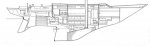
  • Elevation.jpg
    Elevation.jpg
    16.2 KB · Views: 0
I've read all this with interest; I posted some banal thread about track while beating a couple of weeks ago but there weren't many takers - I suspect because people claim that their boats sail closer to the wind than they really do.

We sail a Nicholson 43. She has 30' waterline length and a long fin and skeg keel. We have an aged baggy headsail (approx 130% - last year's was 150% but spectacularly baggy so now binned - need to save for new one!). While I fully understand her poor performance off the wind (she was designed to be an RORC racer in about 1969, built 1971) she has never been bettered in any informal races to windward in our stewardship.

I still think we tack through about 100 degrees true in slack tide.

What makes her point so well? I have no idea. Her underwater profile does not conform to modern conventions; her sails are baggy; her waterline length is laughable. But she sails upwind like a witch.
Sorry, but if you think tacking through 100 degrees makes your boat one of the category that 'sails like a witch to windward' you perhaps ought to enter some races against some modern yachts with deep fin keels, nice hull shapes and new sails.

The Nicholson 43 is a lovely boat, and I am sure you sail her well and enjoy her fine sailing characteristics, but to say she sails like a witch to windward is stretching things a just a little too far.

A Nicholson 43 was on our shopping list when we were last looking for a boat, and they are lovely proper sailing boats, but you won't win a race against a modern deep fin racing yacht with one unless the handicapping is all to pot...
 
but you won't win a race against a modern deep fin racing yacht with one unless the handicapping is all to pot...

Last year I was sailing to Lymington from Cowes in my Dufour 31. It was blowing an 8 from the SW. (Confirmed by reference to the data from Lymington Starting platform). The only other boats around were a fleet of Sigma 362's out for a race. They were pointing higher and sailing faster - but not a lot. We were all well reefed down (I had my number 3 Jib and two reefs they had 3 reefs and blade foresails)

Then

A Contessa 32 appeared - full roller reefing genoa unrolled and full main - going faster, pointing higher and an easier motion. The chap sailing it was sitting comfortably in the cockpit smoking his pipe - the Sigma crews were sitting on the rail.

What price the theories on underwater profiles, fractional rigs?

PS. I know it won't go down wind as fast as a modern racer.
 
Top