Bestevaer 49

Front sail locker:

This is a large area at the bow. It is designed to also store fenders etc. The rear wall is a waterproof bulkhead and just in front of this is the bow thruster, anchor locker and depth/speed transducers.

The advantage is that any water intrusion at the bow thruster or the transducers will not flood the boat. The arrangment also pushes the heavy chain storage well back from the bow. The lack of internal fitout in this area also further reduces bow weight. This means there is more flexibility adding decent ground tackle and light ice reinfororcment.

The reinforcment helps not only for polar regions, but gives the potential for reduced damage in the case of impact with floating objects such as logs, containers and whales. Combined with the aluminium construction and 4 watertight areas we have some chance of limping home should the worst happen.

The sail locker has a waterproof hatch, but with the storage of potentially damp objects like fenders and sails it will be more humid than the boat interior where the bow thruster is normally mounted. Not great for electronics. To compensate, we have fitted an IP bow thruster . These are listed as "waterproof, not for submerged use". There is no official IP rating, but the construction is very well done with a large gasket flange held down by numerous stainless bolts so I think with the construction the durability should be at least as good as the non sealed model installed in the more normal position under the bed.

JccFAzm.jpg


3Dx9Phl.jpg
 
A forepeak to drool over :encouragement:

Presumably the fitting with the hole in the deck plate is to take a wire holding down an inner forestay fitting on the foredeck above?

The angled pipes on the bulkhead are chain locker drains?

I'm slightly surprised at the number of screwholes on the deck plates, I would have expected them to be made more easily removable. Though I can't put a finger on exactly why.

Pete
 
Presumably the fitting with the hole in the deck plate is to take a wire holding down an inner forestay fitting on the foredeck above?

Yes, spot on, the boat is a cutter so there is a stay that will be fitted from the keelson to the deck fitting.

The angled pipes on the bulkhead are chain locker drains.

Yes, the anchor locker is above the waterline, unlike some centrally mounted chain storage areas, so the chain locker only needs a drain pipe rather than pump to clear the water.
 
Last edited:
Yes, spot on, the boat is a cutter so there is a stay that will be fitted from the keelson to the deck fitting.

You've clearly put a lot of thought into this vessel so why have you opted for this arrangement rather than a fitting terminating at a reinforced deckhead? Won't the internal stay not be a bit of an intrusion into useful space?
 
Are you fitting a deck wash pump? I have seen boats with a deck wash pump and hose fitted adjacent to the anchor locker in such a way that any water left in the hose drains down into the anchor locker.
 
You've clearly put a lot of thought into this vessel so why have you opted for this arrangement rather than a fitting terminating at a reinforced deckhead? Won't the internal stay not be a bit of an intrusion into useful space?


The anchor winch and chain stopper are all in this area so the deck at this point is substantial. It is already 15mm thick aluminium here with a comprehensive arrangement of ribs and stringers. I am not sure it could be practically made much stronger.

So the stay from the keelson to the deck is probably unnecessary, but it is important that the staysail can maintain a high luff tension. Even a small amount of flexing is undesirable in a sail that will be used in heavy weather.

An alteternative would have been to add another full bulkhead in this area, but this would have divided the space up further.

The additional stay will be a slight intrusion into the foredeck space as you point out, but when making all these choices we have always elected for simple and strong with backups where possible. Backups are often considered only for equipment, but they are important, perhaps even more so, for structural elements.

It adds very little weight or cost to over-engineer the chainplates, forestay, backstay, mast support and innerstay attachment points so this has been incorporated into the build where possible.

In practice with clever design very little compromise is needed. For example, on our boat the chainplates are reinforced with a watertight bulkhead just to the rear, together with the toilet and shower walls just forward. These are welded aluminium structures rather than the normal non structural dividing walls. This effectively adds a very deep aluminium ring frame, which is part of the hull structure, both just to rear and just forward of the chainplates.

There are many other examples like this where with some careful thought the boat can be safer as well as stronger and stiffer.
 
Beware of lifting keels they don't weigh much, Jane and I crewed on a 54 foot yacht with a lifting and the toe rail was just above the water in 20 knots going upwind. I wouldn't go near a boat with a lifting keel.
 
have seen boats with a deck wash pump and hose fitted adjacent to the anchor locker in such a way that any water left in the hose drains down into the anchor locker.

Yes, there is a deck wash system in the forepeak.

Keeping the hose in the anchor locker so that any water drains out is a good idea.

We toyed with idea of the automatic chain wash rinse like Amel use. It is a good feature, but in the end we have kept it simple with just a hose.
 
Beware of lifting keels they don't weigh much, Jane and I crewed on a 54 foot yacht with a lifting and the toe rail was just above the water in 20 knots going upwind. I wouldn't go near a boat with a lifting keel.
Thats called 'performance'. Something you have obviously never experienced before with a heavy under canvassed steel boat. The link between lifting keels and leaning over is bizarre. Do you know anything about yacht design?
 
Beware of lifting keels they don't weigh much, Jane and I crewed on a 54 foot yacht with a lifting and the toe rail was just above the water in 20 knots going upwind. I wouldn't go near a boat with a lifting keel.

You can find the contact details for this guy by following the link below. Do let me know how you get on in telling him he chose the wrong boat (lifting keel) on more than one occasion!!!
https://cornellsailing.com/aventura/about-aventura/
 
You can find the contact details for this guy by following the link below. Do let me know how you get on in telling him he chose the wrong boat (lifting keel) on more than one occasion!!!
https://cornellsailing.com/aventura/about-aventura/

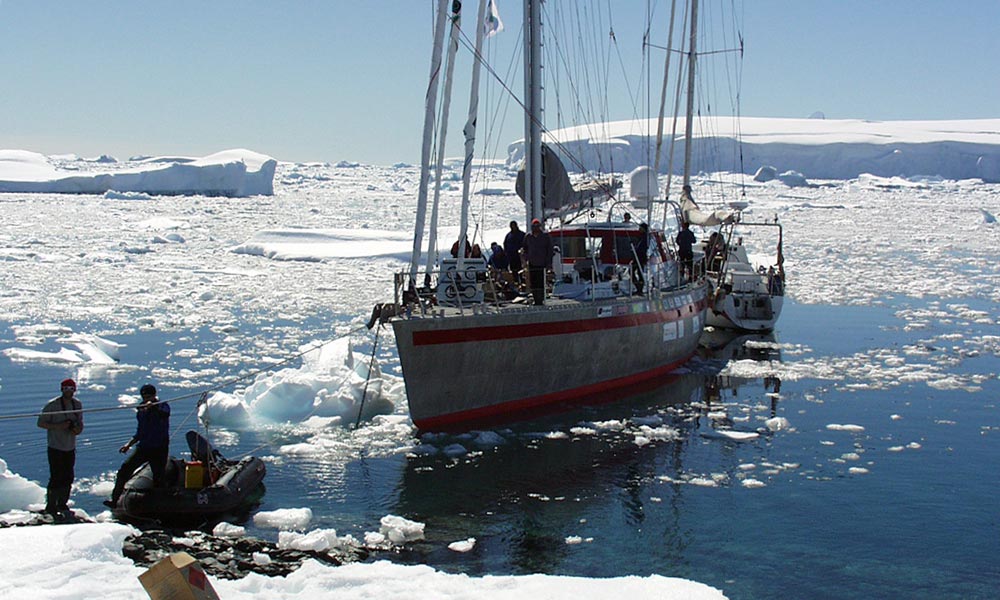
Similar for Skip Novak's boats - Pelagic and Pelagic Australis. Obviously these yachts that have sailed for years in the Arctic and Antarctic, and traversed the globe between them, shouldn't really have been allowed out of the Solent because of their lifting keels.

fleeet007_10x6.jpg


Pete
 
I have never given the boat name or the owner for obvious reasons so why are you doing so know?

Because Jimmy Cornell is a famous ocean sailor:

Jimmy Cornell has sailed over 200,000 miles in all oceans of the world including three circumnavigations as well as voyages to Antarctica, Patagonia, Alaska, Greenland, Arctic Canada and Spitsbergen.

Thousands of sailors have fulfilled their dream of blue water cruising with the help of Jimmy Cornell’s books, among them the international bestseller World Cruising Routes. Now in its 7th edition, and with 200,000 copies sold to date, this is one of the best selling nautical publications in the world.

As the founder of the highly successful ARC transatlantic rally, Jimmy Cornell is credited with having devised the offshore cruising rally concept. In the last three decades, Jimmy Cornell has organized 30 transatlantic rallies, five round the world rallies and one round the world race, with over 3,000 boats and 15,000 sailors having participated in his sailing events. His new series of rallies aimed at cruising sailors: the Atlantic and Blue Planet Odysseys now span the world.

Just possibly, his opinion on lifting keels (choosing to have one in his current boat and the two previous ones, over nearly 30 years of circumnavigations and adventurous voyages) is a little more valid than yours based on one three-day trip along the South Coast.

Pete
 
Some of the deck gear was seen for the first time today.

We have tried to avoid any timber or plastic outside. Timber needs work and plastic deteriorates and looks grey and chalky after a few years in the tropical sun. In addition, it becomes brittle and the part needs replacement.

We have not quite managed to eliminate all exterior timber and plastic, but we have come very close.

We have always admired Anderson winches. The normal Anderson winch is beautiful in stainless steel, but has a very small amount of plastic on the top. As an option this can be replaced with an stainless top, which we specified.

In the flesh they do look stunning.

IYfBsk9.jpg
 
Blocks:

Manufacturers are starting to under specify items such as blocks. Robust deck gear is expensive and with many yachts only sailing a few weekends a year, an adequate life can be achieved with smaller equipment such as blocks and clutches.

On a cruising boat used full time, deck gear takes a beating. KM custom make some of this equipment. It is always robust, overbuilt stuff that looks like it will last a lifetime of hard use.

These flip flop blocks used on our mainsheet are a good example. Notice the attention to detail. The smaller idling block reduces friction and chafe when the mainsheet is let out a long way. Although it does not show up in photos, the thick aluminium cheeks give some confidence that the block is not going explode with an inadvertent accidental gibe.

The yankee and staysail track, as well as the turning blocks were also custom made, but the smaller blocks are commercial Tytec blocks.

mpklV4i.jpg
 
It may have appeared previously - how do they install the hull anodes? I saw an old alloy yacht being serviced some 12 months ago and they had 2 anodes about the size of dinner plates and 50mm thick that were simply bolted to the hull - and protruded, which was odd as she was built as a racing yacht. I cannot recall the name but 50', 1960's, ex Admirals Cup team. Beautiful yacht - except for the incongruity of the anodes. Are yours recessed - and how long do they last?
 
Are yours recessed - and how long do they last?

Hull anodes are needed on a steel boat, but not on a modern aluminium boat.

The exception is aluminium boats with a lot of dissimilar metals in contact with seawater. Those boats with retractable keels and rudders fit anodes around these structures because the lifting mechanisms have dissimilar metals like bronze or stainless hydraulic cylinders.

Most fixed keel aluminium boats have no anodes other than one or two on prop shaft like most fibreglass boats.

Our previous alumiunum boat had no hull anodes. There were two propshaft anodes and two anodes on the rudder. The prop shaft anodes were replaced every four years. The rudder anodes were only replaced once in 10 years.

However, a few hull anodes does no harm on an aluminium boat providing you do not reach the stage of overprotection (which is hard to do).

So in the new build we incorporated some recessed hull anodes. These are flush with hull so there is no drag. The cost of including this into the build is minimal.

Note; the above advice does not apply to aluminium sail drive legs. Here a relatively small amount of aluminium is encasing a large amount of disimillar metal such as bronze, steel and stainless steel in the gear and drive mechanism. This is all immersed in seawater. In this situation the anode is vital to protect the aluminium casing. The anodes attached to saildrives should be inspected once a year.

This photo is from early in the build. The recess for an anode can be seen in the top right of the image:

S0x6rC2.jpg
 
Last edited:
Top
