
Best screws for galvanised rowlocks?

PetiteFleur

Well-Known Member
Joined
29 Feb 2008
Messages
5,245
Location
Suffolk
Visit site
Just fitted new galvanised rowlocks and sockets, replacing very rusty ones. What screws should I use to prevent corrosion?
I used stainless A2 screws but worried it will cause corrosion.
 
Isolate by filling the countersunk will sealant. Just done that with a galvanised fairlead and A4 screws Squirted CT1 into the hole before screwing and then under the head just before hardening down.
 
Why not use galvanised screws? Plenty available on Amazon and other places.
Seems to make sense, but if you do that isolation seems to make rather less, since only the "local" galvanisation on the screw , (perhaps quite thin) rather than that on the fitting, will then be effective.

OTOH isolation will also work as antiseize if it all goes horribly wrong, which seems to be the way to bet with boats.

Perhaps you could improve it by wrapping the screw thread in PTFE tape and/or thin polythene sheet as well as whatever goo you use.

I used to do this pretty routinely to screws on my motorcycles, if I could ever get them off.
 
Last edited:
316 (A4) would seem to be a reasonable choice, isolated as best you can as suggested. Definitely not galvanised steel, which will corrode badly within months.

Alternatively silicon bronze would be good, if cost is reasonable.
 
Use duralac paste (or other similar gels) between the differing metals to isolate

A more corrosion resistant material like stainless, bronze, a or composite rowlock would solve your issue. Does it have to be galvanised?

Are there composite screws/bolts?
 
Use duralac paste (or other similar gels) between the differing metals to isolate

A more corrosion resistant material like stainless, bronze, a or composite rowlock would solve your issue. Does it have to be galvanised?

Are there composite screws/bolts?
Polythene sheet is free, and more...er...solid than duralac, and could usefully supplement it. PTFE thread tape is very cheap.

I dunno if there are composite screws/bolts. Never seen any, but there are some in aluminium. Not very strong but perhaps strong enough. Aluminium rowlocks also exist.

Alternatively, thole pins? Or a rope loop?
 
And yet, as I understand it, one isn't supposed to mix galvanised and SS, for example in standing rigging, so you are asking quite a lot of your mastic,(which could be compressed out of the way to allow metal-metal contact) here
The question was about fastening galvanised rowlocks, not rigging. Once the screw is set down on the sealant it stays there. The fairlead I mentioned earlier was refitted after having been removed because of some rot in the wood it was attached to. It had been there since 1979 and the screws came out easily with no sign of corrosion in either the screws or the galvanised iron casting.

There is a danger of overthinking things and looking for solutions to problems that don't exist.
 
You will get good old fashioned proper galvanised boat screws from Anglia Stainless. They have all sorts of fastenings.
 
Just fitted new galvanised rowlocks and sockets, replacing very rusty ones. What screws should I use to prevent corrosion?
I used stainless A2 screws but worried it will cause corrosion.
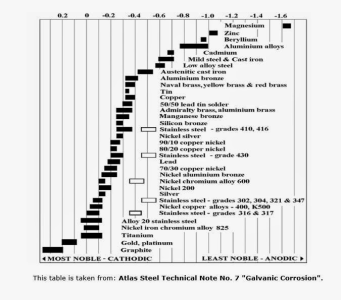
Stainless steel fastenings for galvanised fittings above the water are perfectly OK. In the past I used ss fastenings for all the galvanised mooring cleats on a GRP deck and after 15 years of ownership there was no sign of corrosion .
 
Stainless steel fastenings for galvanised fittings above the water are perfectly OK. In the past I used ss fastenings for all the galvanised mooring cleats on a GRP deck and after 15 years of ownership there was no sign of corrosion .
As someone just getting back to my favourite hobby now I am retired i found this illuminating. I thought messy Duralac would be the answer. 50 odd years on and I am still learning.
 
The question was about fastening galvanised rowlocks, not rigging. Once the screw is set down on the sealant it stays there. The fairlead I mentioned earlier was refitted after having been removed because of some rot in the wood it was attached to. It had been there since 1979 and the screws came out easily with no sign of corrosion in either the screws or the galvanised iron casting.

There is a danger of overthinking things and looking for solutions to problems that don't exist.
So on that basis, mixing metals should be OK on rigging (most of which is a lot further away from all that salty water) too. But in that case there might be danger in underthinking things and not looking for solutions to problems that do exist.

In any case the consequences of getting it wrong are not likely to be disastrous with rowlocks
 
So on that basis, mixing metals should be OK on rigging (most of which is a lot further away from all that salty water) too. But in that case there might be danger in underthinking things and not looking for solutions to problems that do exist.

In any case the consequences of getting it wrong are not likely to be disastrous with rowlocks
The danger here seems to be ignoring the question and introducing a completely different scenario. Nowhere did I say that mixing metals in rigging is OK. Cannot understand why you think there is any connection with the question.
 
On the off chance you might get a bit of corrosion I will take that risk. With rowlock mountings it is vital above all else that they are strong. I have galv sockets on my 17ft rowing skiff & they are fastened with A4 stainless, The boat is 8 years old & has no corrosion trouble. I suspect the gunwales will need replacing before the screws corrode enough to matter. Dont even think of plastic sockets or rowlocks they are simply not up to the job.
Saying that i use Concept 2 glass filled nylon sculling gates on stainless steel pins & they are excellent giving adjustment to blade angle & height if required.
 
The danger here seems to be ignoring the question and introducing a completely different scenario. Nowhere did I say that mixing metals in rigging is OK. Cannot understand why you think there is any connection with the question.
Clearly a different scenario. Just as clearly, not "a completely different scenario". Cannot understand how you can assert that it is, since both scenarios involve mixed metals at sea, and since I've already acknowledged that this is nevertheless probably ok in the rowlock case, based on multiple anecdotes, and much lower risk.

In such a case I would probably supplement the mastic with polythene/PTFE film, as I've done with corrosion prone screws in alloys on motorcycles, another different-but-not-completely-different (i.e. analagous) situation.
 
Top