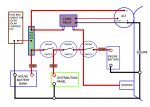
BEP VSR wiring

Can't see that this layout would reduce the current handled by a VSR or combining relay.

The relay only handles the charge going to the engine battery. Because this is normally very lightly discharged, the charging current will be quite small.
 
The relay only handles the charge going to the engine battery. Because this is normally very lightly discharged, the charging current will be quite small.

That's not the case. In your layout, the relay closes immediately the engine starts. In a situation with a fully-charged engine battery and a severely-depleted house bank, there will be quite a large current flowing from the engine battery to the house bank.
 
At last :)


That's bad.


Please, don't encourage him. :)

While you are fitting the new VSR get those dodgy looking cables replaced with nicely crimped ones, as fat as is sensible.


Demonstrates how well the system works and how the added switch gives you a failsafe in more ways than one.
Mwah!
Stu
PS it shows though what a good resource this is, not just me but others that contribute that helps to concentrate the mind, a collective result!
Stu
 
That's not the case. In your layout, the relay closes immediately the engine starts. In a situation with a fully-charged engine battery and a severely-depleted house bank, there will be quite a large current flowing from the engine battery to the house bank.

I totally disagree.
The relay closes as the alternator begins to put out current at charging voltage. Yes, a severely depleted house bank will initially drag this voltage down, normally to somewhere around 13,2V. This will then be the system voltage in the early phase of the bulk charge (slowly rising).
Currents are driven by voltage differences. A very lightly discharged engine battery at say 12,7V will not send current upstream through the relay against a system voltage of 13,2V.
 
That's not the case. In your layout, the relay closes immediately the engine starts. In a situation with a fully-charged engine battery and a severely-depleted house bank, there will be quite a large current flowing from the engine battery to the house bank.
Not being argumentative here but a thought, A flat battery bank, lets say 12volts or less. The charging regime goes in to action, 14.6 volts ish if it is a smart one so a differential of at least 2.6 volts. Ive seen 40 plus amps going in momentarily at this point at the very beginning in to my old 440 amp hr bank from my either smart Sterling mains or Sterling boosted alternator 60 amp Valeo. (by the way, any one thinking of putting a 100amp Balmar or such like on, dont think you are going to see 100amps going in to your bank! )
So a differential of a couple of volts from a controlled charging regime gives rise to a moderate amp charge.
Think this through, taking in to account your statement above. If you connect a fully charged bank without a charger connected, to a depleted bank, the differential will only be about 0.7 (fully charged around 12.7 to discharged 12 ish) So in essence we dont get a big charge going from one bank to the other, more a gentle equalisation over a period of time! There isnt enough differential to do a big one!
That is why we get strange results in situations such as this, people expect an immediate transfer of charge when in actual fact it doesnt happen.
Discuss?
Stu
 
I totally disagree.
The relay closes as the alternator begins to put out current at charging voltage. Yes, a severely depleted house bank will initially drag this voltage down, normally to somewhere around 13,2V. This will then be the system voltage in the early phase of the bulk charge (slowly rising).
Currents are driven by voltage differences. A very lightly discharged engine battery at say 12,7V will not send current upstream through the relay against a system voltage of 13,2V.
Beat me to it
Stu
 
I totally disagree.
The relay closes as the alternator begins to put out current at charging voltage. Yes, a severely depleted house bank will initially drag this voltage down, normally to somewhere around 13,2V. This will then be the system voltage in the early phase of the bulk charge (slowly rising).
Currents are driven by voltage differences. A very lightly discharged engine battery at say 12,7V will not send current upstream through the relay against a system voltage of 13,2V.

At the instant when a large house bank at say 12.0 V is connected to an engine battery and alternator at probably 14V, a pretty large current will flow for a short time, until the system levels at say 13.2V or so as you suggest.
Some people claim to have measured this at hundreds of amps. I'd guess it would vary a lot according to the inductance of the wiring and the battery types. Some VSRs are prone to damage from this as the dI/dt is huge if the VSR should be so dumb as to try interrupting it due to sensing the engine battery voltage dropping. DIY VSRs were often destroyed by contact arcing from this effect.
 
At the instant when a large house bank at say 12.0 V is connected to an engine battery and alternator at probably 14V, a pretty large current will flow for a short time, until the system levels at say 13.2V or so as you suggest.
Some people claim to have measured this at hundreds of amps. I'd guess it would vary a lot according to the inductance of the wiring and the battery types. Some VSRs are prone to damage from this as the dI/dt is huge if the VSR should be so dumb as to try interrupting it due to sensing the engine battery voltage dropping. DIY VSRs were often destroyed by contact arcing from this effect.

One of the main points of the set up I suggested is that the alternator is wired directly to the house bank. As you say, pretty large currents will flow when the engine is started, but they will only flow into the house bank. The engine battery, connected through the relay, will only take a tiny current, as it is normally almost fully charged.
My proposal is not a VSR, but a 'dumb' heavy duty relay that parallels the batteries as soon as the alternator starts to charge. But even if it was a VSR, the risk for damage from arcing would be much reduced with this set up, compared to the conventional, where the starter battery is given 'priority'.
simplified wiring diagram BabaYaga.jpg
 
At the instant when a large house bank at say 12.0 V is connected to an engine battery and alternator at probably 14V, a pretty large current will flow for a short time, until the system levels at say 13.2V or so as you suggest.
Some people claim to have measured this at hundreds of amps. I'd guess it would vary a lot according to the inductance of the wiring and the battery types. Some VSRs are prone to damage from this as the dI/dt is huge if the VSR should be so dumb as to try interrupting it due to sensing the engine battery voltage dropping. DIY VSRs were often destroyed by contact arcing from this effect.
I will disagree, I watch my Nasa volt / ammeter sometimes on start up and when the mains is switched on. You can see the amps slowly climb, Sterling puts a soft start in his products, Even when the batteries were shagged the worst I saw was a slow climb to 40 ish amps for a very short time, then a decline as the juice went in.
Stu
PS house used to be 440 amps and start 70 ish. Now 330 amps and 70 ish
 
Last edited:
One of the main points of the set up I suggested is that the alternator is wired directly to the house bank. As you say, pretty large currents will flow when the engine is started, but they will only flow into the house bank. The engine battery, connected through the relay, will only take a tiny current, as it is normally almost fully charged.
My proposal is not a VSR, but a 'dumb' heavy duty relay that parallels the batteries as soon as the alternator starts to charge. But even if it was a VSR, the risk for damage from arcing would be much reduced with this set up, compared to the conventional, where the starter battery is given 'priority'.
View attachment 65895
Your point is what I have consistantly said, two banks connected together, even in a worst case scenario, the volt differential is not enough to equalise them quickly or for a heavy current to flow.
Stu
 
Your point is what I have consistantly said, two banks connected together, even in a worst case scenario, the volt differential is not enough to equalise them quickly or for a heavy current to flow.
Stu

I agree.

The biggest danger i see with the "fixed" relay is in the event of a battery failure, where a house battery dies and drags all the other batteries down with it. The VSR would disconnect the engine battery when the house bank dragged it down to the relay cut out voltage.
 
The biggest danger i see with the "fixed" relay is in the event of a battery failure, where a house battery dies and drags all the other batteries down with it. The VSR would disconnect the engine battery when the house bank dragged it down to the relay cut out voltage.

I'm now in favour of low-loss splitters, rather than VSRs or combining relays. No contacts to burn. No chance of upsetting voltage sensing systems. No power use when the engine's off. And with 3 isolated outputs, it's easy to feed the engine, house and thruster batteries separately.
 
The biggest danger i see with the "fixed" relay is in the event of a battery failure, where a house battery dies and drags all the other batteries down with it. The VSR would disconnect the engine battery when the house bank dragged it down to the relay cut out voltage.

That would have to be a house battery failure happening while the engine is running and alternator putting out charge. Seems somewhat unlikely to me, but perhaps it could occur.
 
I'm now in favour of low-loss splitters, rather than VSRs or combining relays. No contacts to burn. No chance of upsetting voltage sensing systems. No power use when the engine's off. And with 3 isolated outputs, it's easy to feed the engine, house and thruster batteries separately.


I agree, probably the best solution. More expensive, though.
 
I'm now in favour of low-loss splitters, rather than VSRs or combining relays. No contacts to burn. No chance of upsetting voltage sensing systems. No power use when the engine's off. And with 3 isolated outputs, it's easy to feed the engine, house and thruster batteries separately.

What do you have in mind here Pete ? There a few options.
 
That would have to be a house battery failure happening while the engine is running and alternator putting out charge. Seems somewhat unlikely to me, but perhaps it could occur.


I had just this happen, the house battery failed catastrophically whilst underway. It was unable to take any charge, i left it on a mains charger over night and it was still flat in the morning.

Earlier this year i had two of my three house batteries fail, they drained the third battery (which was new). At the time the boat was in the marina and the engine battery was isolated, so stayed charged.

I've seen it happen several times this year on road vehicles with multiple batteries.
 
I will disagree, I watch my Nasa volt / ammeter sometimes on start up and when the mains is switched on. You can see the amps slowly climb, Sterling puts a soft start in his products, Even when the batteries were shagged the worst I saw was a slow climb to 40 ish amps for a very short time, then a decline as the juice went in.
Stu
PS house used to be 440 amps and start 70 ish. Now 330 amps and 70 ish

Some proper engineers have measured this sort of thing with actual engineering instruments.
It's a surge current which will flow for a fraction of a second, which a Nasa monitor is not going to see.
TBH, anyone who thinks their start battery is 70 amps is not really qualified to comment.
 
I had just this happen, the house battery failed catastrophically whilst underway. It was unable to take any charge, i left it on a mains charger over night and it was still flat in the morning.

Earlier this year i had two of my three house batteries fail, they drained the third battery (which was new). At the time the boat was in the marina and the engine battery was isolated, so stayed charged.

I've seen it happen several times this year on road vehicles with multiple batteries.

Exactly.
People adding complication to their systems risk this kind of failure if they don't think through all the possibilities.
It can be quite fun working out exactly what's going on with a boat that's been modified by a previous owner! It's earned me a few beers so not all bad.

There are many configurations possible, several subtly different ideas of what one is trying to achieve and different constraints like often/rarely/never having shore power etc etc.
 
I had just this happen, the house battery failed catastrophically whilst underway. It was unable to take any charge, i left it on a mains charger over night and it was still flat in the morning.

I have never experienced anything like that. Would be interesting to know what the system voltage was like under such circumstances.
Anyway, with my suggested setup the relay would remain closed only as long as engine was running. For the engine battery to start draining into the failing house battery, the system voltage would have had to be below 12,7V.
 
I have never experienced anything like that. Would be interesting to know what the system voltage was like under such circumstances.
Anyway, with my suggested setup the relay would remain closed only as long as engine was running. For the engine battery to start draining into the failing house battery, the system voltage would have had to be below 12,7V.

That's the whole point. If the house battery fails and won't hold its charge it can measure next to 0v, it will drain the battery with the engine running. I see such things on a regular basis, the fact that you have never personally experienced them does not change that.

There are many things that happen that i have not personally experienced, but i like to consider the likelihood that they may happen and take measures to prevent them occurring and minimise the effect they will have should they occur, within reason.
 
Top