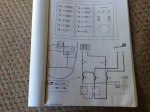
BEP VSR wiring

Have just checked my boat wiring diag which will be the same as the 361. The mains charger goes to both the battery sides of the the isolator, so when the mains is connected both banks charge even if they are switched off. The alternator goes to one of the banks on the OTHER side of the isolators ie the switched side. The link I refer to is on that side, SO both isolators have to be switched on to charge both banks from the alternator. If he, as I suspect, is keeping one of the isolators open then that bank will not be charging from the alternator giving the different voltages reported. That also means that if he has the VSR on the "wrong side" then depending on the isolator positions then he will be getting strange results.
Stu

I think I follow.. Yes you need both isolators to be closed to charge via the strap

If he has fitted the VSR to the switched side of the battery isolators then the house bank will not charge via the VSR when its isolator is open ...... Its not a problem though. Just close it!


The reason I suggest connecting the VSR to the battery side of the isolators is so that both battery banks charge even when the isolators are open.
 
Last edited:
I think I follow.. Yes you need both isolators to be closed to charge via the strap

If he has fitted the VSR to the switched side of the battery isolators then the house bank will not charge via the VSR when its isolator is open ...... Its not a problem though. Just close it!


The reason I suggest connecting the VSR to the battery side of the isolators is so that both battery banks charge even when the isolators are open.
Back of the net!
Stu
Just got in, been out with the inlaws!
 
To make clear my setup, I am sorry for this long post.

As Stu said, the standard Bene setup is two batteries, each around 100ah, one connected to the house, via it's isolator and the other the motor via its isolator. There is a third common negative isolator. The boat sides of the two positive isolators are connected by a heavyweight strap giving the equivalent of a 1,2,both switch.

I have made the following alterations :

1. I fitted a cheapo digital voltmeter via a small two way switch to monitor both batteries

2. I am on a swinging mooring, and after a day sail, the house battery would be well down. So to ensure the house battery was fully charged next time I came to the boat, I fitted a 40W solar panel to charge the house battery only.

3. On longer voyages, the house battery alone was not adequate without engine runs to recharge. So i paralleled up both large batteries to use for house and installed a 40ah battery for engine start only.

4. To avoid having to remember to fiddle with the isolators when engine recharging, I fitted a new BEP (yacht quality) 140 amp dual sensing VSR. I am in Sweden so can't scan and load the fitting instructions. However they shows one red (which came ready attached) to the battery side of the house isolator and the other red to boat or battery side of the motor isolator according to whether it is a single or dual sensing model (I have tried both! ). The strap which previously joined both positives was replaced with one with an "emergency " isolator, normally left open.

My problem is that I don't seem to be able to sail as long as i used to without running the motor to recharge and when I do, the rate of recharge seems lower than before.

I don't think the motor is charging the house battery as well as it should via the VSR and l have to rely on the emergency switch which rather negates the purpose of having the VSR . This is reinforced by the fact that, when the motor is started, the voltage on the motor battery immediately rises to about 14, while the house battery only rises to about 12.7. Closing the emergency switch immediately raises the voltage on the house battery to 14 also.

I have checked that the VSR is opening and closing as it should and it sèems OK although the voltages referred to above seem to suggest otherwise.

Maybe I am expecting too much of the VSR but I don't remember these problems on my last extended cruise two or three years ago. Incidentally, earlier in the year I replaced both house batteries in case they were the cause of the problem. The motor battery does not give cause for concern.

Possibly I should get a proper battery management meter, which would read the amps in and out rather than just relying on a voltmeter. Nevertheless your comments would be welcome.
 
To make clear my setup, I am sorry for this long post.
.
.
.
....................your comments would be welcome.

First thoughts are that either the VSR is faulty or there is some resistance , due to bad connections, in the circuit.

Check for volts drop with a voltmeter on the various parts of the circuit. including across the VSR itself.
 
First thoughts are that either the VSR is faulty or there is some resistance , due to bad connections, in the circuit.

Check for volts drop with a voltmeter on the various parts of the circuit. including across the VSR itself.

Looking more and more like the VSR or connections as you say.
Stu
 
I fitted a new BEP (yacht quality) 140 amp dual sensing VSR. I am in Sweden so can't scan and load the fitting instructions. However they shows one red (which came ready attached) to the battery side of the house isolator and the other red to boat or battery side of the motor isolator according to whether it is a single or dual sensing model (I have tried both! ).

Is this red cable, which came attached, the 4 sq mm you mentioned earlier? If so, it's not big enough. I didn't think BEP supplied cables with their relays. The BEP digital 710-140 does have a thin red wire already attached to it, but that's for an optional ignition control or storage mode.
 
Is this red cable, which came attached, the 4 sq mm you mentioned earlier? If so, it's not big enough. I didn't think BEP supplied cables with their relays. The BEP digital 710-140 does have a thin red wire already attached to it, but that's for an optional ignition control or storage mode.

Id have thought the "thin red wire"would be smaller than 4mm², it only supplies power to the electronics in the VSR

The main connections to the start battery and house battery positive studs should be heavier than 4mm² as you suggest

Stange if it has been supplied with cables attached ..........I am wondering if this was bought a new item or as a used item from ebay ??

Add incorrectly wired to my list of first thoughts !

Link to the instructions .... http://www.bepmarine.com/~/media/inRiver/329437-25323.pdf
 
Last edited:
4. To avoid having to remember to fiddle with the isolators when engine recharging, I fitted a new BEP (yacht quality) 140 amp dual sensing VSR. I am in Sweden so can't scan and load the fitting instructions. However they shows one red (which came ready attached) to the battery side of the house isolator and the other red to boat or battery side of the motor isolator according to whether it is a single or dual sensing model (I have tried both! ). The strap which previously joined both positives was replaced with one with an "emergency " isolator, normally left open.

This would be the basic setup i would have used. My preference would be dual sensing, but do as you see fit there.

If i understand you correctly from above, you fitted a positive (red) cable from the VSR to the engine battery and used the already attached red wire to connect to the house bank ?

If that is the case, you have wired it incorrectly. The small red wire that came attached does not need to be connected in your installation. You needed to fit a pair of cables, one to each battery bank.

These should be the fitting instructions http://www.bepmarine.com/en/710-140a

These include a table of wiring requirements. Fit the VSR as close to the batteries as possible and use the biggest cables for the installation, if you can go up a size from the chart, do so.
 
This would be the basic setup i would have used. My preference would be dual sensing, but do as you see fit there.

If i understand you correctly from above, you fitted a positive (red) cable from the VSR to the engine battery and used the already attached red wire to connect to the house bank ?

If that is the case, you have wired it incorrectly. The small red wire that came attached does not need to be connected in your installation. You needed to fit a pair of cables, one to each battery bank.

These should be the fitting instructions http://www.bepmarine.com/en/710-140a

These include a table of wiring requirements. Fit the VSR as close to the batteries as possible and use the biggest cables for the installation, if you can go up a size from the chart, do so.

As I understand it it must either be left as the uncut loop as originally supplied or connected to another power source because it is the power supply to the electronics. If it is left unconnected the VSR will not operate!
 
As I understand it it must either be left as the uncut loop as originally supplied or connected to another power source because it is the power supply to the electronics. If it is left unconnected the VSR will not operate!

That's what i meant, un-used, left as was etc. But if he has cut it close to the VSR (as the instructions state) he won't be able to join the ends back together, in which case i'd connect it to the engine battery stud (it was most likely connected internally to that anyway).
 
Stange if it has been supplied with cables attached ..........I am wondering if this was bought a new item or as a used item from ebay ??

I asked that question earlier, and the OP said it was a new VSR. We don't know which model it is though; I suggested the digital one as that has a thin red wire attached to it. Frankly, until the OP can be bothered to say which VSR he has, I think we're all wasting our time.
 
I asked that question earlier, and the OP said it was a new VSR. We don't know which model it is though; I suggested the digital one as that has a thin red wire attached to it. Frankly, until the OP can be bothered to say which VSR he has, I think we're all wasting our time.

I thought I had!

As I have little else to do awaiting a new crew, I took it off and had a look

It is definitely a BEP 710 - 140 amp - it says so on the back. It must be an earlier model than this as it doesnt have Digital written on the front - no surprise as I fitted it 4 or 5 years ago
http://www.bepmarine.com/en/search?keyword=VSR

I cant now remember where I bought described as new (I am sure it was) it but it came mail order, possibly through a marine ebay shop.

It definitely came with three wires attached - remember a pre digital model. The 4 sq mm for the two red wires was just my guess (probably wrong) for a cable I have now measured to be about 5mm diameter including insulation (say 1mm insulation 3mm copper- actually nearer 6 sq mm). The black of course is thinner. It is fitted precisely in accordance with the instructions which came with it which have copyright BEP Marine 2007 written on them.

I hadnt looked before but I now see one can take the back off to get at the terminals.
Probably the next step is to have two heavier cables made up and fitted with care to ensure good connections .

What sq mm would you recommend?

AFAIK it is a 60 amp alternator feeding a 180 amp battery bank. Each lead is about 500mm long
 
Last edited:
Probably the next step is to have two heavier cables made up and fitted with care to ensure good connections .

What sq mm would you recommend. AFAIK it is a 60 amp alternator feeding a 180 amp battery bank.
Each lead is about 500mm long

I'd fit chunky cables to minimise voltage drop. At least 25 sq mm.
 
Here is the std Bene wiring layout.

View attachment 65882

I know as I have in my manual.

For reasons I have tried to explain, I made the alterations referred to earlier.

If i close the "emergency " switch the system effectively reverts to the original. But that requires someone to remember to open it or the engine isolator after the engine has been run for a recharge to avoid the house load draining the motor battery .
A scratch crew wont always do this in the middle of the night!
 
I'd fit chunky cables to minimise voltage drop. At least 25 sq mm.

25mm² is heavy enough to keep the volts drop at the full 60 amps down to 0.02 volts. Does it really need to be that heavy ?
 
25mm² is heavy enough to keep the volts drop at the full 60 amps down to 0.02 volts. Does it really need to be that heavy ?

I think your maths has gone a bit astray, I'd have thought 0.05v was nearer. However, it's academic. The OP only has to buy a metre of cable, why wouldn't he be best advised to fit a reasonably chunky cable? A metre of it isn't going to break the bank.
 
I know as I have in my manual.

For reasons I have tried to explain, I made the alterations referred to earlier.

If i close the "emergency " switch the system effectively reverts to the original. But that requires someone to remember to open it or the engine isolator after the engine has been run for a recharge to avoid the house load draining the motor battery .
A scratch crew wont always do this in the middle of the night!
So you are using an emergency switch to disconnect the "both" strap, so allowing the engine start bank to be continuously switched on without it draining to the house side? And then the vsr to direct the charge both separately but at the same time according to need? So if you put the alternator charge to the vsr, then two feeds from the vsr to the load side of the isolators, with the strap cut by your switch, the vsr should sense which bank needs the charge and routes it accordingly. If you need to have both banks on together then close the strap switch? If I have finally got my head around it, you have proved that the vsr isnt sensing and routing the charge correctly, you however have proved you can do it manually by closing the strap switch? Uf so, go back a few posts and your vsr aint working properly?
Stu
 
Top