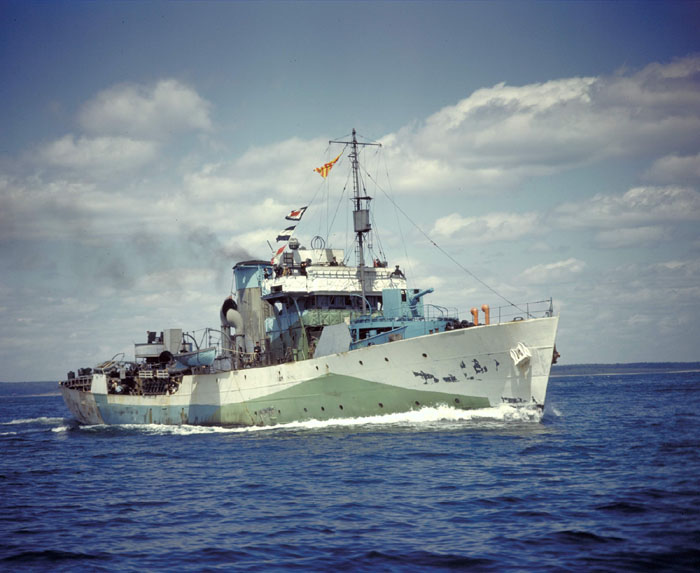
The UK coastguard tugs are chartered from Klyne Tugs who are based in Lowestoft, I believe. Nothing to do with the US. They were brand new when they started their charters and replaced some existing vesels which the MCA originally took on hire from Klyne. They are primarily anchor-handling tugs so they can return to anchor-handling/ rig-towing duties if the MCA charter goes tits-up. The French vessel looks very pretty, but you can see from the pics that she does not have the open stern/ roller arrangement of an anchor-handler. This removes her ability to quickly deploy grapples/ chasing hooks to pick up the anchor cable of a dragging vessel. The old deepsea tugs had closed sterns but the open roller arrangement is a lot more versatile. Also note the French vessel's foremast nav lights are right in front of the wheelhouse, a clear case of form over function.
[ QUOTE ]
Also note the French vessel's foremast nav lights are right in front of the wheelhouse, a clear case of form over function.
[/ QUOTE ]
No need to be humble. I believe the mast-in-front-of-the-bridge is a British design of old, the French are only copying it! /forums/images/graemlins/cool.gif
You miss my point. 'Tis not the position of the mast which is the problem but the position of the nav lights. In your pic the lights are at the top of the mast, way above the line of sight. On the French tug the navlights are on a direct line between the wheelhouse and the horizon. The French have apparently said 'Mon dieu, if we put the lights higher we will need a big heavy mast and that will spoil the looks of our pretty vaisseau. Ce n'est pas acceptable!'
What ever type it is, it is in US colours and Coast Gaurd writen on, we gained it a few year back following the tankers running agroung, Exon etc.
It is stationed at Falmouth to pull tankers, or similar, into deep water if they are liable to run aground, avoiding coastal oil polution. If it only moves anchors, you have given me a lot of faith in the system, never had a lot in MCA.
Wonder if we could borrow it for laying marks Falmouth week?
You would be surprised at how much light scatter there is because there is no screening of mast lights. A little moisture in the atmosphere also makes the problem worse. In mist or fog it would be a real problem.
I'm starting to wonder whether the diagonal stripes on coastguard vessels are an international form of recognition. Because it appears that America, Britain and France decorate their ships with diagonal blue, white and red stripes of varying widths. If that is the case then it could well explain why the MCA ships are painted the same as the USCG's.
I'm going to have a bit of a google on this one...
Re the issue of owning as opposed to chartering tugs - many shipping lines charter their vessels from the Owners, in the same manner basically as the MCA chartering their tugs from the tug Owners - it might even work out cheaper in the long run for them to do this.
Re the steaming light(s) on the foremast of the French tug - yes, they are looking forward, but the crew on the bridge are still going to see a glow from this light, which is not going to help their night vision.
As Tugboat has noted, the steaming light should preferably be above the line of sight from the bridge to the horizon - but this will require a taller, larger mast, and also require the aft mast to be taller as well, in order to maintain the correct aspect of the steaming (or anchor) lights for vessels over 50m.
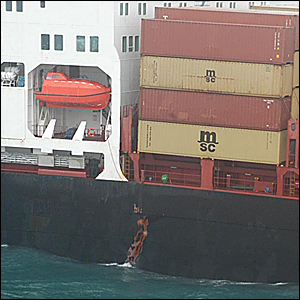
http://news.bbc.co.uk/1/shared/spl/hi/pop_ups/07/uk_stricken_ship/html/5.stm
To my surprise the crack does not run from deck level downwards, but from below the waterline. The fact that the ship is visibly bent downwards at the stern appears to indicate that the ship is not far from breaking completely in two, with the crack (or serious distortion) extending all the way across the bottom of the hull.
Thats tha same failure that the bulk carriers suffered isn't it, may be why the captain took to the boats, he watched the TV prog as well. They sank without warning, no time for a Mayday even.
Teletext say she's aground 1 mile offshore, not where they planned.
I sure would not like to be at sea in a vessel that big, held together by its deck plating and a few feet of side plating each side! However as the crew have abandoned ship I expect the salvors are on Lloyds Open Form terms.
I've just been a-Googling on the Abeille Bourbon and while the figures appear impressive, to me the pictures tell another story. I spent 10 years as Master of anchorhandling tugs so I'll make some observations and would be interested in comments/arguments from anyone else.
The Ulstein 515 is described as 'coastal protection, deepsea towage and salvage'. As far as I can see the vessel's function is really just to tow a manned object. A proper salvage tug has the ability to board unmanned/unpowered vessels and take them in tow by using her own equipment and resources. For this she needs long boarding ladders, salvage pumps, salvage compressors, generators, a multitude of hoses, portable cutting equipment, all sorts of gear,etc,etc. The Abeille Bourbon does not appear to have this equipment or anywhere to carry it. She has a deckhouse on the weather deck, but no doors/hatches large enough to allow passage of large salvage gear.
Her towing guide pins and sharks jaws are located up on the aft bulwark, ie some feet above the deck level. That means heavy wires and shackles have to be lifted up to that level in order to connect up. Not something you want to be doing more than once! A feature that makes her more suitable for 'connect, tow a long way, disconnect at destination'.
The spec says she can load containers of equipment on deck but the deck area is fouled with various stuff that gets in the way.
Looking at the curve of the stern.......... when she is towing long distance or in bad weather with maybe 3000ft of wire out, the catenary means the wire will be nipped over her stern bulwark and be very prone to abrasion. Also the shape of the stern means that the wire is going to have a tendency to slide sideways round to the side of the vessel unless the tension and heading are kept very constant. An open-sterned anchor-handler is much better for this. The stern is lower to remove the nip, and the wire naturally sits in a shallow V to help control it's lead. Also towing pins and shark jaws/Karm forks (used to trap and hold while connects/disconnects are done) rise out of the deck itself so no unnecssary lifting. The shackles and other gear used in these operations are really big and heavy and just dragging them round the deck is hard work. If poss you use tugger winches to pull things around but the French tug has a damn great storage housing clagging up the middle of the maindeck.
OK that's my initial thoughts, no doubt I'll think of more. I'm off to do something else now, I'll be interested in other peoples' responses when I come back.
Thanks for the interesting and informative observations, from a professional seafarer.
(PS - yes, but these two UT515 design sister ships still look quite impressive vessels!)
Best wishes.