Battens - what do they do?

Babylon

Well-Known Member
Joined
7 Jan 2008
Messages
4,397
Location
Solent
Visit site
Some sails have the usual battens, some three-quarter length and some full-length.

What do longer (full and 3/4 length) battens do? Power? Pointing ability?

And boats with in-mast furling have no battens at all - what do they lose?
 
They improve sail shape, and support the loach of the trailing edge, where it curves outside the straight line drawn between head and tack corners. A fully battened main allows full control of the sail shape. In mast reefing means a flat loach and less efficient sail, so is a trade off for convenient sail storage and handling.

Racing boats don't use furling sails at all, and will have carefully designed battens and profiles to optimise performance, especially to windward, where the ability to point higher and faster is King.
 
Some sails have the usual battens, some three-quarter length and some full-length.

What do longer (full and 3/4 length) battens do? Power? Pointing ability?

And boats with in-mast furling have no battens at all - what do they lose?

Short battens prevent leech-flutter on sails. They can be used in both foresails and mains.

Longer battens allow the sail to have a more "aggressive" roach thus increasing sail area aloft.
3/4 length battens are an attempt (frequently fruitless) to get the benefits of a full length batten without the friction problems of batten cars on the mast.

In mast roller-reefing mainsails need to be cut with a hollow (concave) leech, though attempts to support a roach are sometimes attempted with vertical battens. They therefore offer less drive and do not allow flattening the mainsail by mast bend.

Windward ability is a product of hull and sails - the only common factor is that a boat will point less high with an overlapping genoa than with a "skinny" jib.
Possibly, a fully battened main, will give better pointing than a part-battened main with woven sails, on the same boat.

When we come to modern composite sails, the situation is totally different.
 
Last edited:
And boats with in-mast furling have no battens at all - what do they lose?

Not true, this boat has furling main and furling head sail - both with battens
bavaria32.jpg


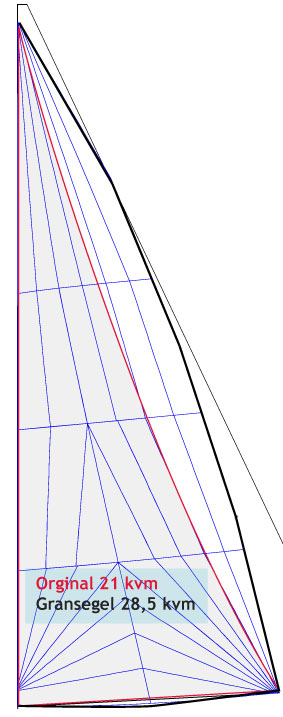
Here is an example of a Bavaria furling main standard vs with battens
storliten.jpg


A furling main w/o batten will have less SA compared to "normal" or furling main with battens.
 
Not true, this boat has furling main and furling head sail - both with battens
bavaria32.jpg


Here is an example of a Bavaria furling main standard vs with battens
storliten.jpg


A furling main w/o batten will have less SA compared to "normal" or furling main with battens.

I would draw your attention to my 3rd paragraph where I cover the point you are making. You are also comparing radial cut sails which, for mains, are unusual in cruising sails, being very much a racing man's prerogative.
If we go on to "advanced" sail construction we enter a totally different and (in sail output terms a minute proportion) where there would be so many caveats as to totally confuse the OP who was asking some reasonable and very basic questions.
I fear you are liable to confuse and could, perhaps, read things more carefully.
 
I would draw your attention to my 3rd paragraph where I cover the point you are making. You are also comparing radial cut sails which, for mains, are unusual in cruising sails, being very much a racing man's prerogative.
If we go on to "advanced" sail construction we enter a totally different and (in sail output terms a minute proportion) where there would be so many caveats as to totally confuse the OP who was asking some reasonable and very basic questions.
I fear you are liable to confuse and could, perhaps, read things more carefully.

Sorry to offend you, but i replied to the OP, not your post.

I'm a cruiser and my sails are radial cut made of cruising laminate (not furling main) - didn't see any references to traditional sail (cross cut & Dacron).

Never understood the concept "cruiser can use baggy pants for sail" :)
 
I am considering having my next mainsail cut with no roach (and hence no battens needed) in the hope of being able to hoist the sail with the wind aft, which would be a useful in some situations, eg reefing when running downwind. There would be some loss of performance but, as the main driving force on my masthead sloop is the genoa, I can't see it being very much.
 
I am considering having my next mainsail cut with no roach (and hence no battens needed) in the hope of being able to hoist the sail with the wind aft, which would be a useful in some situations, eg reefing when running downwind. There would be some loss of performance but, as the main driving force on my masthead sloop is the genoa, I can't see it being very much.

I don't think that will make much difference. The pressure in the sail exerts a lot force on the sail slugs - you may be OK with proper sail cars. Anyway to reef you lower the sail not raise and this is still very difficult with wind in the sail.
 
Think carefully before you do that. I went the other way from a roachless mainsail to a battened one and the improvement, even allowing for new sail rather than old was remarkable. Don't see how not having battens will significantly help being able to reef downwind. You will lose substantial sail area as well.
 
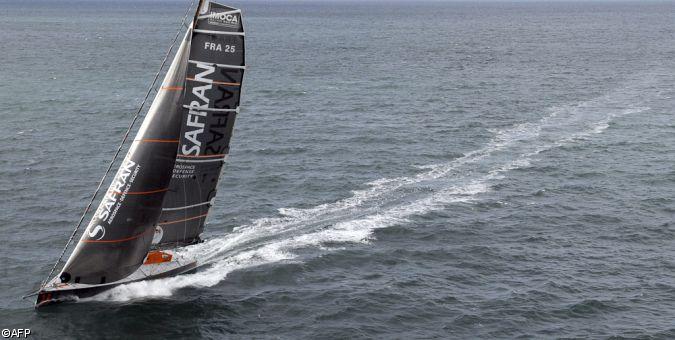
Stabilise sail shape and support the roach.

safranmarcguillemot3675.jpg


Full length battens provide a lot of support - such sails don't flap, but are also much more binary - all on or all off.
 
Battens are for junk rigs really. A clever one part sheet to all their ends and you have a succession of booms rising to the sky. Hoist and lower regardless of attitude to the wind. Such a quiet sail - never any flapping. Climb up the windward battens to look for coral heads and Lepe Spit. No stress in the sail - it cannot blow out or rip past a batten and so on.....

So beautiful to behold and fast and maneuverable. Long live the fully battened sail.
 
I am considering having my next mainsail cut with no roach (and hence no battens needed) in the hope of being able to hoist the sail with the wind aft, which would be a useful in some situations, eg reefing when running downwind. There would be some loss of performance but, as the main driving force on my masthead sloop is the genoa, I can't see it being very much.

I have a masthead rigged boat with inline spreaders and a main with 4 full battens. (according to some it can't sail because i have a self tacking jib :)
Cant hoist the main going downwind..
But I can put in a reef in deep angles with this procedure.
-sheet in so sail is free of spreaders with some room between
-Put the boat on a course where the head sail is pulling and the main starts to flutter (adjusting the head sail sheet)
-ease kick
-Ease the main halyard to preset mark
-pull the tack reef down (two line set up)
-pull in the clew reef
-adjust & go

The lazy jacks and the full battens prevent the sail from going forward and tangle with the spreaders during this procedure. Are you sure a negative roach sail will be better?
 
Penalise the battens or the increased SA?

Penalises the shape. After all if you look at the theory of sail design a large roach is a good way of dealing with tip losses (think Spitfire wing as something like the ideal aerodynamic shape)

Of course IRC is a secret formula, but enough people have worked out to a reasonable extent what increases or lowers the handicap. Normal roach is fine, but a large roach seems to incur a very large penalty.
 
Penalises the shape. After all if you look at the theory of sail design a large roach is a good way of dealing with tip losses (think Spitfire wing as something like the ideal aerodynamic shape)

Of course IRC is a secret formula, but enough people have worked out to a reasonable extent what increases or lowers the handicap. Normal roach is fine, but a large roach seems to incur a very large penalty.
More penalty than if you gained the same SA with a longer boom and normal/no roach?
 
Are you sure a negative roach sail will be better?

No - I'm not sure at all. Which is why I welcome the opinions of others, especially of anyone who has a battenless Bermudan mainsail.

I know that the famous cruising yachtsman Eric Hiscock preferred not to have battens and the author of 'The Sailmaker's Apprentice', Emiliano Marino, doesn't like them. Apart from those two I can't find any other references to battenless Bermudan mainsails.

I did a trans-Atlantic trip on a masthead sloop with in-mast furling and that had no battens. She sailed ok and was easy to reef downwind (apart from excessive friction in the blocks leading the reefing line to the cockpit) but the reefing system was so different from the slab-reefing on my boat that they can't be compared.

The problem is that a new mainsail (which I could do with) is going to cost a lot of money so I don't want to take a chance on getting it wrong.
 
Last edited by a moderator:
More penalty than if you gained the same SA with a longer boom and normal/no roach?

Yes. Or indeed if you gained the same SA with a longer luff (P) and the same boom length (E).

For the same sail area with a larger roach you've got a greater effective SA.

The reason is you get tip vortices from the top of the sail. One way of thinking about that is that it negates a large part of the area of the head of the sail. There's a good diagram in one of CA Marchaj's books that explains it very well - probably dodgy to photocopy it and attach it but Fig 75 on P93 of "Sail Performance" if you can get a copy from the library. All books on aerohydrodynamics of yachts should describe it in a good level of detail though. I've flicked through Fabio Fossati's book but could find such a suitable diagram.
 
Top