Backing plate material

I favour a GRP pad. Next time the boatyard breaks up an old boat, find yourself a piece of hull that is mostly flat. Cut your backing pad from this. You might need to shape it to fit with an angle grinder, but it will make a strong, hard backing pad that is impervious to wet and also a lot lighter than a metal one.
 
...a nylon-type material which is 'plastic'.... in that it deforms and flows under compressive load.
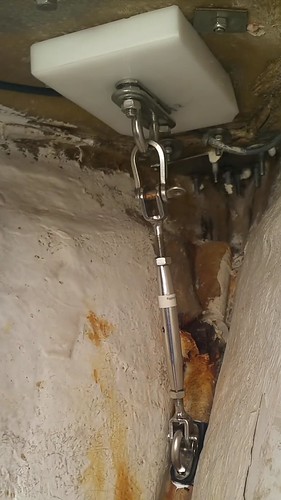
The way I set it up, the new metalwork took all the strain. The acetal pad was a backup if the metalwork failed, as the original certainly had.

53977442159_47289c1e30.jpg


I admit I'd be interested to know if, under years of sustained pressure, the acetal would exhibit plasticity. My impression had been that it would not, but looking at that picture four years on, I might today have spread the load on the acetal with an area of stainless plate. EDIT: Or used stainless plate instead of acetal. 😄
 
Last edited:
My Sadler 34 has no backing plates for the genoa winches . . . The layup is quite thick here and loading is in shear, needing no reinforcement.

As I'm sure you know, the loading on a winch is not wholly in shear. The load from the sheet or halyard is above the base, so there'll be a compressive load on the side of the winch base and mounting on the side with the loaded line, while the opposite side will be in tension - i.e. being pulled upwards.
 
As I'm sure you know, the loading on a winch is not wholly in shear. The load from the sheet or halyard is above the base, so there'll be a compressive load on the side of the winch base and mounting on the side with the loaded line, while the opposite side will be in tension - i.e. being pulled upwards.
True enough but the lever arm length is about 60 mm. The tensile and compressive forces are minuscule compared with the shear. My point is that on a boat that is possibly 50 years old it is most unlikely that the winches suddenly need backing pads.
 
I used the Green MDF which is suppose to be damp proof however I sealed them with epoxy after drilling the holes oversize. The forestay deck fitting and associated Glass fibre was giving way and this 12mm MDF (Green) was easy to work with and still sound after 2 years. I also used it to reinforce for a windlass.
 
One of the good things of using steel (stainless of mild) is that you can tap holes to the mounting bolts from the top which allows easy re sealing the deck fitting when they leak, and they will without disrupting or remove the inside fittings or panels
 
It is only a 22fter. I think under winches just large ss penny washers would be fine. However if he wants more then ss plate is good. Or even lay up carbon fibre and epoxy under the winches etc. 2 or 3 layers will spread the load. or make up flat sheet of carbon fibre. In the end it all depends on what you have to hand and what you fancy using. On my 21fter I don't think there is any significant backing for any fittings. (no problem after 45 years) ol'will
 
I used a scrap of GRP from where I'd added a hatch to an old dinghy, and laminated it in place with some resin and mat.
Probably not really needed, but it was a bow cleat that might be used for towing or anchoring and the deck was fairly lightly built.
 
Looking at Sailboatdata for a Fox Terrier 22 unless the OP is planning a TransAtlantic in it any time soon, @RogerFoxTerrier let us know if you are, there is a serious amount of over engineering going on.

LOL - well I did Canaries to Antigua in 1999 but in a Beneteau 40, and not planning it again in a 22 footer!

I quite like over-engineering as long as it doesn't make too many compromises. I just think that as all the deck hardware is off, I may as well make it as strong as possible (sensible).

Some great advice here so thanks all.

I think I'll go down the glassed over ply. I'm about to learn the skills of fibreglassing and have a kit that's just arrived.
 
No experience in boats but when I used to have fibreglass cars I always used aluminium backing plates ( I was lucky in having access to laser cutting at that time) and put a layer or two of mat and resin underneath it, torquing everything up before it is set. This was to allow for the often rough interior finish on the fibreglass
 
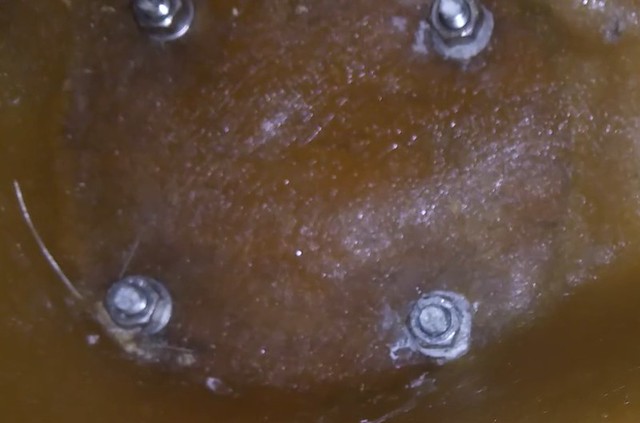
I knew somewhere I had video or a photo of the apparently sub-spec backing for the primary winches on my Achilles 24.

It's a still, taken from an out-of-sight arm's-length video reaching up into the dark void above the quarter berth, hence the poor quality.

54013112414_bbb7327d0f_z.jpg


I had bigger problems to solve at the time and I sold the boat with that unchanged, but I reckon anything, ply, stainless or chopping board would have been an improvement. Having said that, I suppose those tiny washers had spread the load for the previous 40 years, and are likely still proving their worth.
.
 
I have used Tufnol or Paxolin (phenolic with paper or cloth) for backing pads. It is available in various thicknesses and small offcuts from the usual sources. I don't know the differences between the different types such as kite, whale and carp but they are all very easy to cut. At work we used to use Peek which was very expensive but the other varieties are quite cheap.
 
I’ve always used stainless steel.....sometimes all that’s needed is over large stainless washers...other times it can be a customized plate shaped to fit
 
I have used Tufnol or Paxolin (phenolic with paper or cloth) for backing pads. It is available in various thicknesses and small offcuts from the usual sources. I don't know the differences between the different types such as kite, whale and carp but they are all very easy to cut. At work we used to use Peek which was very expensive but the other varieties are quite cheap.
I used Tufnol to back the supports for Yacht Legs. Excellent stuff.
 
G10 FR4 is perfect as its super strong and last forever - its is expensive but you can buy small sheets quite cheaply on eBay which should be perfect for most backing plates . Then you just drill the holes you need through it, put it in place and forget it forever
I hadn't heard the designation 'G10 FR4' before, but I believe I have several 1m. x 1m. x 13mm sheets of the stuff 'rescued' from a defunct company. Please see #15 for an offcut example.

'Close enuff for government work....'

;)
 
Last edited:
G10, make the thickness about the same as the fastener diameter.
It lasts forever and does a better job of spreading the load then plywood, and doesn't corrode / oxidise like steel or aluminium.

I like to epoxy bond it in place and then drill / tap it. Tapping it isn't necessary, but it makes single headedly fitting the deck hardware a doddle. (You still need a nut and penny washer on the back, it just means you don't need someone on deck to hold the screwdriver)
Use a carbide jigsaw blade to cut it, it will blunt a normal steel blade within seconds.

The only real downside is that its quite expensive stuff.
 
Top