
Autopilot trying to kill me?

Joined
27 Oct 2024
Messages
35
Visit site
I was sailing downwind first the wind was 8-10 knots and later on the forecast was 15 knots but the wind built up to 28-32 knots. Apparent wind was probably 22-26 I was sailing downwind (30-40 degrees from run) not particularly fast (6 knots) with dirty boat bottom then the autopilot went on a 90 degrees course change to close haul and heading straight towards land(under 1.5 kNm away). The toe rail was under water and the rudder didn't respond, so I had to turn all around which put a lot of extra stress on the sails.


Then it happens again a few minutes later

My autopilot is a Raymarine type 1 on a 37 foot sailboat at around 8 tonn.

The autopilot is on leisure setting.

It happened a few days day before as well in strong wind.

I furled in the Genoa and it behaved better.

I haven't moved anything close to the sensor thing.

What can I do in the future to avoid the autopilot losing control of the boat? I could have reefed but the speed was not even 7 knots and I was in a hurry to arrive before dark.
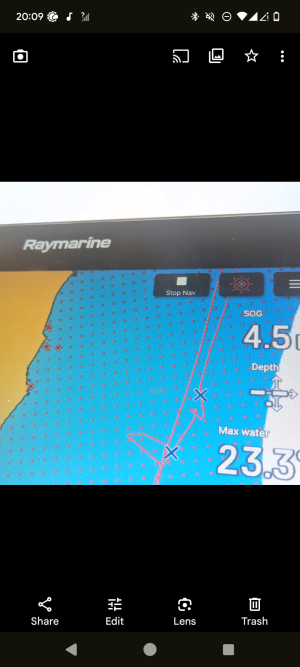
 

Attachments

  • Screenshot_20250326-200955.png
    Screenshot_20250326-200955.png
    1.8 MB · Views: 36
Anything from intermittent failure of DC power supply, to a metal/magnetic item rolling across the hull near the autopilot compass.

Do you have a feeling the autpilot is 'weak' and over powered by the sails ? When you start it, is the boat sail plan balanced or do you already have a lot of rudder in action ?
 
Something causing an electrical/magnetic imbalance. On my old boat if one pressed transmit on the SSB the autopilot would go berserk.
 
Has the pilot being overpowered by the sails or has it intentionally pushed the rudder over? I had the latter happen a few times at the most unconvenient moments, eventually I checked the pilot configuration and found the Joystick option was turned on (of course I had none), joystick option removed it never happened again. Maybe check yours?
 
I am on my 4th Simrad Tiller pilot 10.

On every unit quite often the unit would spit it's dummy, head a very different direction.

I just live with it, as my auto helm is only used when the conditions suit,and i am all ways tracking what the

autopilot is up to.

It is my handiest peice of kit aboard.
 
... My autopilot is a Raymarine type 1 on a 37 foot sailboat at around 8 tonn.

I had this on my old NECO motor, which was modified for my Raymarine ACU400, when it repeated the issue. I found the problem to be dirty commutator rings on the motor. The rings were covered in carbon dirt and smeared all over and sometimes the motor worked, at other times it just stopped. At least check the commutator to eliminate this.

Personally I think you were over canvassed and the boat broached, read the manual and set the auto helm to race mode and reef earlier.
 
There are two things auto/ tiller pilots do not like :

Running with wind ....... over-canvassed.

Both cause the boat to not move uniformly in a way that pilot can play with ... it can build up and off she'll go ....

Of course there are other items that can cause it .... electronic intermittent fault ... a seemingly innocent item placed near the 'pilot' causing the compass to swing off ....

I had a 1000 that one of the 'pots' was faulty and it was unreliable in keeping course for more than a few minutes .. pal of mine replaced the component from a Spares / Repair 1000 I had ...
mate of mine had a mug he liked to carry with him from boat to boat ... one day he placed his mug with tea in on cabin top above the bulkhead compass .... then I knew why my AP used to have fits when he sat next to it ... the metal mug !
 
Where was your mobile phone when this happened? I had the same thing happen twice in the same day on my Princess. A guest had left his mobile on top of the cupboard/locker where the Raymarine gyro was located. Moved the phone and no more problems the rest of the trip. Un nerving when it happened, 90 deg turn straight for land/ rocks at 35knts.
 
I had a similar problem. Sitting in the cockpit, I set the tiller pilot. All's well. I go below to put the kettle on, and the boat alters course 30 degrees. WTF? Back out to get back on course and we go back on course. WTF2? Return below for WTF3.

It turned out that my faithful German Army penknife (Victorinox, but green sides), that I'd carried everywhere for donkey's years, had become quite a strong magnet.
 
Would you have had to fight the wheel/tiller in those circumstances anyway. A human can anticipate that gust or wave knocking the stern sideways and apply force before it’s needed but an autohelm can’t.

We have long gone for the minimal or no main and jib only (sometimes over sheeted to reduce rolling) when going downwind to make the autohelm (or person on the helm) work better.
 
I was sailing downwind first the wind was 8-10 knots and later on the forecast was 15 knots but the wind built up to 28-32 knots. Apparent wind was probably 22-26 I was sailing downwind (30-40 degrees from run) not particularly fast (6 knots) with dirty boat bottom then the autopilot went on a 90 degrees course change to close haul and heading straight towards land(under 1.5 kNm away). The toe rail was under water and the rudder didn't respond, so I had to turn all around which put a lot of extra stress on the sails.


Then it happens again a few minutes later

My autopilot is a Raymarine type 1 on a 37 foot sailboat at around 8 tonn.

The autopilot is on leisure setting.

It happened a few days day before as well in strong wind.

I furled in the Genoa and it behaved better.

I haven't moved anything close to the sensor thing.

What can I do in the future to avoid the autopilot losing control of the boat? I could have reefed but the speed was not even 7 knots and I was in a hurry to arrive before dark.
"Raymarine type 1" doesn't tell anyone anything about the autopilot, other than the drive type. It could be more useful to know the model of the ECU/ACU (the computer).
 
My first thought is that if the rudder wasn't responding to you after it happened, how would the autopilot be able to do any better? That fits with the boat being overcanvassed, the autopilot not being able to react quickly enough, and then it not being able to get back on course (I doubt it's programmed to turn 270 degrees if it can't do 90).

Anything in common with what you were doing at the precise moment it happened on the other two occasions?
 
I was sailing downwind first the wind was 8-10 knots and later on the forecast was 15 knots but the wind built up to 28-32 knots.

My autopilot is a Raymarine type 1 on a 37 foot sailboat at around 8 tonn.

The autopilot is on leisure setting.

It happened a few days day before as well in strong wind.

I furled in the Genoa and it behaved better.

I haven't moved anything close to the sensor thing.

What can I do in the future to avoid the autopilot losing control of the boat? I could have reefed but the speed was not even 7 knots and I was in a hurry to arrive before dark.
I have no idea what 'leisure setting' means, but most people do not go out in 28-32 knots (F7) for leisure! Is there a 'its blowing a hooly' setting?

As many people have posted - including yourself - you had way too much sail up for the autopilot. What was the sea state?

I might be old fashioned, but reef on wind speed not boat speed. I have found that reefing makes the ride more comfortable and has little impact on boat speed.
 
Autopilot instructions used to tell you to reduce sail and although they have come on a lot since then, there must be a limit to what they can do, bearing mind that we have the ability to anticipate factors such as a wave approaching. Considering that they can only react, it is remarkable that they can perform as they do, but in anything of a blow they will always be at risk out being out-gunned under full sail.

Actually, F7 can be quite enjoyable off-wind, and was the wind during some of my favourite sails. The wind force on the boat will only be in the low 20s and my 34 is easily controllable with the odd reef.
 
If its a linear drive then it may offer less push or pull once the rudder quadrant is at a significant angle due to the drive angle moving from 90 degrees to the quadrant to nearer 45 degrees and shortening the leverage length. Once rounded up the drive may not have the force to restore the course with the rudder at an angle (and might lead to an uncontrolled gybe if it did succeed).

I depend on my autopilot (singlehanded) but I treat it carefully and assume it has the steering ability of a beginner. In the conditions you describe I would be reefed (a lot!). Then my autopilot functions well even in the winds you describe and offshore quartering seas. Autohelm 6000 and Whitlock Mamba rotary drive.
 
I had something similar with my S3G. After 15 years, the connections from the compass unit became unreliable (the boat turned sharp-left towards the entrance of Newtown as we headed down the Solent one evening. Much consternation until I got my head around the symptoms and dived below and re-terminated the single-strand (Raymarine) wires. That was 3 years ago - no issues since.
 
I've had two similar issues. The first was when the screws holding the bracket on the tiller tore out! The second was finger trouble - I entered the wrong waypoint on the chart plotter and suddenly discovered I was heading for the shore!

I'd agree with those who suggest that the conditions were far beyond anything an autopilot could be expected to handle. I almost always steer manually under sail, for several reasons:
  1. I do a better job of reacting to wind shifts, gusts and waves than the autopilot.
  2. I have limited battery capacity, and the autopilot uses a lot of power.
  3. I enjoy sailing the boat! I only use the autopilot under sail to allow me to take short breaks.
  4. I mainly use autopilot when under engine, because it's boring to steer under engine!
 

Other threads that may be of interest

Top