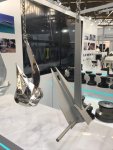
Are you hankering after, or buying, a new anchor?

Neeves

Well-Known Member
Joined
20 Nov 2011
Messages
14,073
Location
Sydney, Australia.
Visit site
If you are in the market for a new anchor, or expecting one under the tree - if its not too late - maybe you might want to wait a month or three.

Lewmar released new anchors at METS 2018, a stainless and galvanised Spade lookalike (some differences in design) and a Fortress clone. The Fortress clone, imaginatively called LFX, really does look like a Fortress and will be available (initially?) in smaller sizes (don't know what smaller means). The Spade/Ultra clones are unusual as they appear to be weighted in the toe - but have handles on the rear of the fluke, and the handle looks like a roll bar.

Urging some caution - Lewmar introduced another anchor at METS 2017 - and it was never mentioned nor seen again.

However the LFX appears to be made from custom extrusions (as is Fortress) and dies are not cheap - so it does look as if the LFX will see the light on chandlers shelves.

To add some weight to the imminent introduction of the LFX one of my other moles, at West Marine, says shipments of the LFX (maybe also the Spade clones) will commence in Feb 2019 and WM have contracted to buy (the LFX). I assume - good timing, Feb shipment, for the American (and similarly timed European) boating season. My mole may just be repeating internal Lewmar gossip - I have no way of verifying the accuracy of the information.

Because Lewmar make their Delta in China, in Qingdao, I am assuming the Spade clones will also be made there. The Spades clones look to be cast flukes with welded shanks (and a funny bolt on handle, that looks like a useless roll bar). Given Lewmar's knowledge of China and China's cheap aluminium processing - I'df expect the LFX to be made in China as well - but these are guesses.

WM might have tested - seems unlikely - but selling untested anchors is not new, WM sell an anchor called Scoop, made for them by Manson, and it has been a resounding flop and of course the Mantus has not enjoyed any/much independent testing either. Good marketing prevails over good design - it is easier to fool people than demonstrate they have been fooled.

My WM mole adds that Fortress' smaller models, at least, will be relegated to the Flagship WM stores - with the Lewmar copies taking pride of place.

It is cheap as chips to cast a steel fluke and weld on a shank, in China which is why Delta are so popular as a commissioning anchor (they are sold competitively in bulk). The Spade clone will cost no more than a Delta to make - but whether the cost is reflected in retail prices we need wait - and wait also to see if they surface at all!

Boat shows at the end of the year, New Year would be a good time for more information to surface - but a direct request for information to Lewmar did not merit a response.

Interesting times.

Jonathan
 
Ah, but we need to know what colours they are available in. As with all fashion items, it's not just the shape and style that matters. Will they be producing a tartan model? :D
 
Ah, but we need to know what colours they are available in. As with all fashion items, it's not just the shape and style that matters. Will they be producing a tartan model? :D
I thought that was a Knox anchor, my next anchor of choice.
 
Apparently the models at METS, and I refer to the anchors, had a metallic finish - though the stainless version of the Spade clone might result in Ultra sharing the niche they have created.

I'm in favour of choice - one reason being it keeps prices in check. If these anchors gain traction (and they work) we might find the price of other models becoming more attractive - there is no reason (apart from overhead and profit) why most anchors (of the same weight) should not cost something similar to a Kobra or Delta. They are 'generally' made the same way from the same or similar steels, they have the same freight - they might be made in the same or neighbouring factories.

Sadly it will also squeeze margins on anchors like Knox - and though I like choice I like entrepreneurs as well - as with most things 'anchor' - compromises, compromises.

Jonathan
 
I like to credit where ideas and information comes from.

This appeared in the CF link above:

https://www.marineindustrynews.co.uk/new-proportional-thruster-control-system/

And is really close to home - as it is a UK publication. I actually did a quick google search, earlier, and missed this

Once you have read the link:

If you check the image on CF you will find that the roll bar is simply bolted on (like the Mantus roll bar) this form of attachment is not very strong (some Mantus roll bar flanges have bent) - but the roll bar illustrated is very 'low' - so I don't see how it can quite work -- and the whole point of the Delta shank is that the anchor rolls on the shank, without a roll bar. I also cannot see why a sailing yacht needs a roll bar but other vessels do not.

I can only think the roll bar in the final version, the one for the shelves, will have a more robust attachment and be bigger - or its just a sop to the idea that a 'new gen' anchor must have a roll bar to be saleable (its easy to fool people etc)

But you need to read the article.

Jonathan
 
31312421017_e69bccb383_m.jpg


( Not really. It might be worth a guffaw.... )
 
You could follow the link on post 7 - that's almost the only illustrations available. But if you want to know what the alloy fluke anchor looks like - just look at any image of a Fortress:)

Noelex has the pic(s) which I suspect he picked up from part of the METS website (that I have not yet found). I'm sure he will be reading this - maybe he will come to the party.

I am trying to get better pics and more information - but so far Lewmar are not responding, but then it has been the weekend.

Maybe next year you can fund me to visit (surely an idea meriting more than one guffaw) - but its quite a long way from Sydney :( which is why I have never been.

Jonathan
 
I have attached the photo showing two of the new anchors (Lewmar have also displayed a third new anchor which is Britany type anchor). If you look closely you can see the bolt on rollbar on the Epsilon anchor.

Note this photo is from Lewmar. I have not seen the anchors yet myself.
 

Attachments

  • 140FB631-79C1-48CC-B778-D15EB17395FA.jpeg
    140FB631-79C1-48CC-B778-D15EB17395FA.jpeg
    335.8 KB · Views: 1
Thanks Alahol

I also note Noelex' image is from Lewmar's Facebook page

and that requests for detail from Lewmar have, so far, not resulted in any reply. Zoidberg will have to be satisfied with what has been posted - and then patiently wait.

The question of whether the world needs yet another anchor obviously has not worried Lewmar, given they have released a whole new wardrobe, and maybe they are right - currently (according to the stats) this thread has had almost 700 views.

Jonathan
 
Chaps - what's the difference between a Fortress the LFX and a normally very cheap and undesirable Danforth please? (apart from the Fortress has 2 setting angles and is made of light alloy in the USA)

They seem so similar... I've used a Danforth on a number of occasions but have never trusted it to reset at the turn of the tide.
 
Chaps - what's the difference between a Fortress the LFX and a normally very cheap and undesirable Danforth please? (apart from the Fortress has 2 setting angles and is made of light alloy in the USA)

They seem so similar... I've used a Danforth on a number of occasions but have never trusted it to reset at the turn of the tide.

I replaced a 20kg Danforth with a Fortress FX23, which has similar dimensions, and presumably similar holding, simply because it is lighter in weight (a lot) and therefore much easier to handle if laying it out by dinghy as a second anchor. As a second anchor, either in a Vee, or a Bahamian Moor, it is not normally subject to a major change in direction of pull.
 
Chaps - what's the difference between a Fortress the LFX and a normally very cheap and undesirable Danforth please? (apart from the Fortress has 2 setting angles and is made of light alloy in the USA)

They seem so similar... I've used a Danforth on a number of occasions but have never trusted it to reset at the turn of the tide.

As Norman says.

I understand the LFX will also have an adjustable angle.

However I very much doubt you have been using a genuine Danforth so it is unlikely you are comparing like with like. A cheap copy of doubtful origin is unlikely to match the performance of a genuine product (made by Tie Down Engineering in the US, and available from West Marine). I see a number of Fortress on the bow rollers of yachts in America (looking most ungainly) but I assume they do not find them tripping every time the tide changes. I have een genuine Danforth for ale in Japan - but not in Oz nor the UK.

Danforth and Fortress (and one assumes the LFX) have superb holding in sand and if you use the mud angle (Fortress and LFX) unbeatable performance in soupy mud against any anchor of a similar size. It is possible that if the anchors are deeply set they will not trip with a change of wind direction. The danger is - if you simply chuck one over the side and hope it sets - hope springs eternal.

As Norman implies if you have any intelligence and set the Fortress to accomodate any wind shift, which seems like good seaman ship you should not have the issues you fear. No anchor is guaranteed to re-set in a tide change - you set your anchor with care, hopefully motoring it in, why do you think the anchor will reset by itself in a tide change?

I have always thought Fortress size recommendations have been overly generous, the anchors are too big - maybe sized for a Gale or Storm - and thus very difficult to deep set with 'our' auxiliary motors. We have altered our wardrobe and now carry a FX16, set for sand, a FX37 set for mud (where size helps) and a alloy Spade and alloy Excel. We are a 38' 7t cat using 6mm high tensile chain. I cannot say we have tested in anger our smaller sized FX16 (vs the recommended FX23) as we have not anchored since we changed in testing winds - but we did find it difficult to bury the FX23. We use our Fortress in mud, cannot be baeten, much more reliable than the Excel or Spade, and we would also use it set in a 'V as Norman describes. One advantage of a 'v' arrangement - it reduces veering and veering may be one of the major causes of anchors dragging (and discomfort on board).

No anchor is perfect - accept reality - and choose your anchor for the conditions.

A major complaint of Fortress outside N Am is its cost and hopefully Lewmar will address this issue.

Jonathan
 
My 20kg Danforth IS a genuine Danforth, and is now languishing in the boatyard beside my boat. Possibly free to a good home - any takers?

Jonathan, I do quite often "set" my anchor using the engine, but often I just let the wind do it. How does the anchor know the difference?
 
My 20kg Danforth IS a genuine Danforth, and is now languishing in the boatyard beside my boat. Possibly free to a good home - any takers?

Jonathan, I do quite often "set" my anchor using the engine, but often I just let the wind do it. How does the anchor know the difference?

Anchors are very intelligent and sensitive - so be careful what you say (they might be listening).

You anchor in windy places that many people only dream of. Consequently I suspect when you anchor you commonly have wind and it 'sets' the anchor for you. The anchor will like this (as your anchor, being sensitive, will be environmentally friendly).

Other people enter an anchorage, carefully chosen to be very sheltered, toss the anchor off the bow and thinking the wind will set the anchor is a divorce waiting to happen. The result is the tide changes, the anchor trips (wrong word for an unset anchor but it will do) and then does not reset - because it is clogged with a towel, beer can dropped over the side by a previous occupant off said anchorage (or if you don't like the implications - clogged with seaweed).

The anchor is, of course, blamed for being inadequate. The owner publishes said misfortune on a forum - hey presto within months its a known fact - certain anchors trip on a change of tide. It i then repeated and we have another internet truth (that isn't).

I confess we are some of those wimpy people who try to anchor in places with shelter, its why we choose them, and allowing the wind to set the anchor would be a rare occasion. We do tend to use the engine to set. I forget some members here are much more robust and sail to anchor, set with the wind - and of course you are right - what's the difference?

I know that our anchor when set with engine at 3/4 full revs has been tested to the equivalent of about 30 knots - which might occur in an anchorage - but if the anchorage is well sheltered 30 knot would be the extreme. I appreciate you cruise in some of Britain's windier waters and 30 knots to you would be quite normal - so your 30 knots and my engine setting are based on a similar tension - setting in a light breeze of 10 knots is not going to be much comfort when the wind gets upto 30 knots as the anchor will set further (than it did at 10 knots of wind) and may meet some unusual company on the way (that beer can, for example). Setting by engine offers some security when the wind is insufficient to set deeply - as if you do catch that beer can (we caught a gas cylinder once) - your anchor will drag under engine power.

Beer cans and towels would not be unusual in popular anchorages and seaweed apparently occurs everywhere.

Now how do I know my engines at 3/4 max revs develops the same tension in the rode as 30 knots of wind - I've measured both, with a load cell.

So - I'm using the engine because I don't enjoy your bracing Atlantic wind and we are cowering in as much shelter as we can find from a Southern Ocean breeze - and use the engine to simulate what nature offers you.

When I was young, like you, I fondly recall being less of a wimp - but with age my memory is a bit jaded - and I might alway have been a wimp as we have been using the engine for the last 20 years to et the anchor (and it works - as there have been no divorce proceedings :) )


When I was younger I would have taken up your offer of a genuine Danforth. Now that I have matured (or at least weakened with age) and become a convert to alloy anchors I'll leave the opportunity to anyone with some discretion and who has not yet seen the value of lightweight anchors. I'd have said it was worth at least a couple of bottles of a decent malt whisky - so your offer is a bargain.

Jonathan
 
Anchors are very intelligent and sensitive - so be careful what you say (they might be listening).

You anchor in windy places that many people only dream of. Consequently I suspect when you anchor you commonly have wind and it 'sets' the anchor for you. The anchor will like this (as your anchor, being sensitive, will be environmentally friendly).

Other people enter an anchorage, carefully chosen to be very sheltered, toss the anchor off the bow and thinking the wind will set the anchor is a divorce waiting to happen. The result is the tide changes, the anchor trips (wrong word for an unset anchor but it will do) and then does not reset - because it is clogged with a towel, beer can dropped over the side by a previous occupant off said anchorage (or if you don't like the implications - clogged with seaweed).

The anchor is, of course, blamed for being inadequate. The owner publishes said misfortune on a forum - hey presto within months its a known fact - certain anchors trip on a change of tide. It i then repeated and we have another internet truth (that isn't).

I confess we are some of those wimpy people who try to anchor in places with shelter, its why we choose them, and allowing the wind to set the anchor would be a rare occasion. We do tend to use the engine to set. I forget some members here are much more robust and sail to anchor, set with the wind - and of course you are right - what's the difference?

I know that our anchor when set with engine at 3/4 full revs has been tested to the equivalent of about 30 knots - which might occur in an anchorage - but if the anchorage is well sheltered 30 knot would be the extreme. I appreciate you cruise in some of Britain's windier waters and 30 knots to you would be quite normal - so your 30 knots and my engine setting are based on a similar tension - setting in a light breeze of 10 knots is not going to be much comfort when the wind gets upto 30 knots as the anchor will set further (than it did at 10 knots of wind) and may meet some unusual company on the way (that beer can, for example). Setting by engine offers some security when the wind is insufficient to set deeply - as if you do catch that beer can (we caught a gas cylinder once) - your anchor will drag under engine power.

Beer cans and towels would not be unusual in popular anchorages and seaweed apparently occurs everywhere.

Now how do I know my engines at 3/4 max revs develops the same tension in the rode as 30 knots of wind - I've measured both, with a load cell.

So - I'm using the engine because I don't enjoy your bracing Atlantic wind and we are cowering in as much shelter as we can find from a Southern Ocean breeze - and use the engine to simulate what nature offers you.

When I was young, like you, I fondly recall being less of a wimp - but with age my memory is a bit jaded - and I might alway have been a wimp as we have been using the engine for the last 20 years to et the anchor (and it works - as there have been no divorce proceedings :) )


When I was younger I would have taken up your offer of a genuine Danforth. Now that I have matured (or at least weakened with age) and become a convert to alloy anchors I'll leave the opportunity to anyone with some discretion and who has not yet seen the value of lightweight anchors. I'd have said it was worth at least a couple of bottles of a decent malt whisky - so your offer is a bargain.

Jonathan

Jonathan, you have brightened my morning. :D I wish I was still young, but we can be young in outlook, even if not in age.
 
Top