Anchoring overnight (peacefully)

Cactus Sailing

Well-Known Member
Joined
30 May 2013
Messages
444
Visit site
i just can't do it without constantly worrying about dragging anchors, overnight anchorages make me restless and i never get any sleep, How to you all do it?

i know the techniques etc and this all stems from an overnight in a bay when the wind changed direction some years ago.

i was anchored fine and my anchor didn't drag at all, there was a boat anchored a lot closer to the rocks than myself and i thought it was a stupid location for the boat to anchor when i arrived but perhaps they're local and know better than me.

At 3am an unforcasted wind came in blowing directly into the bay, i awoke to flares going off and the other boat being bashed against the rocks with two young kids on board, i sorted my own anchor out which was still set firmly and tried to assist but long story short the coast guard ended up sorting them out and i sailed out into the dark not wanting to reset the anchor in the moonlight and high winds.

but since then it's always at the back of my mind, and it winds me up as im always keen to get back to the boat while exploring on land, and every time i return everything is fine obviously

help?
 
I know how you feel. Don't anchor too close to anybody or anything, dig a new generation anchor in big time with engine, put 'too much' chain out, check your ground tackle / shackle mousing, foredeck cleats etc regularly. If you have a chart plotter set up an anchor zone alarm on it at night. Worst thing for me is worrying about chafe on a warp rode so chain is my psychological answer ! Oh and do your weather homework for your proposed anchorage. Phil
 
Last edited:
I'm a bit like you , a 'worried' anchor user.
My boat originally had a CQR with perhaps 10m of chain , then rope.

My few tries were rubbish , I did not appreciate that you have to dig it in and dragged all over the place.

To cure this I went to 20m of (for my boat) heavy chain (8mm) and no rope.

Providing it's not too deep I put it all out and dig it in with a little reverse.

So far so good , on about 5 goes.

And yes I know CQR's have their detractors but my locker is a real constraint to the type of anchor and it's size.
If I upgrade it will be a Kobra.

Like you , It's the turn of the tide that concerns me.
 
i just can't do it without constantly worrying about dragging anchors, overnight anchorages make me restless and i never get any sleep, How to you all do it?

i know the techniques etc and this all stems from an overnight in a bay when the wind changed direction some years ago.

i was anchored fine and my anchor didn't drag at all, there was a boat anchored a lot closer to the rocks than myself and i thought it was a stupid location for the boat to anchor when i arrived but perhaps they're local and know better than me.

At 3am an unforcasted wind came in blowing directly into the bay, i awoke to flares going off and the other boat being bashed against the rocks with two young kids on board, i sorted my own anchor out which was still set firmly and tried to assist but long story short the coast guard ended up sorting them out and i sailed out into the dark not wanting to reset the anchor in the moonlight and high winds.

but since then it's always at the back of my mind, and it winds me up as im always keen to get back to the boat while exploring on land, and every time i return everything is fine obviously

help?

You dont say where abouts you are - Med or Tidal?

Sounds like you got your anchoring techniques right as you did not drag.

Some ideas/pointers:
1. Always have a plan B anc C if the unexpected happens.

2. Watch the guys anchoring near you, especially the ones to windward - but if the wind changes that could be the ones now to the lee. I hate it if some one dumps and forgets especially a CQR or copy. Try and note how much chain is going out, you may want to check - there is nothing wrong with asking (nicely).
3. When coming in to anchor ask the guys near you how much chain they have out. Thos means that when the wind changes, that you wont foul them and vice versa. SOmetimes - say in 10 meters of water AND a crowded anchorage, the owner will say - I have 70 or 80 meters out - you may need to go somewhere else!

4. Check how the anchors have set near you: I generally always swim on my anchor and check how it is set and the nature of the bottom. You should take the chance to inspect your near neighbour that are in your "protection" zone, especially if bad weather is forecast.

5. Anchoring and mooring stern too is a communal activity as anything you do may affect your neighbours - so talk to them.

6. Often one just accepts that someone is badly anchored - or across you anchor chain. The easy way out is to do nothing, and many times there will be no consequences. You as the skipper have to decide whether to put the situation right now before night time (and anticipated bad weather?). How you do it is important as you may well just get their backs up. But you want to avoid the midnight snarl up when one guy leaves because he is (or thinks) he is dragging and picks up the other stern to anchored boats chains. Utter chaos and damage is the result!

7 Of course get your own techniques right and understand how and why
 
The non electric way:

Know the seabed (arm the lead with some grease in the hollow at the base) and wander around in the dinghy making sure you have a good idea how the depth changes.

When you are solidly anchored, take anchor bearings with a compass, and plot them so that you know your escape route(s).


If really twitchy, prepare a second anchor and chain, and have it on standby, along with torch and gloves.


Listen to the chain over the ground.


Not an electron in sight !
 
The non electric way:

Know the seabed (arm the lead with some grease in the hollow at the base) and wander around in the dinghy making sure you have a good idea how the depth changes.

When you are solidly anchored, take anchor bearings with a compass, and plot them so that you know your escape route(s).


If really twitchy, prepare a second anchor and chain, and have it on standby, along with torch and gloves.


Listen to the chain over the ground.


Not an electron in sight !

There speaks a farmer!
 
I think the OP is just being a careful seaman; nothing wrong with that. I get out of bed at slackwater and stay up until the boat has settled onto its new direction. I also get up and investigate any unusual noise or movement. Sleep interruption is part of seafaring; you can usually make it up later and, if you can't, it won't hurt you.
 
There is too much angst associated with knowledge of what could happen compared to the high probability and confidence of it not happening. You need cognitive therapy to stop your catastrophic thinking from dominating your life.
 
i just can't do it without constantly worrying about dragging anchors, overnight anchorages make me restless and i never get any sleep, How to you all do it?
Living mostly on the hook I like an anchor alarm app like anchor pro which does the watching for you. That, a good anchor and a good full blast astern after dropping the hook to give you confidence in the holding.
Though I still wake quite often when the tide turns and listen for the chain rumbling to stop :)
 
I think the OP is just being a careful seaman; nothing wrong with that. I get out of bed at slackwater and stay up until the boat has settled onto its new direction. I also get up and investigate any unusual noise or movement. Sleep interruption is part of seafaring; you can usually make it up later and, if you can't, it won't hurt you.

We take it in turns to get up through the night. If the weather turns bad we stay up. As you say, you can sleep later.
This seems to be the consensus with anchoring; do the best job you can of setting the hook, then be prepared to deal with changes of conditions. If you want an uninterrupted night's sleep, go into a marina!
Doubtless there will be others who say they've never dragged and never needed to get up during the night. I can't do that.
 
Write down the compass course to take you out of the anchorage in the dark. Keep it by the wheel along with the engine keys and a head torch.

If the worst happens and for some reason you can not recover your anchor have a plan to abandon your anchor and chain ideally with a buoy to facilitate recovery. Mine is the bitter end is rope and involves my bread knife. I have only had to do this once in 15 years of living on the hook. But if I had not then I would have been on the beach. 3 boats were lost by getting smashed up on the beach that night.

Security for me is an oversize Rocna [ replaced an oversize CQR ] all chain and making sure that the anchor is well set by backing down HARD on it. I am appalled by the numbers I see who do not back down at all.
 
Write down the compass course to take you out of the anchorage in the dark. Keep it by the wheel along with the engine keys and a head torch.

If the worst happens and for some reason you can not recover your anchor have a plan to abandon your anchor and chain ideally with a buoy to facilitate recovery. Mine is the bitter end is rope and involves my bread knife. I have only had to do this once in 15 years of living on the hook. But if I had not then I would have been on the beach. 3 boats were lost by getting smashed up on the beach that night.

Security for me is an oversize Rocna [ replaced an oversize CQR ] all chain and making sure that the anchor is well set by backing down HARD on it. I am appalled by the numbers I see who do not back down at all.

+1 for all of that. That is more or less my technique, and I anchor more often than not. I am lucky to sail in waters where it is rare to be in a tidal stream, so that is one worry out of the way.

Also, get good at interpreting weather forecasts - if it looks as if it is going to blow up a bit, get somewhere more secure.
 
Write down the compass course to take you out of the anchorage in the dark. Keep it by the wheel along with the engine keys and a head torch.

If the worst happens and for some reason you can not recover your anchor have a plan to abandon your anchor and chain ideally with a buoy to facilitate recovery. Mine is the bitter end is rope and involves my bread knife. I have only had to do this once in 15 years of living on the hook. But if I had not then I would have been on the beach. 3 boats were lost by getting smashed up on the beach that night.

Security for me is an oversize Rocna [ replaced an oversize CQR ] all chain and making sure that the anchor is well set by backing down HARD on it. I am appalled by the numbers I see who do not back down at all.

I once anchored in daylight in an area I did not know well.

I knew I'd be leaving early in the dark so I approached the anchorage with a gps that leaves 'breadcrumbs' to show one's path.

I don't like relying upon electrics, but it certainly was a very easy way to leave the anchorage and get back to the big buoys.

Garmin geko, £10 from ebay was the gps I used.
 
Probably needs a psychologist more than a sailor to address this one :). In the incident you describe, it seems you did everything right - identified the dangerous position (so you wouldn't have anchored there) and didn't drag yourself. Logically it should have been a confidence booster rather than knocker.

Is it dragging you worry about, breaking free, or swinging into something? Probably doesn't help you, but I banished all worries about the first two by getting the biggest Spade I could fit on the roller (S100 model), a six-tonne tested shackle, and new certificated 4-tonne chain (lightish 34' boat). When I drop the pick I give it a good pull in full astern, and thereafter do not worry at all about it shifting.

I do regularly end up worrying that I'll ground at low tide or swing into some rock or shoreline; the solution to that is for me to stop creeping into such marginal anchorages :). If I want a good night's sleep in any normal weather conditions, I can pick a spacious anchorage with a flattish bottom of moderate depth and sleep perfectly well.

Pete
 
Probably needs a psychologist more than a sailor to address this one :). ...

+1

The OP appears to know how to anchor but has an excessive amount of worrying due to witnessing an event on a yacht that reads to be quite frightening. He needs professional help to reset his thoughts to normal levels of concern. I would hazard a guess that this traumatic event has affected him significantly at the subconscious level and it manifests itself consciously by excessive worrying that is affecting the quality of his sailing.

A few sessions with an appropriate counsellor may give the OP the techniques and methods to manage this and get back to where he was before. These things can fester away and impact other areas of life for many years.

That's how I see it, but I am not a psychologist.
 
There is too much angst associated with knowledge of what could happen compared to the high probability and confidence of it not happening. You need cognitive therapy to stop your catastrophic thinking from dominating your life.

I was just about to write the same. These words should not be taken harshly. They apply to lots of us "worriers". Anything can trigger this sort of feeling. A break-in into a "safe" house. A bad storm blowing your roof off. An illness. A random act of terrorism striking on a peaceful night out at a Xmas market.

We must learn to put the catastrophic thoughts into the "naughty corner" and keep them there. Those who can teach us how to do it, earn an honest living...
 
I make it a point to anchor away from other boats whenever possible. I have seen too many cases of people letting out all their chain and then wiping the anchors of other boats when the wind changes direction during the night.
Anchor alarm set at the point where I let down the anchor, with a radius of the length of chain let out.
I only turn in late at night after keeping an eye on the other boats and the weather pattern and am satisfied that all are settled.
I am a light sleeper when on board and will snap wide awake if the boat changes orientation due to wind or waves. Even if there is no change, for some unexplained reason, I do wake up every two hours or so, take a quick look around to see that all is well and then go back to sleep; it never happens when sleeping ashore.
 
I sail on the West Coast of Scotland, where we are blessed with innumerable good sheltered anchorages. Having thought about it, I reckon that we've spent about 3500 nights at anchor, and of all these, only one was worrying. Many nights are disturbed, mainly due to the noise of the wind, but not really worrying. On quiet nights, I sleep like a log. On wild nights, I don't, and may get up occasionally just to make sure that all is well. I have started to make occasional use of the anchor drag alarm in the plotter, just because it's there. Very few of our anchorages have significant tides running through them, so that's one less thing to worry about.

Obvious requirements include good ground tackle, with adequate equipment to deal with it.
Selecting a suitable anchorage for the expected conditions, including type of bottom, depth, fetch, shelter from any sea etc.
If I plan to anchor in a particular place, and find that lots of others have had the same idea, I change my plan and go elsewhere, particularly if bad weather is expected. That's because although I have confidence in my own anchoring abilities, I don't know about all the others'. Sometimes, even in Scotland, I have seen anchorages that were too crowded for safety.

To the OP I say, build up your anchoring experience and confidence, but not to the extent of being complacent.
 
The 'comfort blanket' which works is diferent for everyone so noboby's solution works for everyone. Bit fwiw I like to do the logic / maths thing and ask myself what if x happens? Where x may be a 180 degree wind shift, or increase to F8. Ususally I end up saying to myself 'well, if that happened I'd be tipped out of my bunk and so wake up well before we got in trouble...' so go to bed without worry.

In my opinion the mags like our esteemed host of this forum are partly to blame with all their gloom and 'rules of thumb' which have been untrue for a centuary at least. We have engines and modern anchors and winches etc. Some simpler rules:
- if in doubt anchor in deeper water: further to the rocks and lower forces on the anchor
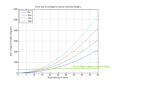
- don't worry about the wind coming onshore: force due to waves is damn all unless breaking, by which case you are throuroghly awake!

The attached graph helps put the latter in context:
Presentation1.png
 
Top