Anchoring "fun"

Anchor scope and the catenary. The anchor is there to stop the chain from sliding across the bottom, but for the anchor to work the anchor shank should not lift off the seabed. The weight and length of the catenary is very important in removing energy from surges and keeping the last links on the seabed in all winds.
Obviously the multiple of depth of water and rode length will change from 30m depth to 3m. It is due to the weight of the caterary and the energy in the system. In 30m the exciting energy is a lot less per meter of catenary that it is for 3m.

If I was anchoring in 30m I would put out my 40m of 10mm chain and say 50m of nylon. Up to 8m of depth I put out 30m of chain regardless...... in gales and worse I'd put out all my chain and a decent second anchor too (dependant on swinging room of course).

I used to anchor with 15m of chain and the rest nylon, but it wasn't suitable in tight anchorages.

Anchoring is a VERY emotive subject. A lot of people learn the hard way when they are off their boats and a squall goes through the anchorage. Prove your anchoring technique every time by going say hard astern once your anchor is set. If you drag you are NOT anchored!
 
Tradewind, I'm sorry but I must strongly disagree with the comment "The anchor is there to stop the chain from sliding across the bottom".
The anchor is there to transfer the force on the rode to the ground! Only in light conditions does the chain contribute to holding (eg via friction) - in heavy/extreme conditions the chain is mostly off the seabed.

As others have said, if you don't believe this, then take a small loop of chain near the anchor and tie it with a cable tie or two (to take the anchor's weight). The cable tie takes any force left over after the chain has woven its magic. Then anchor normally in strong wind (eg 20kts up) - if the chain is taking the load the cable tie will be intact when you retrieve it next morning. (if you really trust your assertion then undo the shackle at the anchor too).

I do agree that in less than extreme conditions the rode contributes to dampening snatch loads - but a snubber is better. Cheers, Andrew
 
Tradewind, I'm sorry but I must strongly disagree with the comment "The anchor is there to stop the chain from sliding across the bottom".
The anchor is there to transfer the force on the rode to the ground! Only in light conditions does the chain contribute to holding (eg via friction) - in heavy/extreme conditions the chain is mostly off the seabed.

As others have said, if you don't believe this, then take a small loop of chain near the anchor and tie it with a cable tie or two (to take the anchor's weight). The cable tie takes any force left over after the chain has woven its magic. Then anchor normally in strong wind (eg 20kts up) - if the chain is taking the load the cable tie will be intact when you retrieve it next morning. (if you really trust your assertion then undo the shackle at the anchor too).

I do agree that in less than extreme conditions the rode contributes to dampening snatch loads - but a snubber is better. Cheers, Andrew

+1

And at 30 knots there is little visible catenary left in the rode (accepting you have a finite length of standard sized chain). At 30 knots and above the rode acts like a long steel rod and all loads are thus imposed directly onto the anchor and deck gear - hence snubbers (or mixed rides). And if your snubber is short it will be inadequate (think 10m as being effective).

Jonathan
 
Andrew G you completely misunderstand what I wrote. Of course the anchor is taking all the horizontal load. The catenary is there to transfer the vertical load to the horizontal. Every N of vertical load .... from too short a rode ... results in a moment that is actually pulling the anchor out of the ground.

Jonathan .... if there is little catenary left in you anchoring system at 30 knots .... do you expect to still be there in 60 knots or would you put more ground tackle out?
 
Andrew G you completely misunderstand what I wrote. Of course the anchor is taking all the horizontal load. The catenary is there to transfer the vertical load to the horizontal. Every N of vertical load .... from too short a rode ... results in a moment that is actually pulling the anchor out of the ground.

Jonathan .... if there is little catenary left in you anchoring system at 30 knots .... do you expect to still be there in 60 knots or would you put more ground tackle out?
 
Anchor scope and the catenary. The anchor is there to stop the chain from sliding across the bottom, but for the anchor to work the anchor shank should not lift off the seabed. The weight and length of the catenary is very important in removing energy from surges and keeping the last links on the seabed in all winds.
This myth has been debunked many times. Without an unrealistic length and weight of chain, in a big blow all your chain will be off the seabed. And the tiny distance required to straighten out the final catenary does next to nothing in terms of transfering energy. It's well understood physics. You need a snubber.
 
Tradewind - thanks for clarifying that and apologies if I got your intention wrong. There ARE those who think the chain does all the holding - hence the quick responses.
deception-island.jpg
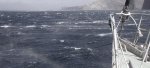
This an old favorite pic. about 60kts, plenty of scope, good anchor, no catenery. Cheers, Andrew
 
A little graph fun... :)
https://www.desmos.com/calculator/quflstd1oh

Y axis is horizontal force on the anchor/boat in Kg tonnes force just as the last link lifts off the seabed, X axis is water depth, S slider is scope ratio of chain length/water depth. Chain is 10mm at 2.2kg/m minus a little as it weighs less less in water.

Equation seems to work OK if you put the numbers in here, bearing in mind the boat only has half of the catenary, any maths gurus care to check? Could be wrong.

http://www.spaceagecontrol.com/calccabm.htm?F=1500&a=80&q=1.9&g=9.81&Submit+Button=Calculate

Doesn't take much to lift the chain up.
 
I did an experiment with 8mm chain. I took 30m and set it at a 5:1 scope in air, I wanted to have it longer at the same scope but did not have room. It took 80kg to lift the chain so that the last link, where the anchor shackle would be, lifted off the ground. The load would be slightly less if done in water. 80kg is about the same load I have measured in 20 knots of wind when I am at anchor with a 5:1 scope - so at 20 knots all the chain is off the seabed - but still lots of visible catenary. Also above 20 knots the angle of the pull on the anchor increases above the horizontal.

In 30 knots I observe that my chain looks as straight as an arrow (its not but it might as well be), see Andrew Gs picture above. However I supplement our chain with, in our case, 2 x 14m snubbers (climbing rope) and they continue to absorb energy as they stretch upto their failure point (at about 2t). Beyond 30 knots my chain is like a long piece of steel wire (effectively straight - there is some catenary but it has little impact) all the energy is taken up by the nylon climbing rope. In fact I would deploy more than 30m, we carry 50m) and being a cat might be able to get closer to shore - but I do not rely on catenary, at all, beyond 30 knots. We have some heavier duty nylon, thicker, for winds over 45 knots. If you rely on catenary and have no snubbers, short snubbers or snubbers that are too thick - then the snatch loads need to be 'taken' somewhere - and that's at your anchor and your bow fittings. Catenary is great at under, about 25 knots (varies slightly, note the slightly) with chain weight and length - but we (most of us) can only carry a finite length and few of us in 35' yachts carry 12mm chain - beyond 25 knots its, catenary, an illusion - and illusions are fairly unreliable.

If we know the winds are to be above 40 knots (at our masthead) for a prolonged period, more than a couple of hours, and we know that the wind will come from one predominant direction we will deploy a second anchor (on a mixed rode) at about 45 degrees to the first anchor. Our storms tend to be well forecast and come from primarily one direction, SW-SE. We will then sit on 2 anchors (both anchors are of the same size and are the size recommended for our specific yacht - we carry only anchors that can each be considered as primary anchors). If we can we would also tie to trees or rocks - we are wimps and go belt and braces.

But catenary - as far as we are concerned its for dreamers. The chain is simply there for its abrasion resistant properties - beyond 30 knots it could be 1mm kryptonite wire for all the benefit of catenary.

Jonathan
 
My observations match Jonathan's closely. I have swum many times to observe my anchor and chain, especially in stronger winds. Once the wind speed is over about 25 - 30 knots all of the chain is regularly lifted off the bottom and appears straight, although I assume it is actually slightly curved. The shank of the anchor, either Delta or Rocna, is lifted slightly on these occasions, tending to help the anchor bed more deeply. In such conditions my scope would normally be about 5:1, 8 mm chain plus nylon snubber.

In a bay in Sardinia where we sat out winds to 40 knots for a couple of days we were anchored in only 2 - 2.5 metres, with around 35 metres of chain out. Even with this huge scope the whole lot was lifting off the bottom frequently. Here the wind was gusting from two directions and yaw was problematical, so we put the Fortress out at 90 degrees to the bower. This visibly reduced the alternate angular pull on the Delta and quietened the boat enormously.
 
Can I ask a question, you say you tightened the shore line. In doing so did you lift the chain from the anchor of the seabed?

Most likely. When taking a line ashore, especially with a strong cross wind, you need to have the chain (and shore line(s)) reasonably tight to stop you from moving too far downwind. Not ideal, and I would normally anchor in line with the wind if possible, but that wasn't an option in this bay. Well, until we decided to use the kedge instead of a line ashore.
 
Well in that case the I would say that you probably needed to let out much more chain and possibly need a bigger anchor and as other have said a chum would help. Pulling the bow anchor tight and lifting the chain it is possible that the shank of the anchor is being lifted and looses grip in the process.
 
Well in that case the I would say that you probably needed to let out much more chain and possibly need a bigger anchor and as other have said a chum would help. Pulling the bow anchor tight and lifting the chain it is possible that the shank of the anchor is being lifted and looses grip in the process.
Indeed. I think more chain would've done the trick, but the small size of the bay didn't really allow for much more chain to be put out. However, in future I will make sure I put out plenty more if I possibly can.
 
Most likely. When taking a line ashore, especially with a strong cross wind, you need to have the chain (and shore line(s)) reasonably tight to stop you from moving too far downwind. Not ideal, and I would normally anchor in line with the wind if possible, but that wasn't an option in this bay. Well, until we decided to use the kedge instead of a line ashore.
That might be a big factor, the loads can be massive with what is effectively a very shallow bridle.
 
GHA - well done with your graphs (I haven't checked them in detail though). Here is my favourite source (apart from Vyv's work that is), http://alain.fraysse.free.fr/sail/rode/forces/forces.htm . He goes through the whole lot . . .

Vyv, don't feel guilty about having a scope of 10:1 in shallow water - my playing with Alain Fraysse's graphs shows that this is the minimum required at say 2m (plus say 1.5m for freeboard). In deeper water, say 25m, this might reduce to a scope of 3:1 for equivalent holding. Thus I rarely use less than 30m of chain and even in deep water try for a scope of 4:1. Your trick of of a second anchor would reduce the sailing around etc which is always a problem in a tight spot. Two anchors in line gives greater holding power but you do have the swinging issue. Some drop an anchor off the bow (say 1+:1) so it drags along the bottom as the boat swings - this dampens movement (but digs up the seabed). Cheers, Andrew
 
If you put two anchors out. One forward, one backward. And then apply a force perpendicular to that line, on the boat in the middle, surely the tighter the line, and surprisingly (?) the more line you have out, the greater the force on the two anchors? And it would be massively more force, than the one applied to the boat.

Allowing a little slack would reduce this effect considerably wouldn't it?

Don't pull it all up tight. Allow it to form a considerable V. Or put a third line from the bow to some position upwind of the boat.
 
Top
