Anchor thread

It seems to me.... that yawing in gusts, or 'veering', or 'wiggling about', is the cause of many of the anchor-holding problems mentioned. And anchors are not particularly good at resolving the cause, merely responding to the effects in different ways.

So why not deal directly with the cause?

On boats susceptible to 'veering about', often those with a cut-away forefoot or narrow fin keel, why not set a small riding sail on the backstay? No, it's not fashionable, but it's known to work - and cheaply.
 
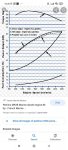
Sorry I could not look at the proper curve, this is a typical one for engine/propeller absorbed power, I think it gives an idea about the difference between engine power and propeller absorbed power.
86hp at 2400 as you say.
You run it at 1200rpm, if your propeller is correctly dimensioned (max absorbed power at max power), at 1200 rpm it would absorb 20hp, give or take a few hp.
With similar, typical propeller/engine power curves, to absorb 60hp at 1200rpm the engine should deliver 250ish hp at full rpm.


Add: for a simple two blade fixed propeller, the absorbed power in reverse gear would most likely be a small percentage of the forward (graph) one.
View attachment 149151
We have a Brunton three blade folder. It's has a blade profile like Micky Mouses ears. Lots of surface area. We are also over propped. We should reach 2400rpm but we only reach 2000rpm. Again, not much downside as we cruise at 1200rpm usually and when dealing with some big seas and current under engine we do push to 1500rpm. We can still hit 7 kts at 1800rpm in 2m seas if we want to but but there is a crazy increase in fuel consumption.
I just looked at the engine curve again and realise I was reading the power off in kW. So at 1800 rpm in forward gear we would use 77hp. At 1200rpm, our cruising revs we use about 52hp according to the graph. Obviously for my engine/propeller set up, the graph isn't true as we are over propped. We swing a 22" prop that gives us lots of grunt, hence the lack of full revs.

received_540300748057791.jpeg
 
It seems to me.... that yawing in gusts, or 'veering', or 'wiggling about', is the cause of many of the anchor-holding problems mentioned. And anchors are not particularly good at resolving the cause, merely responding to the effects in different ways.

So why not deal directly with the cause?

On boats susceptible to 'veering about', often those with a cut-away forefoot or narrow fin keel, why not set a small riding sail on the backstay? No, it's not fashionable, but it's known to work - and cheaply.

Fair point.

As someone said, many sizing charts specify undersized anchors maybe in the hope it makes their designs look good. As long as you have plenty of well sized chain it's probably as good a compromise as many for the weekend sailor.
More robust sailors will have heavy anchors, heavy chain and our friend the long snubber in the locker; I'm sure the riding sail is a useful addition.

.
 
Is there any scenario were a smaller anchor would hold my boat better? I sincerely doubt it, please explain to me how this would work.

Yes - probably. As you see if you read all the discussion much depends on the anchor developing its holding power which means setting well and burying. Many anchor designs develop their holding power by progressively wider flukes as they bury deeper and the argument is that a smaller boat may not be able to apply the load to access this extra holding power.

This of course assumes anchors of the same design. However for many people making a decision on buying an anchor, particularly a replacement the objective is to get superior holding. This is exactly the position I am in (and you from what you say). My boat had a 35lb copy CQR and if you look at the data in post#117 (and broadly similar data from other tests) you will see that this design typically has around 40% of the holding power of the newer designs such as the Rocna. A Delta was in between with around 80% of the best. So just changing to the Delta of the same size would give a theoretical doubling of holding power along with better setting performance in a wider range of seabeds. This is in fact what I did on my last but one boat which I kept in Corfu and it achieved these aims. My last boat was virtually identical in size (weight and windage) to the previous one came with a 10kg Delta which Bavaria fitted because it is within the length recommendation of Lewmar. Despite my scepticism in the 6 years I had the boat with a lot of anchoring in my local conditions I had no problems, although admittedly never in really heavy conditions. Since then the Epsilon has come on the market with superior holding power to the Delta closer to the best of other designs.

The question now is that I have a boat that has had 45 years successful use with a low holding power anchor, do I need well over double the holding power of a new style anchor of the same size or can I actually downsize? The boat is smaller than my two previous boats, particularly windage and I shall be using it in the same way so based on my experience with the 10kg Delta not unreasonable to think that the better Epsilon will do the job and that is what I have bought.

The bigger and heavier is better mantra is well embedded but is really not supported by the data. This is recognised by designers and the current crop of anchors where the focus has been primarily on improving performance for a given weight. As we have seen this has resulted in the doubling of holding power (as well a other improvements). A simple change in type of anchor is a major step up, but it is well worth considering if a reduction is size could be appropriate for your boat and pattern of usage.
 
At 1200rpm, our cruising revs we use about 52hp according to the graph.
You are reading the wrong curve: you would use 52hp at 1200rpm only if the propeller power curve would cross the engine power curve at that level, in other words if you could not increase revs beyond that point, which as you say is not the case (and hardly the case with any boat).
52hp is the maximum power the engine can deliver at those rpm, the actual delivered power depends on the propeller curve: your propeller curve is crossing the engine power curve at 2000rpm so somehow steeper than the one in the graph, but power delivered to the propeller at 1200 remains well below the max engine power available at that rpm. :)
 
I think the argument given in the Practical Sailor article quoted by Jonathan goes as follows: A deeper dug anchor seems to be less susceptible to yawing than a more shallow-set anchor. And if yawing gets excessive, then over some 20 min or so the shallow-set anchor will wiggle free and start its walk about, whilst the deeper-set anchor does not. But they also do note that once the deeper-set anchor does wiggle free, it will never dig in as deep again and so will not set properly, whilst the anchor that was set more shallow can manage to reset. It seems like a choice between 'everything is completely fine until it fails ungracefully' and 'it will start to drag earlier, but it will not fail ungracefully'. They also say that when you can keep yawing under control (less than 30 degrees according to them), then all this is not a problem to begin with.

So, I believe that article says that if you have excessive yawing, then shallow is bad, but if this is not an issue, there is no difference.

Whether this is all true, I really do not know. But this is the essence of what I read out of that article. But interestingly, in that article they did not warn of oversized anchors. It was more a comparison between anchors that by nature bury deep versus those that stay more shallow. I am not sure one can extrapolate those results to two anchors of the same type, with one being much larger than the other, and hence not as deeply set.

My Spade is according to that in the category of 'more shallow' independent of it being oversized or not. I can confirm that it has handled all wind shifts very well and never caused me trouble because of that. This is very valuable to me. The maximum we had to sustain yet was 50+ kn in a brief spell. 40+kn we have seen regularly. Using my 'storm' bridle for that.

The few times I ever dragged (slightly), even with more than enough chain and a very good bridle, was in extremely poor mud, and it was only noticeable over a 24h period. Once I was in poor mud in the middle of a small harbour in Mexico and I knew I had not enough chain out should the wind be much stronger than predicted. And it did get much stronger, resulting in a serious drag in the middle of the night... And once I was anchoring at a steep bank, were the anchor just fell off the cliff, so to speak. That place was labeled as for day anchorage only, for good reason. When it was crowded and you had to anchor in the 2nd row, you were simply at the edge of the cliff.
Last night the catamaran infront and slightly to one side of us dragged past us at 0300. I had got up to let more chain out. We we only planning to stay for a few hours but decided to delay our departure for a few days so we only had 3:1 scope. I was up letting another 10m of chain out as the wind was up to a steady 30kts. As the cat passed us I blew our very loud horn and shon a bright flood light on the dragging cat. All to no avail as it hit the reef behind. I was glad I deployed the extra chain as the cat mised us. They had been veering alarmingly on their Delta anchor. Anyway, 3:1 on our Spade anchor didn't seem to be a problem in 30kts but I feel happier with a bit more scope since there is a reef 200 metres behind us.
They manged to get off the reef with help pf our neighbour in a large rib. I think they hit sand before they hit the reef proper. They are now reanchored some distance away thankfully.
 
You are reading the wrong curve: you would use 52hp at 1200rpm only if the propeller power curve would cross the engine power curve at that level, in other words if you could not increase revs beyond that point, which as you say is not the case (and hardly the case with any boat).
52hp is the maximum power the engine can deliver at those rpm, the actual delivered power depends on the propeller curve: your propeller curve is crossing the engine power curve at 2000rpm so somehow steeper than the one in the graph, but power delivered to the propeller at 1200 remains well below the max engine power available at that rpm. :)
Yes of course. I never mention propeller power at 1200 rpm just engine power and the fact that that was out cruising revs.
I said we set the anchor at 1800rpm so 60hp seems correct since at 2000rpm we would be using 77hp on our propeller curve
 
Being objective - why do you think the big one will be better. Quote the data that convinced you to shell out more cash (the numbers must be there to justify the cash)

[...]

But define the data that confinced you to buy the bigger anchor.

Jonathan

I'm still not sure what the argument is here, or what data you would like. Is there a doubt that a bigger anchor has more straight line holding power than a smaller one? I think not. So the only 'open' question is perhaps whether a smaller anchor will outperform a larger anchor during a wind shift. Nobody to my knowledge has explicitly tested this either, so I'll just have to trust my intuition that a larger anchor is probably no worse than a smaller one.

Do I actually need a bigger anchor? Probably not, I would probably be fine with the smaller one in almost all circumstances. But I can't see how the larger anchor can be worse than the smaller one. So if I find myself dragging in the middle of the night during a squall, I'll at least have the comfort of knowing that it isn't because I tried to save a buck on the anchor. The bigger anchor gives me peace of mind -- I'll probably never need it, but it doesn't hurt that it's there.

For what it's worth I'll probably keep the old anchor on the boat as a spare, in addition to my emergency stern anchor.

To me the weight argument is ridiculous. The weight of the anchor is negligible compared to the weight of my rode -- that's where I'd cut down if I were looking to save weight. Which I'm not -- when racing we leave the bow anchor behind completely, and when I'm on holiday I don't really care about getting to my destination 15 minutes early.
 
Whether this is all true, I really do not know. But this is the essence of what I read out of that article. But interestingly, in that article they did not warn of oversized anchors. It was more a comparison between anchors that by nature bury deep versus those that stay more shallow. I am not sure one can extrapolate those results to two anchors of the same type, with one being much larger than the other, and hence not as deeply set.

I'm fine with the idea that anchors of different designs, that bury to varying degrees, will behave differently when the wind veers. But until I see evidence of a scenario where a large anchor dragged when a smaller one of the same design held, I'll keep believing that I have "nothing" to lose with a larger anchor (other than money and a trivial amount of weight on the bow).
 
I'm still not sure what the argument is here, or what data you would like. Is there a doubt that a bigger anchor has more straight line holding power than a smaller one? I

No doubt the potential is there. The question is whether your boat is capable of applying sufficient load to actually access that potential. Again perhaps the data in post#117 will help. The loads that a small(ish) boat like yours can generate are far smaller then even the holding power of the recommended size. Larger anchors are recommended for larger boats on the basis that greater weight and greater windage generate higher loads and some warn against oversizing except perhaps for short scope anchoring
 
No doubt the potential is there. The question is whether your boat is capable of applying sufficient load to actually access that potential. Again perhaps the data in post#117 will help. The loads that a small(ish) boat like yours can generate are far smaller then even the holding power of the recommended size. Larger anchors are recommended for larger boats on the basis that greater weight and greater windage generate higher loads and some warn against oversizing except perhaps for short scope anchoring

I didn't oversize the anchor because I believed I would exert a load anywhere near the maximum holding power on long scope in a favourable seabed. In those conditions I have no doubt the recommended size anchor is already more than enough. It is when the bottom doesn't provide good holding, and/or I can't let out too much chain, that I hope the bigger anchor will provide more of a safety margin.
 
To those who insist that a larger/heavier anchor will not "set" properly, and then will apparently be a disaster when the wind increases. Please explain how the same anchor used on a bigger boat will be alright, when there's initially not enough wind to "set" it, but apparently it will be alright when the wind gets up.
Correct me if I'm wrong, but is there an absolute law that we must anchor under engine power? I often take great delight in threading my way into, sometimes quite a tricky, anchorage, and anchoring under sail. I have a sailing boat. Am I doing it all wrong? Has everyone given up real sailing, and are now using motor boats with auxiliary sails?
 
…. It is when the bottom doesn't provide good holding, and/or I can't let out too much chain, that I hope the bigger anchor will provide more of a safety margin.

And the reason the larger anchor is better over the smaller anchor, is that the force per area is less on the larger anchor than the small anchor. Hence the delta between the soil shear strength and larger anchor is bigger, compared to the smaller. That is what it all condenses down to, which will exceed the soil shear strength first, all other things being equal.
 
I'm fine with the idea that anchors of different designs, that bury to varying degrees, will behave differently when the wind veers. But until I see evidence of a scenario where a large anchor dragged when a smaller one of the same design held, I'll keep believing that I have "nothing" to lose with a larger anchor (other than money and a trivial amount of weight on the bow).
Quite frankly, if you sleep better with an oversized anchor than you might with the recommended size then isn’t that mission accomplished?
My query about over sized anchors is based on this :
The deeper the anchor digs in, the better the soil grips the anchor. But that grip also prevents the anchor digging deeper. An anchor should be designed to have as little resistance as possible to digging in and as much resistance as possible to being dragged horizontally through the soil. A smaller anchor has a lower resistance to digging in (less surface area) and also a lower resistance to dragging. Vice versa for a larger anchor. The question is, do the two resistances change at the same rate? It might be possible in my mind at least that where you have a soft soil over lying a harder one, a large anchor might not bite into the harder soil (insufficient load to get decent penetration) whereas the smaller one might pull straight through the soft stuff into better holding. Another scenario might be the anchor is set using a steady pull from using astern, but when the wind gets up, there is a larger but more dynamic load which instead of causing the anchor to ease gently deeper, it causes shock loading at the anchor which causes the anchor to jump or change the structure of the soil at the interface. A deeper set small anchor might not be affected in the same way as a shallow set big anchor because the soil structure and properties are different in each case. But as I say, I don’t know. There is plenty of anecdotal (and very valid) evidence that supports choosing a bigger anchor and I don’t dispute that. But I think there is little that proves the recommended anchor size wouldn’t have achieved the same or better anecdotal evidence.
as I said at the beginning, it’s not what anyone else thinks of your tackle, it’s how well you sleep with it
 
Correct me if I'm wrong, but is there an absolute law that we must anchor under engine power? I often take great delight in threading my way into, sometimes quite a tricky, anchorage, and anchoring under sail. I have a sailing boat.

I haven't anchored nearly as often as several hugely-experienced contributors, nor have I conducted umpteen published surveys, but I HAVE anchored a number of different boats, using a variety of anchors from GenZ to Grandad, in waters familiar and 'furrin', over a lot of years. I've learned a lot from absorbing the wisdom of more experienced salty ol'scrotes, often in these pages.

And, on the several occasions when my hosts' engine had failed, our capacity to sail reliably onto anchor mattered rather a lot at the time. By 'Sods Law of the Sea' ( accreditation to YM Editor passim Andrew Bray ) that was always when it 'was blowing a hoolie'.

I've picked up a 'wheen' of bits of knowhow from resources such as this 'ere, and like to use the metaphor of having 'Lots of Little Tools In The Toolbag'.
 
It might be possible in my mind at least that where you have a soft soil over lying a harder one, a large anchor might not bite into the harder soil (insufficient load to get decent penetration) whereas the smaller one might pull straight through the soft stuff into better holding.

I do not think this can be the case. The anchor - regardless of size or type - will keep digging deeper until there is a balance between the pulling force exerted from the vessel, and the counter force from the soil substrate. So, in the end, all anchors will have exactly the same momentary holding power (unless they break out), but for the larger anchor this is achieved sooner than for a smaller anchor, so it will not bury completely, perhaps.

The potential problem starts when wind loads pick up further and perhaps now pull from the side, or if yawing starts to wiggle the anchor shaft. Then there could be a difference depending on how deeply buried the anchor is. The leverage on the anchor shaft is different, the wiggling of the anchor shaft in the soil will degrade the substrates shear resistance over time, etc. All that is rather complicated.

But the tests seem to show that the next-gen shallow-set anchors perform well in wind shifts, which I can confirm for Spade. And with regards to yawing, there are a number of ways to reduce that.
 
I didn't oversize the anchor because I believed I would exert a load anywhere near the maximum holding power on long scope in a favourable seabed. In those conditions I have no doubt the recommended size anchor is already more than enough. It is when the bottom doesn't provide good holding, and/or I can't let out too much chain, that I hope the bigger anchor will provide more of a safety margin.


Yes, you put it very well. The best circumstances look after themselves, larger anchors help insure you when the chips are down

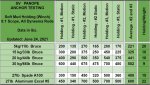
Here is a chart compiled by Steve Goodwin, available on YouTube. It demonstrates four things:


1673615758686.jpeg


1) Something probably accepted by most folk but needing to be demonstrated regardless: That heavier anchors, of the same sort, hold better.

2) That the control anchors perform better. Though of a very different type, we can imagine that their performance would scale in the same way as the Bruce.

3) That, in strong/moderate winds, a 30ft boat would drag all of these anchors. It is a deliberately chosen poor, soft mud seabed.

4) That the dragging would Start with the lightest Bruce first.


1673616838762.png


.
 
For the catamaran that dragged past us at 0300 this morning with his Delta anchor and ended up on the reef those tables might make some sense. The holding hee is very good once you your anchor has cut through the seagrass. Winds of only 30kts. By comparison, we were lying to a 30kg Spade anchor of the correct weight for our boat. I did put another 10 metres of chain out as we have a reef a couple of hundred metres away and the squall clouds looked a little menacing.
As for the Steve Goodwin videos, I believe them to be discredited. I once watched them avidly but noticed quite a few anomalies. I challenged him on some of his findings. I asked him why every single magazine test( with several organisations and people involved) found completely different results for the Rocna anchor. He described his testing as 'clean sand' when challenged he said there might be some binding in the 'clean sand' so it isn't really clean and at all. Easy to create a dodgy set of results if he wanted to. He also mentioned sponsors but did not declare who they were. Could they have been one particular anchor manufacturer sponsoring him? They would certainly benefit from a poor set of results for a Rocna, one of the most successfully marketed anchors out there.
I think I would put more faith in tests done by YM, Practical Sailor etc rather than one guy with a 'sponsor'
 
For the catamaran that dragged past us at 0300 this morning with his Delta anchor and ended up on the reef those tables might make some sense. The holding hee is very good once you your anchor has cut through the seagrass. Winds of only 30kts. By comparison, we were lying to a 30kg Spade anchor of the correct weight for our boat. I did put another 10 metres of chain out as we have a reef a couple of hundred metres away and the squall clouds looked a little menacing.
As for the Steve Goodwin videos, I believe them to be discredited. I once watched them avidly but noticed quite a few anomalies. I challenged him on some of his findings. I asked him why every single magazine test( with several organisations and people involved) found completely different results for the Rocna anchor. He described his testing as 'clean sand' when challenged he said there might be some binding in the 'clean sand' so it isn't really clean and at all. Easy to create a dodgy set of results if he wanted to. He also mentioned sponsors but did not declare who they were. Could they have been one particular anchor manufacturer sponsoring him? They would certainly benefit from a poor set of results for a Rocna, one of the most successfully marketed anchors out there.
I think I would put more faith in tests done by YM, Practical Sailor etc rather than one guy with a 'sponsor'
I have never watched a complete test of his, for me they are far too long to waste my time on. Someone who has watched the complete Rocna tests pointed out that the 25 kg one had been bent and unsuccessfully "straightened". Anyone who remembers Craig Smith on these forums may recall his insistence that whenever he and his father presented one for test they would measure a few and submit one that was perfectly straight. Even a degree or two out of true would result in poor results.

It seems to me that presenting results on a damaged anchor as comparable with those of perfect ones is totally reprehensible and verging on criminal where sales based on those results will be affected.
 
For the catamaran that dragged past us at 0300 this morning with his Delta anchor and ended up on the reef those tables might make some sense. The holding hee is very good once you your anchor has cut through the seagrass. Winds of only 30kts. By comparison, we were lying to a 30kg Spade anchor of the correct weight for our boat. I did put another 10 metres of chain out as we have a reef a couple of hundred metres away and the squall clouds looked a little menacing.
As for the Steve Goodwin videos, I believe them to be discredited. I once watched them avidly but noticed quite a few anomalies. I challenged him on some of his findings. I asked him why every single magazine test( with several organisations and people involved) found completely different results for the Rocna anchor. He described his testing as 'clean sand' when challenged he said there might be some binding in the 'clean sand' so it isn't really clean and at all. Easy to create a dodgy set of results if he wanted to. He also mentioned sponsors but did not declare who they were. Could they have been one particular anchor manufacturer sponsoring him? They would certainly benefit from a poor set of results for a Rocna, one of the most successfully marketed anchors out there.
I think I would put more faith in tests done by YM, Practical Sailor etc rather than one guy with a 'sponsor'


Most of the large published testing is commonly sponsored by a chandler, (West Marine) a safety organisation or a bunch of motivated individuals. many tests are conducted with independent observers providing labour, Fortress recent Chesapeake tests. It’s difficult to skew results in favour of one anchor when there is a cross section of questioning individuals around. Some tes are conducted by an individual but are published by the printed media and the result are looked at carefully for bias. No author is going to risk their future by being caught out.

Steve Godwin conducts the tests himself and publishes the results himself.

I am not lover of Rocna, or I’m not entirely happy with the attitude of the Smiths to the bendy shank saga. I am this biased and I do question the performance of Rocna, particularly the clogging issue. You might say I’m anti Rocna - but I do try to suppress my weakness. Like Geem I thought Rocna maligned and I too questioned the results Steve Godwin had for Rocna - I too received no sensible answer. basically I think the results on Rocna are wrong - and consistently so, not once, but every time.

2-3 years ago I watched one of Steve Godwin’s videos ,to the end. At the end of the video he has been thanking his sponsors. On the video I watched he specifically thanked one donor for the size or generous toy of the sponsor. No mention of names but there was a specific mention that he had received a large donation.

at the time I did wonder and was grateful that an individual, or individuals, are sufficiently altruistic to make a donation sufficient to mention. Later I did wonder who might be so generous, would Bill Gates be interested? I did wonder about an anchor maker but that was a fruitless direction to consider, conspiracy theories etc.

Now, of course, I forget which video I watched and if I thought the comment raised a question then others would be similarly questioning - and I’d guess the offending comment has been edited out.

Who might want Rocna trashed (I can answer that - most of them :) ) which other anchors have an interesting performance that might be questioned. Who comes up there being rated well.

And you do not make these things up.

it might be said I’m anti Steve Godwin - which might be a fair comment - but I’d hardly dislike Steve sufficient to champion Rocna and the Smiths. It’s the combination of a big sponsor and the damning of Rocna - I’m more than happy with a massive sponsor - provided the results look ‘right’ And to me the Rocna results stand out like a beacon. It would be interesting if there was an industry group publishing sales data ….. but I think I need not worry - Rocna have, or had, sufficient momentum to ride through most negativity - but the rash of new kids on the block, Epsilon, Excel, Viking are possibly a bigger issue.

Jonathan
 
Top