Anchor setup for serious crusing - anchor size for 25 foot, 2 tons (4500 pounds) yachts

Status
Not open for further replies.
"Breaking out an anchor in a gale" as pictured above is an example of absurd exaggeration. I've been sailing for 45 years and have so far avoided the pictured senaro and am quite certain I will go to my grave having avoided it. But yes, there are times when poor planning makes the whole break-out and get under way thing is difficult. Get a Boomerang. But turning the anchor is probably not the most pressing problem.

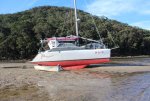
The owner, single handed, was aiming to make a tidal gate into a local marina (its a locked entrance). For some reason his calculations were wrong and he was too late to enter. His options were limited as the approaching weather did not offer him the opportunity to go elsewhere. He chose to anchor in the river - the weather was coming from the left and his target was 'up-river' to the right.

Maybe he should have take shelter, earlier, as he came eastward along the coast. I don't know the coast and hind sight is marvellous. He anchored and was secure - the picture was taken the following morning when he wanted to leave and enjoy a less boisterous location.

It could happen to some of us. We all can be optimistic with our passage planning, unforeseen events do occur. The detail we receive of weather is but a forecast - not a certainty.

There may be some with local knowledge - the picture was taken from New Brighton, looking Nly, down the river to open water.


We have done much the same - crossing Bass Strait heading north (from Tasmania to 'The Mainland') and knowing that the next front was already being described as a 'Storm' we decided to make the crossing knowing the winds were forecast at gusting to 35 knots. We did not fancy being pinned on Tasmania's north coast for a prolonged period. In the event the winds were only 25 knots, a previous time, similar forecast, the winds for the crossing were 55 knots! You make decisions and then have to live with them - and be prepared to cope. In an idle moment in Tasmania I made a subjective analysis of forecast - in the summer there is a Storm forecast for somewhere on the island's coast at least once a month and forecasts of 35 knots every week. We have never ventured there in the winter.

Jonathan
 
... the anchor to the correct mode while the anchor is underwater, that effect is lost as soon as the anchor is in the air. Needless to say, this will allow any twist in the chain to turn the anchor anyway.
That is the beauty of a Boomerang or Bent Link. They work when they're actually needed.

That is not completely correct. If the chain is in the correct orientation on the windlass gypsy (in a vertical windlass, at least, it is secure and will not change), the chain will be in the correct orientation and thee will be no force causing the anchor to rotate any other way. At least it works for me 98% of the time. Perhaps it is in part because my windlass is so close to the stem that it forces the rotation. But this is not a theroy, this is the way it happens on my boat, with my set up. No swivel, right way up 98% of the time.

And yes, I like the Boomerang. But I cannot use one with my current setup, because the space between the shank and chain lock is too short. There is no room to move the chain lock. I wish this were not so, but I'm probably not the only one. The windlass is really quite far forward.
 
Last edited:
Here we are at 15 pages of discussion and the peer pressure is starting to tell. It seems that I need to change up from my Bruce type anchor that came with the boat when I bought her a year ago.
So now a real debate: should I buy a Rocna or an Epsilon???
:)
 
Here we are at 15 pages of discussion and the peer pressure is starting to tell. It seems that I need to change up from my Bruce type anchor that came with the boat when I bought her a year ago.
So now a real debate: should I buy a Rocna or an Epsilon???
:)

This thread was not about anchor choice and I think it would be useful, for you and other members, if you started a new thread and ask the question.

It would be invaluable if you were to include an image of your bow as you might find a roll bar anchor might not fit, anyway. Do you have access to chandlers supplying either a Rocna or an Epsilon - and have you made any measurements and know both will fit.

A few members have bought Epsilon (and I think there are one or 2 Rocna owners here :) ) but whether there are Rocna and Epsilon owners seems unlikely. To get useful replies to your new thread, if you decide to follow that route, is to know what size of Epsilon owners bought, on what size of yacht they use it and experiences in different seabeds.

I know Tranona has recently bought an Epsilon but may not have had much opportunity to use it, being winter, but his experiences are always good value.

I am aware that the occasional post made on YBW has commented negatively on the galvanising quality of Epsilon. I am sure Lewmar will have take note and will not want this comment to become widespread and I would assume they will make comment to their manufacturer. Delaying your purchase, it is winter after all, in the hope of buying from a recent batch might be an idea. Having said that how people know the gal is bad - might be an interesting line of investigation to follow. If the gal is bad and I were an owner I'd complain to Lewmar, not here - and require rectification - but note what Tranona says.

Galvanising can be bad if the underlying object was not 'clean' and then the gal can flake off. But galvanising thickness needs to be measured with a meter (which no-one here will have) and looking at a galvanised object tells you nothing (of the gal quality). If its bright and shiny the gal can be as good as a 'weathered' older gal that has sat quietly in a warehouse.


But being a bit more specific - why is the choice an Epsilon vs a Rocna, why not include a Spade, Excel, Supreme, Viking, Knox, Kobra, Vulcan - these are all good anchors, they all do what it says on the box, there are users/owners, here. Rocna is now a really old design, almost 20 years now (as is Spade, which is even older). You may have reasons for your choice - articulate them it will help that your preferences are known when people reply (cost, fit, perceived weaknesses......)

Jonathan
 
Last edited:
So now a real debate: should I buy a Rocna or an Epsilon???
:)

Bang in an ad in your local Freegle/Wanted. Or in here.... For Sale/Wanted....

There's always someone disenchanted with what they bought 'full ticket' a few months ago, at an eye-watering discount for cash.
It's a bit like that wi' boats, at times.
:)
 
This thread was not about anchor choice and I think it would be useful, for you and other members, if you started a new thread and ask the question."………………
Really ???? I think if you go back to post #1 …… before TNLI and others blasted off onto a fantasy land ……… the OP was very specifically asking about choice of anchor gear, anchor type and chain, for a very specific purpose of a cruise round UK waters (which includes more remote areas on the NW where ability to anchor in a gale may be necessary, as the OP had sensibly spotted).
And I think the OP long back concluded and made a purchase.
It is the thread drifters into fantasy of fishermen anchors, bent stocks, lifeboats and all the rest who might have created a separate thread :-)
 
I stand corrected - but the OP seemed to be asking about a complete rode, choice of chain with a focus on Delta.

Farmer Piles is specifically asking about anchor choice, between 2 named anchors. No mention of anything else, chain, locations.

But no matter. Its upto Farmer Piles how he handles it. It was upto the OP of this thread to query posts and make his decisions - not me. Thread drift is not unusual - and is sometimes useful (and if not the OP can mention that the drift is a distraction and/or simply start a new thread).

As you imply there are no rules, other than be polite.

Jonathan
 
I stand corrected - but the OP seemed to be asking about a complete rode, choice of chain with a focus on Delta.

Farmer Piles is specifically asking about anchor choice, between 2 named anchors. No mention of anything else, chain, locations.

But no matter. Its upto Farmer Piles how he handles it. It was upto the OP of this thread to query posts and make his decisions - not me. Thread drift is not unusual - and is sometimes useful (and if not the OP can mention that the drift is a distraction and/or simply start a new thread).

As you imply there are no rules, other than be polite.

Jonathan
I think the OP and most everybody else was bored and departed when TNLI took this miles off track - and then otherscontinued with long theoretical replies not related to the original post #1 and long after the OP said he had ordered the kit he wanted (not the Delta).
 
I was being a little tongue in cheek in that how anchor posts always drift - see what I did there, ;). That said, I do like thread drift as long as the OP got some sensible answers and the thread stays roughly on topic. Healthy debate when kept in good humour is always informative - especially with some very experienced members as we have had on this thread.
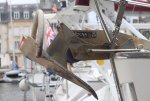
With regard to the two anchors I mentioned: they happen to be two that my chandler can get easily and I do like to support locally where I can. That said, I have nothing against any of those that you listed Jonathan, but I do prefer anchors that are welded together rather than those that bolt together.
One element of my choice is that the estuary when I'm based has very gloopy mud and an anchor without a roll bar or too much concave will hold less of the stuff. However, that wouldn't totally dictate my choice.
Seems to me that most of the new generation anchors rated SHHP will do a good job of holding my boat in most conditions and all will hold better than my imitation Bruce in all but sand and mud.
 
The OP of this long thread, started off asking for advice about anchoring equipment for his projected ambitious circumnavigation of the UK, in his 25ft yacht.
He has since let us know that his time limit is four weeks. If that is the case, I very much doubt if he will need an anchor at all, as he won't have time to stop. ?
 
I found myself thinking of the comments of racer Roderick Knowles, following his class-winning RBIR....

[....about the record breaking 1800 mile lap around the British Isles and Ireland. “We knew that we were the only Class40 left in the race and from that moment on, our only goal was to finish the race. So to break the record is just fantastic. Right out of the blocks we had tough conditions and it was painful..... we were more cautious, up until we got to about half way up the coast of Scotland we had 30 knots of wind most of the time.....]
 
I was being a little tongue in cheek in that how anchor posts always drift - see what I did there, ;). That said, I do like thread drift as long as the OP got some sensible answers and the thread stays roughly on topic. Healthy debate when kept in good humour is always informative - especially with some very experienced members as we have had on this thread.
With regard to the two anchors I mentioned: they happen to be two that my chandler can get easily and I do like to support locally where I can. That said, I have nothing against any of those that you listed Jonathan, but I do prefer anchors that are welded together rather than those that bolt together.
One element of my choice is that the estuary when I'm based has very gloopy mud and an anchor without a roll bar or too much concave will hold less of the stuff. However, that wouldn't totally dictate my choice.
Seems to me that most of the new generation anchors rated SHHP will do a good job of holding my boat in most conditions and all will hold better than my imitation Bruce in all but sand and mud.

Tongue in cheek is good, I concur - if it engenders thread drift it often results in additional information being revealed - that turns out to be 'to the point' though not necessarily something the OP had thought of.

I think history indicates that welded anchors can also fail, commonly through inadequate choice of steel. (but also aggressive retrieval).
I would have said this was impossible, the photo shows I am wrong - and its a good thing I get out and about and see what happens in the real world.
IMG_9616.jpeg
No reflection on Rocna - but you can damage and/or bend any anchor if you try hard enough. The owner also destroyed a shackle.

Its hardly typical but it would be worth your time to have a look at both a Viking and an aluminium Excel. This is not to say I'm pushing them - but both are held together with a, or a series, of bolts. The aluminium Excel's shank is secured in a box, or rectangular slot but the shank has protuberance that holds the shank in place. There is also a bolt - but it largely stops any minor wobble, The Viking shank has a long flange welded to it and (as with the aluminium Exc el) the shank is inserted from the underside of the fluke. The Excel's protuberance stops it pulling out the flange stops the Viking shank pulling out. The flange is made from the same HT steel as the shank (and fluke). Viking is also secured with, I think it is, 6 bolts with Nyloc nuts, Both shanks are high tensile, the Excel is a hefty bit of HT aluminium alloy, 7075, and the Viking shank high tensile steel from SSAB

I've used both and would suggest that, they might not be perfect for your location and bow roller, but I'd trust the construction more than the construction on some other anchor(s).

For 'gloopy' (an excellent technical term :) ) I'd suggest a Fortress, but you will reject that idea (as might I) on the basis its a devil to stow on a bow roller and seems special designed too catch sheets. But you may not like the idea it is held together with bolts (though I've never heard of one 'falling apart'). The nearest design with the similar characteristics to a Fortress is a ........ Viking as it is simply a large fluke but dispensed with the articulating shank and replaced with a fixed shank (so think of it as a Fortress with the shank fixed). The large surface area, no ballast, means the steel is optimised to hold in mud (look for Fortress' test in the Chesapeake for results on anchors in mud - many SHHP anchors failed miserably). For mud - unballasted anchors work well (like a, genuine, Bruce:), Danforth and maybe a Knox).

An Epsilon, Delta, Excel, Spade, Kobra, Vulcan, Rocna, Supreme - are all ballasted (so some of the steel does not offer any surface area at all - its just weight..

We were anchored in gloopy mud, there was an oyster farm just upstream of us and enjoyed a 55 knot front passing through. We had our Excel deployed. We saw the front coming, like an impenetrable wall of water, and had togged up, engines running in neutral. When the front hit - visibility disappeared - we were in world about 20m in diameter. We were slowly driven back - the anchor simply carved a furrow through there mud - until we were driven into more shallow water where the underlying sand allowed the anchor to bite. I simply sat at the helm watching the events slowly unfold ready to apply some throttle (in gear :) ). To explain - the geology of the location had been wind blown sand over which a thick layer of mud had been more recently deposited. Once the mud shallowed out the mud eventually thinned sufficiently that the anchor held. Not something I'd rely on, unless you know the geology, - but the experience was educational, to me.

The mud was good for hold upto 35 knots with our Excel, that's roughly the limit of our power setting, - but not beyond.

Maybe it illustrates that over reliance on 'power setting' (with our limit of 35 knots) might have risks and that anchor tests might have value.

And my apologies for those who only have a 5 line limit on posts.


Jonathan
 
Last edited:
The Scillies event was a serious lesson and we have some examples of what some people did. I'm in favour of Geem's solution, listen to the forecast and go somewhere where the forecasts are more benign.

What we don't know, and it is not clear in the article, for those that stayed, what failed and what worked. We know yachts ended up on rocks (having obviously dragged) but we don't know what gear they were using. The storm in the Med article has a deeper insight into what went wrong and we can decide what the wish list might have been (better chain hook for one). There are so many unanswered questions and so many of the lessons are not available to us.

Jonathan
If you are dragging or embayed due to serious conditions, it's often better to pick a spot to beach your pride and joy before mother nature decides where you are going to drag or get blown to. Obviously it's better if you have a bilge keel or lifeboat design like my old wreck. Even better if it has a steel hull. Try to beach at or near high tide and then dig in an anchor or two. If there are light fingered natives around make sure the anchor and rode are both dug in to reduce the chances of theft.
Tongue in cheek is good, I concur - if it engenders thread drift it often results in additional information being revealed - that turns out to be 'to the point' though not necessarily something the OP had thought of.

I think history indicates that welded anchors can also fail, commonly through inadequate choice of steel. (but also aggressive retrieval).
I would have said this was impossible, the photo shows I am wrong - and its a good thing I get out and about and see what happens in the real world.
View attachment 149661
No reflection on Rocna - but you can damage and/or bend any anchor if you try hard enough. The owner also destroyed a shackle.
Its hardly typical but it would be worth your time to have a look at both a Viking and an aluminium Excel. This is not to say I'm pushing them - but both are held together with a, or a series, of bolts. The aluminium Excel's shank is secured in a box, or rectangular slot but the shank has protuberance that holds the shank in place. There is also a bolt - but it largely stops any minor wobble, The Viking shank has a long flange welded to it and (as with the aluminium Exc el) the shank is inserted from the underside of the fluke. The Excel's protuberance stops it pulling out the flange stops the Viking shank pulling out. The flange is made from the same HT steel as the shank (and fluke). Viking is also secured with, I think it is, 6 bolts with Nyloc nuts, Both shanks are high tensile, the Excel is a hefty bit of HT aluminium alloy, 7075, and the Viking shank high tensile steel from SSAB
I've used both and would suggest that, they might not be perfect for your location and bow roller, but I'd trust the construction more than the construction on some other anchor(s).
For 'gloopy' (an excellent technical term :) ) I'd suggest a Fortress, but you will reject that idea (as might I) on the basis its a devil to stow on a bow roller and seems special designed too catch sheets. But you may not like the idea it is held together with bolts (though I've never heard of one 'falling apart'). The nearest design with the similar characteristics to a Fortress is a ........ Viking as it is simply a large fluke but dispensed with the articulating shank and replaced with a fixed shank (so think of it as a Fortress with the shank fixed). The large surface area, no ballast, means the steel is optimised to hold in mud (look for Fortress' test in the Chesapeake for results on anchors in mud - many SHHP anchors failed miserably). For mud - unballasted anchors work well (like a, genuine, Bruce:), Danforth and maybe a Knox).
An Epsilon, Delta, Excel, Spade, Kobra, Vulcan, Rocna, Supreme - are all ballasted (so some of the steel does not offer any surface area at all - its just weight..
We were anchored in gloopy mud, there was an oyster farm just upstream of us and enjoyed a 55 knot front passing through. We had our Excel deployed. We saw the front coming, like an impenetrable wall of water, and had togged up, engines running in neutral. When the front hit - visibility disappeared - we were in world about 20m in diameter. We were slowly driven back - the anchor simply carved a furrow through there mud - until we were driven into more shallow water where the underlying sand allowed the anchor to bite. I simply sat at the helm watching the events slowly unfold ready to apply some throttle (in gear :) ). To explain - the geology of the location had been wind blown sand over which a thick layer of mud had been more recently deposited. Once the mud shallowed out the mud eventually thinned sufficiently that the anchor held. Not something I'd rely on, unless you know the geology, - but the experience was educational, to me.
The mud was good for hold upto 35 knots with our Excel, that's roughly the limit of our power setting, - but not beyond.
Maybe it illustrates that over reliance on 'power setting' (with our limit of 35 knots) might have risks and that anchor tests might have value.
And my apologies for those who only have a 5 line limit on posts.
Jonathan

I agree with most of that reply, apart from a few lines, as follows:

The Excel is good in holding terms when used in mud and hard mud in particular, BUT, the sides are rather thin. If it was used in debris or rocks, I suspect it might get slightly bent. It's fairly classic pre bent plough design in my opinion, so it might be best to stick with the Lewmar Delta.

Any bolt together anchor is a no go, unless it's for a weight critical application, like a RIB or powerboat. In that case non of the modern anchors can hold a torch to the Danforth, although it would need to be a bendable one like the Alloy Lewmar FX series, or the more popular Fortress.

There is a lack of data for the Lewmar Epsilon, but I'm sure it's a real good mud and sand anchor. Some owners have complained about them rusting, so check with Lewmar to see if they have corrected that potential lack of hot dipping issue. The UK Spade or Sapade UK is another good M & S anchor that has a more serious reputation for loss of the yellow paint and ultra thin Zinc coating, and a number of them have been bent.

Don't forget that you need a specialist anchor for thick weed and rocks. Fishermans, Admiralty pattern or best of all a Herrenhof 3 piece version.

If you are an avid anchor collector like myself, make sure you do not buy a bad copy. I posted a reply to a daft post from Cox who does know one CQR from another about how to figure out from the marks on the shank, if it's a copy, which the ones in his pictures are. There are no pictures of a bent genuine CQR or Bruce that he can find. If there is please post it, BUT with detailed pictures of the entire anchor, not just a few sections.
 
I agree with most of that reply, apart from a few lines, as follows:

The Excel is good in holding terms when used in mud and hard mud in particular, BUT, the sides are rather thin. If it was used in debris or rocks, I suspect it might get slightly bent. It's fairly classic pre bent plough design in my opinion, so it might be best to stick with the Lewmar Delta.


Except that the Excel has twice the hold of a Delta and sets easily and reliably. I think over 10 years use, from Sydney to the southern tip of Tasmania, of the aluminium Excel with the bolt in shank without issue is a better test of security that some vague idea that it might fall apart from someone who has never even seen one.

Jonathan
 
There's one place I drop into with whatever frequency I can muster. Been doing that since the early 70's in an engineless Hurley22.
The spot I have habitually chosen, over the years, to anchor is marked with a 'red spot' just off Custom House Quay, at Falmouth - which is as close to 'The Chainlocker' as I can now get.

Gone are the days of sculling right in there, with one oar, to the Custom House steps.

52645551899_46c32e88ce_z.jpg


Optimally, one needs a falling tide and bilge keels, for no anchor I know will hold in the gloop - and there is no suitable chart symbol in Chart 5011 - Symbols and Abbreviations for 'Brown Windsor soup'.....

:cool:
 
Last edited:
There's one place I drop into with whatever frequency I can muster. Been doing that since the early 70's in an engineless Hurley22.
The spot I have habitually chosen, over the years, to anchor is marked with a 'red spot' just off Custom House Quay, at Falmouth - which is as close to 'The Chainlocker' as I can now get.

Gone are the days of sculling right in there, with one oar, to the Custom House steps.

52645551899_46c32e88ce_z.jpg


Optimally, one needs a falling tide and bilge keels, for no anchor I know will hold in the gloop - and there is no suitable chart symbol in Chart 5011 - Symbols and Abbreviations for 'brown windsor soup'.....

:cool:

I suppose our 'bilge keels', will also suffice. However I'm not sure of getting ashore in 'Brown Windsor soup'? I think Fortress invested a lot of cash testing in Brown Windsor soup in their most recent testing in the Chesapeake.

Normally we would deploy anchors to allow us to stay through a second high tide and to allow us to float off at our convenience, not that of the tide. Here we have our primary, I think we were testing the Viking 10, on our 6mm rode with a Spade A80 and FX 16 on dyneema (retired halyards) rodes off the transom using the sheet winches.

IMG_4947.jpeg
Jonathan
 
Status
Not open for further replies.
Top