Anchor setup for serious crusing - anchor size for 25 foot, 2 tons (4500 pounds) yachts

Status
Not open for further replies.
Thanks. I have read your article about swivels. Is there a budget swivel you could recommend, or its better to go for expensive one?
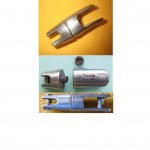
Which ever swivel you use avoid fitting it direct onto the anchor .

If you slide the jaws over the anchor stock and put the pin in its fine for a direct straight line pull but if the wind or tide changes you could be pulling on a big angle which could bend the jaws in the swivel.

A short bit of chain between the swivel and the anchor will avoid that happening.
 
Which ever swivel you use avoid fitting it direct onto the anchor .

If you slide the jaws over the anchor stock and put the pin in its fine for a direct straight line pull but if the wind or tide changes you could be pulling on a big angle which could bend the jaws in the swivel.

A short bit of chain between the swivel and the anchor will avoid that happening.

Chinese or Indian anchor connectors and swivels, and the stainless ones in particular have caused a number of losses of boats at anchor. 90% of them are far weaker than the chain or anchor, (Unless it's a lightly built Fortress or New Generation failure special). Cox might know which article in PBO, PS or Yachting Monthly covered the subject of how to connect an anchor to the chain. If he or another member posts a link that would be good, as I want to take note of a few of the products mentioned.

USING A SWIVEL IS OFTEN A MISTAKE, but read the instructions from the anchors manufacturer, as Lewmar or another good company might say that their anchor needs a swivel or special connector that has one incorporated. If it does, then make sure you buy the swivel or anchor connector from the company concerned, NOT from Fleabay, as you risk getting a far Eastern copy with a minimal fatigue life and a shear strength that is dangerously low in comparison to even cheap Chinese steel.

My father once said about an engineering task that I had made a mess of, "IF IN DOUBT, READ THE INSTRUCTIONS", and anyone connecting an anchor to their chain should do just that.

PS: I do use a swivel on grapnels used in deep water, cos they often get a lump of mud or weed on one arm, which then causes them to spin as you weigh anchor.
 
Last edited:
Chinese or Indian anchor connectors and swivels, and the stainless ones in particular have caused a number of losses of boats at anchor. 90% of them are far weaker than the chain or anchor, (Unless it's a lightly built Fortress or New Generation failure special). Cox might know which article in PBY, PS or Yachting Monthly covered the subject of how to connect an anchor to the chain. If he or another member posts a link that would be good, as I want to take note of a few of the products mentioned.
All here Swivel problems and solutions
I'm sure that this has been discussed on these forums before.
 
All here Swivel problems and solutions
I'm sure that this has been discussed on these forums before.
I think it was in 2007 that I came up with the three links solution. It is now used world-wide. I recall a very well-known chandler selling anchors and chain telling a customer that there was no technical merit in the idea and recommending that it not be used. They will now sell you three links specifically for it!

The power of the Internet can be a wonderful thing.
 
I think it was in 2007 that I came up with the three links solution. It is now used world-wide. I recall a very well-known chandler selling anchors and chain telling a customer that there was no technical merit in the idea and recommending that it not be used. They will now sell you three links specifically for it!

The power of the Internet can be a wonderful thing.

it should have been called the CoxLink - to give credit to a brilliant and simple idea.

Sadly bending of the fork by omission of the link is not the only mechanism of failure. For some swivels the swivelling mechanism is a simple pin with a stop welded on - the weld can fail and the pin simply pull apart. If you must have a swivel - buy a decent one. I wrote an article formPractical Sailor which you can find with a simple Google search - it describes a failure where the end stop fell off And includes a picture of a bent fork, kindly provided by Vyv.

if you do not have a slotted roller - use a Boomerang, available from manufacture in Ukraine via Viking Anchor.

I’d offer a link but I’m still struggling to learn such tricks on my iPad.

Jonathan
 
My lap top was returned and my wallet lighter - but I can offer you the links for articles on swivel failure and, as a bonus, a (maybe) better photo of a different swivel failure (the weld on the end stop on the swivel failing)

My work of swivels lacks the originality of Vyv's work. I was prompted to investigate after a failure in Western Australia, where the end stop on the swivel itself corroded and failed. The lucky part is that all the bits and pieces were retrieved from the seabed and no vessels lost.

Don't think you will be so lucky - its not called "The Lucky Country" without reason.. :)

How Well Do Swivels Reduce Twist? - Practical Sailor

Anchor Swivels: Caution Required - Practical Sailor


IMG_0029.JPG

Basically cheap swivels have multiple weaknesses.

With no disrespect to Vyv - if your swivel is cheap adding the Cox-link is a good idea, not a panacea - but the swivel may still fail.

Now.... do you want me to start of interscrews aka sex bolts?

You get what you pay for.

Jonathan

Another vote for a Boomerang?? :) (if you do not have a slotted bow roller) and support Ukrainian industry or NormanS' bent link. No moving parts.

Its your choice......... :)
 
A bit of thread drift and some provocation

Despite all of the investment in the development of anchors, (make your own choice but Spade, Fortress, Rocna, Excel, Epsilon) and anchor development is not cheap and the work on testing shackles (culminating in the Crosby recommendation), better chain, chain joiners (the Crosby 'C' link) and snubbers/bridles - we still have adherents to old (and questionable) ideas (catenary, CQR) and a constant series of queries - eg swivels and use of 'C' links.

Have we progressed?...... at all..... :)

Are we learning - are there new ideas accepted, or too revolutionary...?


Don't get me wrong - if the ideas need more explanation - its a reason to re-run article in YM or PBO.

Jonathan
 
Well, we choose to get from A to B by wind: gaff rigged wooden boat to foiling cats. The choice (money aside) is yours, when technically superior modes of transport are available.

It’s the egotistical pontificating that is hilarious and frankly silly at times.

Most folks, I assume, are intelligent enough to make a satisfactory choice of anchor gear for their type of sailing. If that does not involve NGA, multiple styles of anchor onboard, lighter higher tensile chain, bent links, slotted, self launching bow rollers, bridles, various choices of snubbers, diving equipment, underwater cameras and precise force analysis, so what.

Happy hooking with whatever you use!
 
Well, we choose to get from A to B by wind: gaff rigged wooden boat to foiling cats. The choice (money aside) is yours, when technically superior modes of transport are available.

It’s the egotistical pontificating that is hilarious and frankly silly at times.

Most folks, I assume, are intelligent enough to make a satisfactory choice of anchor gear for their type of sailing. If that does not involve NGA, multiple styles of anchor onboard, lighter higher tensile chain, bent links, slotted, self launching bow rollers, bridles, various choices of snubbers, diving equipment, underwater cameras and precise force analysis, so what.

Happy hooking with whatever you use!

Except that some, if not many, suffer sleepless nights when a yacht, or yachts are anchored on a short rode using a CQR, Delta or Bruce to windward and the forecast is questionable. Maybe its genetic or simple hard won experience.

Jonathan
 
Except that some, if not many, suffer sleepless nights when a yacht, or yachts are anchored on a short rode using a CQR, Delta or Bruce to windward and the forecast is questionable. Maybe its genetic or simple hard won experience.

Jonathan

There's the opposite problem too, that many will sleep soundly on poor gear totally convinced that everything is fine. Matching the right level of concern to the objective risk seems the best strategy for survival. You can freely choose your own opinions but you get no choice of external reality. The first has to be a good-enough fit with the second.
 
There's the opposite problem too, that many will sleep soundly on poor gear totally convinced that everything is fine. Matching the right level of concern to the objective risk seems the best strategy for survival. You can freely choose your own opinions but you get no choice of external reality. The first has to be a good-enough fit with the second.

Your gear is good enough, until it isn't. I suspect that most of the time the kit is found wanting its simply a minor inconvenience (it takes time and a number of attempts to get the anchor to set, convincingly). The number of catastrophic failures are few and far between and commonly occur during, almost, unique weather events (like the Med storm and the Scillies event). People therefore live with what they have.

'It' did make me wonder if the frequency of people dragging has reduced compared to say, 20 years ago. My subjective view is that this is the case - people are not dragging with the frequency they did 20 years ago. I attribute this to the increased use of better anchors as, actually, I don't see much change in how people use them. People still deploy and don't bother to power set, people still use rodes that are too short, the number of people using long snubbers has not significantly improved. I cannot comment on whether techniques change in strong wind events - as most people don't anchor where the winds are strong - they have a choice and either stay at home or go to locations with real shelter - or use a public mooring (the numbers of which have increased, commonly to protect the seabed). People who venture into the wild blue yonder, whether it is NW Scotland, Labrador, Patagonia or the Scillies - tend to know what they are doing, are few and far between and have decent anchors (not necessarily oversized).

So the adventurist have learnt and the less andeventurist have updated their anchor and don't need to worry about a snubber, light, longer rode etc etc - because they are cautious and don't venture far from home.- except for the very few (and who are statistically insignificant).

The reality is people don't venture far (this has not changed) - the demand for people, who own yachts, has not changed, they still have young children, possibly reluctant wives, careers and a mortgage all of which reduces the incentive to be adventurist.

It was interesting that Skip Novak took almost a couple of decades to see the light and retire his CQR (clone or copy) in favour of a Rocna - maybe indicative of the conservative nature of boat owners. Similarly Lewmar took almost 20 years before they introduced (with Epsilon), what might be 'a Rocna beater' and 'replaced' the Delta.

Removal of questionable swivels, use of 'long' snubbers, misuse of shackles are still battles to be won (or not).

People complain bitterly and repeatedly about the frequency of anchor threads - but if my subjective comment is correct - the messages are slowly getting through, even to Skip Novak! :)

There are still people to be persuaded, snubbers, swivels, shackles, chain (and all it implies) - I don't see the end of anchor threads, yet.

And ....what we need is the next step, improvement, in anchor design - that factorial improvement over SHHP as we had with HHP to SHHP (which only took decades :) ).


I do find it interesting that most 'improvements' have been made by individuals working in small workshops, with inadequate funding - think, Fortress, Spade, Rocna, SARCA, Excel, Knox, Viking. The 'big' corporate development Delta, now Epsilon, Kobra, Supreme - are few and far between. Also think of the failures and the losses incurred Hydro-bubble, Bulwagga, SuperMax, XYZ.......

Jonathan
 
People who venture into the wild blue yonder, whether it is NW Scotland, Labrador, Patagonia or the Scillies - tend to know what they are doing.....

Or are 'blind leading blind'.... :eek:

Over the years ( rather a few of them ) I've paid quite some attention to what 'Oor Jonathan' has been banging on about, and bit by bit it has sunk in. He knows what he's on about ( but don't tell him I said so! ) As my Ould Mither used to say - 'He's no' as green as he's cabbage lookin'....'

Mind you, I did pay some heed to quite a few others - Fraisse, Smith, 'Smith' at Fortress, Cox, Harries, 'SV Panope', Novak et al - looking for hints of consensus. And so I've adopted most - well , quite a few - of his accumulated recommendations. And some I've 'sandbagged' for another day.

Why? Mine is a very different boat, of a different size/weight/antiquity..... sailing in places where >30kts is a normal summer..... where there's a wider choice of cheap wine.... the sun, when it's out and about, is 'doon sooth' where I expect it.... the world is the right way up.... and I need something to argue with him about.

Like - 'Does the world really need a better anchor than SHHP?'

:LOL:
 
Last edited:
I found that as long as I am backing (not going forward) when I bring the anchor up, it comes up right-way-round 95% of the time. Most NG anchors will naturally align with the flow of the water. If you are pulling forward, and the anchor wants to align point into the flow, yes, the anchor is going to come up backwards every time and you are going to fight with it. I've watched this an laughed many times.

Simple.
 
Or are 'blind leading blind'.... :eek:

Over the years ( rather a few of them ) I've paid quite some attention to what 'Oor Jonathan' has been banging on about, and bit by bit it has sunk in. He knows what he's on about ( but don't tell him I said so! ) As my Ould Mither used to say - 'He's no' as green as he's cabbage lookin'....'

Mind you, I did pay some heed to quite a few others - Fraisse, Smith, 'Smith' at Fortress, Cox, Harries, 'SV Panope', Novak et al - looking for hints of consensus. And so I've adopted most - well , quite a few - of his accumulated recommendations. And some I've 'sandbagged' for another day.

Why? Mine is a very different boat, of a different size/weight/antiquity..... sailing in places where >30kts is a normal summer..... where there's a wider choice of cheap wine.... the sun, when it's out and about, is 'doon sooth' where I expect it.... the world is the right way up.... and I need something to argue with him about.

Like - 'Does the world really need a better anchor than SHHP?'

:LOL:
I think it was 'Brian' at Fortress or Mr Sheehan to his juniors. His skills and diplomacy are still in use in the marine industry and he is a big wheel in the wireless 'auto' docking systems for large MoBos - our loss. You possibly missed Starzinger in you list of Gurus.

And Australia does not have cheap wine, only quality wine :) (some of which is not soooo expensive), After all who invented the wine cask or box. To finish off this drift, sacrilege I know, we have award winning single malt whisky and, as most places in the world now, a whole variety of craft gin.

But I digress:

SHHP? we need something that will infuriate the members here who lack the ability to pick and choose and naturally gravitate to anchor threads as their means of entertainment. I'm more than happy to support other options - if it is proven the keep them entertained. and diverts them from less healthy activities.

And in case you are tempted - sand bags are used here during floods - they are a poor substitute for, even, a CQR, to keep water out of the dunny.

Jonathan
 
I found that as long as I am backing (not going forward) when I bring the anchor up, it comes up right-way-round 95% of the time. Most NG anchors will naturally align with the flow of the water. If you are pulling forward, and the anchor wants to align point into the flow, yes, the anchor is going to come up backwards every time and you are going to fight with it. I've watched this an laughed many times.

Simple.

Don't try this in a crowded anchorage - use a Boomerang, it reduces the palpitations of your neighbours. :)

J
 
I found that as long as I am backing (not going forward) when I bring the anchor up, it comes up right-way-round 95% of the time. Most NG anchors will naturally align with the flow of the water. If you are pulling forward, and the anchor wants to align point into the flow, yes, the anchor is going to come up backwards every time and you are going to fight with it. I've watched this an laughed many times.

Simple.
True but in most cases the height of inconvenience. Far more convenient for us for Jill, who is on the foredeck anyway operating the switches, to rotate the anchor on the swivel before motoring it up. If it is muddy we may need to motor forwards 100 metres or so to clear it, then go astern? I don't think so.
 
I found that as long as I am backing (not going forward) when I bring the anchor up, it comes up right-way-round 95% of the time. Most NG anchors will naturally align with the flow of the water. If you are pulling forward, and the anchor wants to align point into the flow, yes, the anchor is going to come up backwards every time and you are going to fight with it. I've watched this an laughed many times.

Simple.
The addition of a simple "bent link" close to the anchor guarantees that the anchor will orientate correctly 100%, irrespective of whether the boat is moving ahead or astern, or standing still. Unnecessary for the OP, as he is hauling up by hand, and merely has to twist the chain, but invaluable for those of us with windlasses.
 
All the above shenanigans and gyrations are attempts to solve a problem, which create their on problems, which didn't need to be there in the first place.

Good design can ensure that an anchor comes up already oriented properly to fit its place in the hawse-hole or bow roller. In fact, that WAS done for celebrated designs such as the Admiralty Pattern, then Danforth, then Fortress.

As others have found, it's truly difficult to 're-invent the wheel' in a different shape. ;)
 
All the above shenanigans and gyrations are attempts to solve a problem, which create their on problems, which didn't need to be there in the first place.

Good design can ensure that an anchor comes up already oriented properly to fit its place in the hawse-hole or bow roller. In fact, that WAS done for celebrated designs such as the Admiralty Pattern, then Danforth, then Fortress.

As others have found, it's truly difficult to 're-invent the wheel' in a different shape. ;)
My Spade anchor self stows the right way every time. The combination of good anchor design, good bow roller design and good chain locker design ensures the anchor can be released at the push of a button and stowed at the push of a button. Nobody needs to open a chain locker and poke a stick at the chain to get it to flake. It goes in the chain locker and comes out of the chain locker all on its lonesome. Good design can't be short cutted. You would have thought with all the development in yacht design over the years that these things would be a given but apparently not. Is good design a thing of the past?
 
Status
Not open for further replies.
Top