Anchor setup for serious crusing - anchor size for 25 foot, 2 tons (4500 pounds) yachts

Status
Not open for further replies.
‘what a load of rubbish, Epsilon is made from steel and is approved by Lloyds as a SHHP anchor. Supreme is made from Steel and is approved by Lloyds as a SHHP anchor. Rocna is made from Steel was approved, may still be, by RINA as a SHHP anchor. Excel is approved by Australia’s Marine Salert Authority as a SHHP anchor - and is made from steel. Most, or all, of these anchors can be made up to at least 100kg - in steel. Spade, made in Tunisia to a French design is approved by Lloyds as a SHHP anchor - in steel. Ultra is made in stainless steel and approved by ABS as a SHHP anchor.. Fortress is made in aluminium and is approved by ABS as a SHHP anchor and used by US Govenment agencies,’ and some of the vessels are large.

High tensile steels are common place in anchor production.

All of those anchors with the exception of the Lewmar Epsilon failed the full ABS strength test. The Fortress only has a partial ABS approval as it passed the drop test and failed the shear one because they bend. Look it up in Lloyds or ABS web sites.
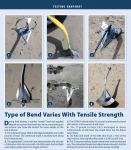
The worst offenders for bent shanks are in this picture some of you will have seen before:
Anchor Tests: Bending More Shanks - Practical Sailor (practical-sailor.com)
1673692737927.png
 
The Lewmar Deltas are on all the RNLI RIB's, as they need a good plough for rescues that need the boat anchored, like a boat on the rocks where they veer down to get the crew off in very bad conditions. If the anchor drags, they would probably be too close to the rocks to try again.

The UK Spade is a very good main anchor, BUT the RNLI made a horrible mistake by not doing a rust test. All of the older Spades corrode very badly, although the first issue was the yellow paint fell off. They need to be hot dipped galvanised correctly if you have the same problem. I doubt very much if they will order any more unless the manufacturer gets their act together over the Zinc coating and uses a real good 2 component yellow epoxy. Alas that will make the Spade more expensive.

Ploughs like the Delta or CQR need more scope than the Spade, and that is an issue in deep water, hence the anchors in the inshore boats are different to the offshore ones. Same with the USCG, although they only use the Claw, (Bruce), steel Danforth and fishernmans inshore, but use 2 ships anchors that are basically fat steel Danfoths. Their RIBS use Fortress anchors as they are weight critical.

The offshore boats often get called out to do an inshore rescue, so they do anchor, but in much more serious conditions than any other operator, although I've seen some fishing boats using the same gear to get to fish like Sardines that hang out near the shore, so they anchor and veer down on them. Had to rescue one once as his engine had failed due to a flat start battery. All lifeboats are required to have 2 start batteries if they can't hand crank their engine(s).


What a load of rubbish, have you ever worked for the RNLI or been involved in UK SAR. The RNLI will not carry fishermans anchors on the ALBs anymore as they're too awkward to deploy. Hense why the Mersey, Shannon and Tamar Class all have two Deltas or Spades.

Along with that there is no such thing as a UK Spade anchor they're the same anchor where ever you go they're not produced in the Uk nor do they change nationality when they get shipped to the UK. GET YOUR FACTS RIGHT.

Lewmar anchors with the exception of the Delta and Epsilon are all copies of anchor designed by others that are no longer produced by the original manufacturer. Hense why the Lewmar Claw is a poor copy of the Original BRUCE anchor.

Please stop making stuff up and filling these useful threads with litter.
 
What a load of rubbish, have you ever worked for the RNLI or been involved in UK SAR. The RNLI will not carry fishermans anchors on the ALBs anymore as they're too awkward to deploy. Hense why the Mersey, Shannon and Tamar Class all have two Deltas or Spades.

Along with that there is no such thing as a UK Spade anchor they're the same anchor where ever you go they're not produced in the Uk nor do they change nationality when they get shipped to the UK. GET YOUR FACTS RIGHT.

Lewmar anchors with the exception of the Delta and Epsilon are all copies of anchor designed by others that are no longer produced by the original manufacturer. Hense why the Lewmar Claw is a poor copy of the Original BRUCE anchor.

Please stop making stuff up and filling these useful threads with litter.

Sounds like another upset bent anchor owner. In answer to your questions, I don't do voluntary work, but did do 2 years armed rescue work for the TNLI, (Trinidad), and I might go back to skippering one of their offshore boats, although they spend a lot of time inshore. Great job and very well paid. I'm too old to run around in RIB's and the SBS, (special Boat Service take care of Trinidad armed resue duties and general police boat jobs. Tobago is far safer, so during the day the Red Cross take care of most incidents, but can call up for help which is about 30 mins away, in the form of a well armed 85ft Vosper Thorny patrol boat crewed by the Trinidad Navy.

I work overseas, and my main home is in Germany, which rules out local S&R work. They pay peanuts anyway. Oddly enough the RNLI pay their engineers and production staff very well, so almost every nautical type is trying to get a job there. I just want to depart once I've finished the present build.

Nit picking is a bad habit, UK Spade is the term used for anchors made by Spade Anchors UK Ltd
Spade Anchor UK - UK & Ireland Website - Official Spade Anchor Distributor - Dealer (spade-anchor.co.uk)

Lewmar purchased the design rights to a number of different anchors, but the name Bruce is trademarked, hence the use of the Claw. So I wonder what the difference is, as it sure looks like a Bruce to me. It failed Lloyds test for weeds and is not as good as the Lewmar CQR or Delta in most types of bottom with 4 to 1 chain rode. 3 to 1 is the same in holding power terms.
The Bruce anchor was based on a thinner version of a Claw designed during the early days of WW2 for use in sand, mud, coral and rocks, BUT not for weed as there is very little around the islands in the central and Western Pacific where the tank landing craft needed a real good kedge stern anchor. I wish I could get a picture to look at the actual shape, as I've only seen them in war movies where they are half hidden by a serious hydraulic windlass with a very large drum of chain mounted just above the stern. Those USN landing craft used to smash through coral and slide over rocks to get to the beach, but dropped the Claw just before hitting outer reef. The 2 props and flat bottom were very similar to some offshore lifeboats in terms of shape and the way the props are recessed. Not sure if the USN Claw was a copied design or not, but I don't think so.

PS: This part of the UK Spade, or Spade UK's web site is funny, cos it's mud slinging at some of the new generation anchors. The Rocna is probably the worst as they are hopeless in 180 degree veer terms. The Danforth is ten times better. I love to be able to buy a stainless Spade, but alas they are kind of expensive.
SPADE WARRANTY TERMS

SPADE ANCHOR GUARANTEE – From Sea Tech & Fun, Manufacturers of the SPADE Anchor

LIMITED GUARANTEE :
The SEA TECH & FUN sarl Company hereby warrants the SPADE anchor against breakage that may occur to any part of the anchor.
The SEA TECH & FUN sarl Company will replace the defective anchor free of charge, subject to the following conditions :

· The anchor has been correctly selected in relation to the length and displacement of the vessel (see our leaflet)
· The anchor has not been modified, drilled or repaired in any way
· Damage by deformation or bending is not covered by the guarantee
· The galvanisation of the steel version must be kept in right order
· The anchor has not been abused, misused or improperly taken care of.
· The anchor has been used following admitted anchoring practice
· The anchor did not suffer from an abnormal strength in particular to kick it away of an obstacle

The anchor must be sent back, ONLY AFTER AGREEMENT with the SEA TECH & FUN sarl Company, with a Return Merchandise Authorisation number, a copy of the original invoice and a picture of the defective anchor.
The shipping costs in both directions are at the charge of the customer and are not covered by the guarantee.
Under no circumstances, The SEA TECH & FUN sarl Company can be liable for any direct or indirect, incidental or consequential damage from the sales or use the anchor.


PS: This part of the UK Spade, or Spade UK's web site is funny, cos it's mud slinging at some of the new generation anchors. The Rocna is probably the worst as they are hopeless in 180 degree veer terms. The Danforth is ten times better. I love to be able to buy a stainless Spade, but alas they are kind of expensive.
 
Last edited:
Sounds like another upset bent anchor owner. In answer to your questions, I don't do voluntary work, but did do 2 years armed rescue work for the TNLI, (Trinidad), and I might go back to skippering one of their offshore boats, although they spend a lot of time inshore. Great job and very well paid. I'm too old to run around in RIB's and the SBS, (special Boat Service take care of Trinidad armed resue duties and general police boat jobs. Tobago is far safer, so during the day the Red Cross take care of most incidents, but can call up for help which is about 30 mins away, in the form of a well armed 85ft Vosper Thorny patrol boat crewed by the Trinidad Navy.

I work overseas, and my main home is in Germany, which rules out local S&R work. They pay peanuts anyway. Oddly enough the RNLI pay their engineers and production staff very well, so almost every nautical type is trying to get a job there. I just want to depart once I've finished the present build.

Nit picking is a bad habit, UK Spade is the term used for anchors made by Spade Anchors UK Ltd
Spade Anchor UK - UK & Ireland Website - Official Spade Anchor Distributor - Dealer (spade-anchor.co.uk)

Lewmar purchased the design rights to a number of different anchors, but the name Bruce is trademarked, hence the use of the Claw. So I wonder what the difference is, as it sure looks like a Bruce to me. It failed Lloyds test for weeds and is not as good as the Lewmar CQR or Delta in most types of bottom with 4 to 1 chain rode. 3 to 1 is the same in holding power terms.
The Bruce anchor was based on a thinner version of a Claw designed during the early days of WW2 for use in sand, mud, coral and rocks, BUT not for weed as there is very little around the islands in the central and Western Pacific where the tank landing craft needed a real good kedge stern anchor. I wish I could get a picture to look at the actual shape, as I've only seen them in war movies where they are half hidden by a serious hydraulic windlass with a very large drum of chain mounted just above the stern. Those USN landing craft used to smash through coral and slide over rocks to get to the beach, but dropped the Claw just before hitting outer reef. The 2 props and flat bottom were very similar to some offshore lifeboats in terms of shape and the way the props are recessed. Not sure if the USN Claw was a copied design or not, but I don't think so.

PS: This part of the UK Spade, or Spade UK's web site is funny, cos it's mud slinging at some of the new generation anchors. The Rocna is probably the worst as they are hopeless in 180 degree veer terms. The Danforth is ten times better. I love to be able to buy a stainless Spade, but alas they are kind of expensive.
SPADE WARRANTY TERMS

SPADE ANCHOR GUARANTEE – From Sea Tech & Fun, Manufacturers of the SPADE Anchor

LIMITED GUARANTEE :
The SEA TECH & FUN sarl Company hereby warrants the SPADE anchor against breakage that may occur to any part of the anchor.
The SEA TECH & FUN sarl Company will replace the defective anchor free of charge, subject to the following conditions :

· The anchor has been correctly selected in relation to the length and displacement of the vessel (see our leaflet)
· The anchor has not been modified, drilled or repaired in any way
· Damage by deformation or bending is not covered by the guarantee
· The galvanisation of the steel version must be kept in right order
· The anchor has not been abused, misused or improperly taken care of.
· The anchor has been used following admitted anchoring practice
· The anchor did not suffer from an abnormal strength in particular to kick it away of an obstacle

The anchor must be sent back, ONLY AFTER AGREEMENT with the SEA TECH & FUN sarl Company, with a Return Merchandise Authorisation number, a copy of the original invoice and a picture of the defective anchor.
The shipping costs in both directions are at the charge of the customer and are not covered by the guarantee.
Under no circumstances, The SEA TECH & FUN sarl Company can be liable for any direct or indirect, incidental or consequential damage from the sales or use the anchor.


PS: This part of the UK Spade, or Spade UK's web site is funny, cos it's mud slinging at some of the new generation anchors. The Rocna is probably the worst as they are hopeless in 180 degree veer terms. The Danforth is ten times better. I love to be able to buy a stainless Spade, but alas they are kind of expensive.


Have you got a website link to the TNLI I cannot see any information about them on the internet?
 
Whilst TNLI disappears off in his fantasy land, have any regular anchor users ever had a bent anchor shank?

It’s a no from me
There have been photos of most anchors with bent shanks on the internet but all created in exceptional conditions. I have many of them in my collection, including the 'unbendable' CQR.

The only ones I know of that bent in normal service were the Rocnas made with soft shanks. All were recalled and destroyed. I think there were less than 10 documented examples. This was more than 20 years ago.
 
There have been photos of most anchors with bent shanks on the internet but all created in exceptional conditions. I have many of them in my collection, including the 'unbendable' CQR.

The only ones I know of that bent in normal service were the Rocnas made with soft shanks. All were recalled and destroyed. I think there were less than 10 documented examples. This was more than 20 years ago.

Lots of anchors get bent, mostly in rocks. The Danforth I bent in Australia got jammed in a wreck I was chumming over. I did get it free by pulling hard in different directions, but one of them was too much. Got it unbent in the local Freemanle machine shop. Replaced it with another rusty Danforth and made a fixed grapnel from rebar for fishing over wrecks.

PS: As regards the other reply, the TNLI does not exist at present, although it was a part of the SAUTT, (Special Anti Crime Unit of Trinidad &Tobago), which is a part of the TNSS, (National Security Service). TNLI stands for Trinidad's National Lunatics Institute when off duty or in Blighty.
I am in no way involved with operating offshore rescue boats for the oil & gas folks in Trinidad, as I'm too expensive. They do get in the press on occasions, mostly demonstrating what not to do:
Video: Liftboat Capsizes and Sinks off Trinidad & Tobago (maritime-executive.com)
 
... have any regular anchor users ever had a bent anchor shank?

It’s a no from me

Bent shanks on light weight (not heavy ship-type) pivoting fluke are not too unusual. Not me, but I've seen several in the marina. The cause is typically yanking hard during recovery by running the boat up over it. It might be stuck under a rock. It might be deeply set in firm mud and they were too impatient to use steady pressure to break it out.

This is not to imply they are not good anchors in their place. Often the cause of a broken tool is missuse, not poor construction or design.
 
All of those anchors with the exception of the Lewmar Epsilon failed the full ABS strength test. The Fortress only has a partial ABS approval as it passed the drop test and failed the shear one because they bend. Look it up in Lloyds or ABS web sites.
The worst offenders for bent shanks are in this picture some of you will have seen before:
Anchor Tests: Bending More Shanks - Practical Sailor (practical-sailor.com)

View attachment 149238
I bent all of the anchors in this collection of photos. They were my anchors and my test. The test resulted in some of the manufacturers taking note and improving shank strength and fluke re-design.

Some manufacturers take note of test results.

I was testing shank strength to snatch loads, imposed by a 2t 4x4. All the anchor were set to a 500kg tension and the 4x4 took a run at the embedded anchors.

The steel Excel shank did not bend. As a result of the test the shank of the SARCA was altered to BIS 80. The aluminium Excel was redesigned and the shank made from high tensile aluminium and the shank thickened - it is now of the same order of strength as the steel Excel with the BIS80 shank. Fortress honoured their warranty of no questions asked and sent me a new shank at their expense. The bent SARCA and bent aluminium Excel were replaced with the updated models, free of charge. We have been using the new updated aluniummExcel as our primary ever since - no issues.

Jonathan
 
Whilst TNLI disappears off in his fantasy land, have any regular anchor users ever had a bent anchor shank?

It’s a no from me

It takes a lot to bend a shank of an anchor, you need to have the anchor we’re secured and risk damaging some component on your yacht if you snatch load the immovable anchor. Better to dive and try to free the anchor or cut the chain and simply replace your loss with your spare primary nchorn(a which everyone has in their locker and is the size and quality as the embedded model)

we have never had an anchor immovably stuck, we tend to anchor in locations that are sheltered and where rocks and coral are accurately located. We would always try to anchor in sand patches, obvious from the surface as they are white and the rocks and weed look black. Both rock and weed provide very insecure location for anchoring for a whole variety of reasons and are best avoided (for anchoring). Today most anchorages are well defined and have been described for decades, initiallyfrom Navy vessels (our anchoring guide for Tasmania includes the UK Navy Admiralty Pilot, the surveys originally being made by HMS Bramble and HMS Rattlesnake - both sailing vessels, and then ‘us’ - there is little excuse to anchor in heavy weed coral or rocks.

Jonathan
 
Last edited:
It takes a lot to bend a shank of an anchor, you need to have the anchor we’re secured and risk damaging some component on your yacht if you snatch load the immovable anchor. Better to dive and try to free the anchor or cut the chain and simply replace your loss with your spare primary nchorn(a which everyone has in their locker and is the size and quality as the embedded model)

we have never had an anchor immovably stuck, we tend to anchor in locations that are sheltered and where rocks and coral are accurately located. We would always try to anchor in sand patches, obvious from the surface as they are white and the rocks and weed look black. Both rock and weed provide very insecure location for anchoring for a whole variety of reasons and are best avoided (for anchoring). Today most anchorages are well defined and have been described for decades, initiallyfrom Navy vessels (our anchoring guide for Tasmania includes the UK Navy Admiralty Pilot, the surveys originally being made by HMS Bramble and HMS Rattlesnake - both sailing vessels, and then ‘us’ - there is little excuse to anchor in heavy weed coral or rocks.

Jonathan
Here in the Caribbean we don't always have the luxury of good water visibility to select a nice sandy spot. As a result we often anchor in seagrass. A decent sharp pointy anchor of new generation variety makes all the difference. We also are in a windy location. We can anchor in sheltered spots but they are not always the best spots. It hot here even in winter. No reason not to be somewhere where the breeze blows hard and the bugs stay away. A good anchor allows us access to these spots in complete confidence that we will stay put.
 
Last edited:
Bent shanks on light weight (not heavy ship-type) pivoting fluke are not too unusual. Not me, but I've seen several in the marina. The cause is typically yanking hard during recovery by running the boat up over it. It might be stuck under a rock. It might be deeply set in firm mud and they were too impatient to use steady pressure to break it out.

This is not to imply they are not good anchors in their place. Often the cause of a broken tool is missuse, not poor construction or design.

So which ones have you seen bent in your marina ??

If you have serious problems trying to weigh anchor, don't go nuts at full power or sail. Try tripping the anchor by slowly working around the other side after placing a steel clip, or special loop over the chain and using your secondary rode or a good line to see if that trips it. In the end though if its jammed under a rock or wreck you will have no choice but to guess at the best direction and then use flank power, unless a diver can connect up a trip line to the head.
I've have had some fairly bad problems tripping jammed anchors, but never lost one yet. Alas I've spent too much time anchoring over areas where the bottom has debris, rocks and even wrecks. After I bent a Danforth I switched to using cheap home made grapnels that were thin enough rebar for full stern to unbend, and cheap enough to throw away on occasions.
 
It takes a lot to bend a shank of an anchor, you need to have the anchor we’re secured and risk damaging some component on your yacht if you snatch load the immovable anchor. Better to dive and try to free the anchor or cut the chain and simply replace your loss with your spare primary nchorn(a which everyone has in their locker and is the size and quality as the embedded model)

we have never had an anchor immovably stuck, we tend to anchor in locations that are sheltered and where rocks and coral are accurately located. We would always try to anchor in sand patches, obvious from the surface as they are white and the rocks and weed look black. Both rock and weed provide very insecure location for anchoring for a whole variety of reasons and are best avoided (for anchoring). Today most anchorages are well defined and have been described for decades, initiallyfrom Navy vessels (our anchoring guide for Tasmania includes the UK Navy Admiralty Pilot, the surveys originally being made by HMS Bramble and HMS Rattlesnake - both sailing vessels, and then ‘us’ - there is little excuse to anchor in heavy weed coral or rocks.

Jonathan

The fishing is not so good in most sand or mud areas, and some places that are fun to anchor as lunch stops with a great view or real good beach have weed or rocks, so adventurous boaters do get the occasional stuck anchor incident.
 
The CQ
Here in the Caribbean we don't always have the luxury of good water visibility to select a nice sandy spot. As a result we often anchor in seagrass. A decent sharp pointy anchor of new generation variety makes all the difference. We also are in a windy location. We can anchor in sheltered spots but they are not always the best spots. It hot here even in winter. No reason not to be somewhere where the breeze blows hard and the bugs stay away. A good anchor allows us access to these spots in complete confidence that we will stay put.
The CQR and Danforth both have good points, it's the Bruce that is a bad choice if there is any weed. The only issue is that the CQR needs more scope than a Danforth or new generation anchor. If the point is too radical as some are, the Zinc chips or wears off the point and results in the anchor rusting from the tip first.
 
Why was
I bent all of the anchors in this collection of photos. They were my anchors and my test. The test resulted in some of the manufacturers taking note and improving shank strength and fluke re-design.

Some manufacturers take note of test results.

I was testing shank strength to snatch loads, imposed by a 2t 4x4. All the anchor were set to a 500kg tension and the 4x4 took a run at the embedded anchors.

The steel Excel shank did not bend. As a result of the test the shank of the SARCA was altered to BIS 80. The aluminium Excel was redesigned and the shank made from high tensile aluminium and the shank thickened - it is now of the same order of strength as the steel Excel with the BIS80 shank. Fortress honoured their warranty of no questions asked and sent me a new shank at their expense. The bent SARCA and bent aluminium Excel were replaced with the updated models, free of charge. We have been using the new updated aluniummExcel as our primary ever since - no issues.

Jonathan

Interesting, so there is a Mk 2 Excel, but why did you not include the Rocna ??

I don't regard the Excel as a new generation anchor, as it looks like a modified Delta plough. Alloy anchors should only be used as a main if you need to keep the weight as low as possible. The USCG uses the Fortress Danforth for that reason in their RIBS, although the one I saw in Florida was fairly big in size terms and was not a kit bolt together job.
 
Why was


Interesting, so there is a Mk 2 Excel, but why did you not include the Rocna ??

I don't regard the Excel as a new generation anchor, as it looks like a modified Delta plough....

You would be wrong about that, but I can certainly understand why it looks that way. But having tested and owned both Delta and Excel ...

The changes are more than an accidental tweaks. The down turned nose makes a big difference during enguagment. The flange around the outside discourarages dirt from sliding off, making it function more like two scoop facing outwards than a plow. The nice thing about facing outwards is that the soil is placed in compression rather than shear, which can make a big difference in weak soils. Even the tail kicks are different, facing outwards to aid turning behavior, instead of upwards like the Delta, which helps ... nothing, other than making a useless mound. And unlike roll bar anchors, clogging, which can prevent reset, is impossible, which have learned is a thing.

Very different, and just as much an evolutionary step as other NG anchors. More subtle than pasting on a roll bar or adding a Delta shank to a Bugel.
 
Why was


Interesting, so there is a Mk 2 Excel, but why did you not include the Rocna ??

I don't regard the Excel as a new generation anchor, as it looks like a modified Delta plough. Alloy anchors should only be used as a main if you need to keep the weight as low as possible. The USCG uses the Fortress Danforth for that reason in their RIBS, although the one I saw in Florida was fairly big in size terms and was not a kit bolt together job.

Because I wpould not buy One. I am of the opinion Yhe Smiths should not have obfuscated over the bendy shanks and should also have had rigorous QC in place to ensure quality was maintained. my disapproval is such that I would not buy one. I cannot do more and I acce[t that it is a decent anchor (they are all A compromise) and Inormally include then in my list of good anchors. If you find the follow up article to the one you included you will find I did test one of the Rona’s with a bendy shank - and still have it.

You may discount the Excel as not a new generation anchor - but I don’t actual;y think mahy here care what you think. It has twice the hold of a similar;y weighted DeLita or CQDR and the same hold as a similarly weighted Ultra, Spade or Rocna. Whether you rate it is immaterial.

I’m not sure why you so readily discount the alumnium Excel - it has the same hold as the steel version and it’s shank is stronger than many of its steel peers and not much different in strength to its steel twin with the BIS80 shank. maybe you should use one for 10 years or so - amd then you would change your mind.

Yhe Fortress FX 125 are used a the primary anchor on the 125’ ocean going customs or coastguard boats in the US. You might not use one but the US do and sad;y, for you, I rate the US experience and usage than yours

Jonathan
 
Gosh! I was wondering what I'm going to do this afternoon!
Cheweating Popcorn GIFs | Tenor

It’s been a long afternoon, I hope you can stand the pace!

:)

Jonathan
 
Lots of anchors get bent, mostly in rocks. The Danforth I bent in Australia got jammed in a wreck I was chumming over. I did get it free by pulling hard in different directions, but one of them was too much. Got it unbent in the local Freemanle machine shop. Replaced it with another rusty Danforth and made a fixed grapnel from rebar for fishing over wrecks.

PS: As regards the other reply, the TNLI does not exist at present, although it was a part of the SAUTT, (Special Anti Crime Unit of Trinidad &Tobago), which is a part of the TNSS, (National Security Service). TNLI stands for Trinidad's National Lunatics Institute when off duty or in Blighty.
I am in no way involved with operating offshore rescue boats for the oil & gas folks in Trinidad, as I'm too expensive. They do get in the press on occasions, mostly demonstrating what not to do:
Video: Liftboat Capsizes and Sinks off Trinidad & Tobago (maritime-executive.com)

that explains a lot - but if TNLI does not exist why does it keep posting erroneous information on YBW.
TNLI needs to get back to the alternate universe where it belongs.

Jonathan
 
Status
Not open for further replies.
Top