Anchor setup for serious crusing - anchor size for 25 foot, 2 tons (4500 pounds) yachts

Status
Not open for further replies.
You would be wrong about that, but I can certainly understand why it looks that way. But having tested and owned both Delta and Excel ...

The changes are more than an accidental tweaks. The down turned nose makes a big difference during enguagment. The flange around the outside discourarages dirt from sliding off, making it function more like two scoop facing outwards than a plow. The nice thing about facing outwards is that the soil is placed in compression rather than shear, which can make a big difference in weak soils. Even the tail kicks are different, facing outwards to aid turning behavior, instead of upwards like the Delta, which helps ... nothing, other than making a useless mound. And unlike roll bar anchors, clogging, which can prevent reset, is impossible, which have learned is a thing.

Very different, and just as much an evolutionary step as other NG anchors. More subtle than pasting on a roll bar or adding a Delta shank to a Bugel.
Great, so I will
You would be wrong about that, but I can certainly understand why it looks that way. But having tested and owned both Delta and Excel ...

The changes are more than an accidental tweaks. The down turned nose makes a big difference during enguagment. The flange around the outside discourarages dirt from sliding off, making it function more like two scoop facing outwards than a plow. The nice thing about facing outwards is that the soil is placed in compression rather than shear, which can make a big difference in weak soils. Even the tail kicks are different, facing outwards to aid turning behavior, instead of upwards like the Delta, which helps ... nothing, other than making a useless mound. And unlike roll bar anchors, clogging, which can prevent reset, is impossible, which have learned is a thing.

Very different, and just as much an evolutionary step as other NG anchors. More subtle than pasting on a roll bar or adding a Delta shank to a Bugel.

Thanks for the reply, and I will add the new Mk 2 steel Excel to my list of potential main anchors, BUT, (And that is a big BUT), I would want to see results for the, UFF, (Ultimare failure force for a rock or similar jam), which is the lower of the shear or tensile force required to either break or bend the anchor so it does not reset. That figure is very important if the anchor is used in a storm.

The UFF for a genuine CQR, Bruce, (Or Lewmar Claw) and Admiraly pattern fishermans made by a good company are all irrelevant, as the chain connector shackle or the chain itself will fail first, unless you use a titanium or very expensive high grade anchor connector with oversized chain.

I agree with all of your reply, (Rare for me to think any of the replies completly correct), as clogging is sometimes a problem, and is one thing along with poor performance in weed about the Bruce that I don't like, if used in heavish mud in particular. I only use small undersize Bruce because it's a stainless one that looks cool as a lunch or stern pick.

Final question, why did you not include a standard anchor to act as a reference in the very good article and picture ??? The obvious choice would be a good steel Danforth from Force 4, or West Marine.
 
Whilst TNLI disappears off in his fantasy land, have any regular anchor users ever had a bent anchor shank?

It’s a no from me
I bent my danforth shank a few years back. Then had a 10kg delta that was the correct size for my boat and it dragged in mud so upgraded to a 15kg? rocna that works well for me even when the tide turns.
 
The CQ

The CQR and Danforth both have good points, it's the Bruce that is a bad choice if there is any weed. The only issue is that the CQR needs more scope than a Danforth or new generation anchor. If the point is too radical as some are, the Zinc chips or wears off the point and results in the anchor rusting from the tip first.
CQR doesn't work here. They are horrendous. They won't dig through the tough sea grass. Totally the wrong anchor. Nobody uses a Danforth as a primary anchor. We get lots of strong squalls. If the squall arrived from a different direction, which they often do, you would bend a Danforth. Squalls here can be over 40kts. You need a good modern anchor not a relic from the past.
 
Final question, why did you not include a standard anchor to act as a reference in the very good article and picture ??? The obvious choice would be a good steel Danforth from Force 4, or West Marine.
I feel that a standard anchor should be a CQR as they have been used round the world. I get the impression that danforth is more a USA and UK item.
 
The TNLI does exist in Trinidad & Tobago, and in vitual world. Trev's Nautical Lunatics Institute has even made the press a few times, mostly following some kind of serious loss during a rescue, civil surveillance, (Looking for folks in small boats who lack a visa), and in my local pub.
 
In a former life I was active in several standards organizations (API, ASTM). Many standards call for a "baseline" piece of equipment, such as an engine or pump. It was not intended to be a low performer, but rather something middle of the road that was widely used and well understood. And the baseline equipment was commonly changed to something more modern every 10-20 years, as products and the market evolved.

The baseline anchor, then, should be a new generation anchor that has been used widely all over the world. There are a few obvious choices.

As for Danforth and Fortress anchors, it should be obvious that pivoting fluke anchors and scoop/plow anchors are as different as monohulls and multihulls, and thus are separate categories that will have separate baselines.

In my testing I used a NG and a pivoting fluke anchor as separate baselines, and limited my direct comparisons between the two categories. Comparing a Fortress with an Excel is rather like comparing pliers with an open end wrench. Not fruitful.
 
The TNLI does exist in Trinidad & Tobago, and in vitual world. Trev's Nautical Lunatics Institute has even made the press a few times, mostly following some kind of serious loss during a rescue, civil surveillance, (Looking for folks in small boats who lack a visa), and in my local pub.

You've just completely made that up. At the same time as making up your own personal dream land. Could you please create an anchor that will set in every seabed and will never break out when resetting don't forget your favorite subject of bending anchors so make sure its unbreakable. TNLI Super Holder
 
I feel that a standard anchor should be a CQR as they have been used round the world. I get the impression that danforth is more a USA and UK item.

When you compare with a standard I would base it on the most common anchor for the type of sea bed you are interested in and the application. The anchors you select as a main or storm anchor should be based on a comparison with the Lewmar Delta for mud, sand and light gravel. The CQR is a fraction better if compared with a 4 to 1 all chain rode. That's why they put the CQR back into production. The stainless version is slightly different in shape terms, as even the best 316S is weaker in shear terms, (Better in a straight pull), than any good steel. Never forget that you must not use an anchor that bends of brakes before the chain snaps, because if your beloved storm main does pull out and gets bent in the process, it will not reset. That is one of many reasons why I often use a secondary anchor. Some of the so called new generation anchors are just modified light weight versions of old designs.

If you are comparing anchors, make sure to base the comparson on the limiting factors in installation or use terms. That might be weight, BUT, it's often size or if you can use an existing fitting to mount it. Many authorities do not allow you in a marina or race with a bow anchor fitted that protrudes past the bow or either side, as they are bad news in a collision and hook up other yachts rigging when some chump makes a mess of docking. One limiting factor for my fishermans is height, as I'm copying the way some USCG and RNLI boats carry their anchors, so will clamp it to a stanchion. If it's too high the sheets for the jib would hook up on it, although weight is a main factor as regards the CQR because I'm not fitting a heavy manual windlass, as it would be significant negative factor in the various self righting calculations and tests, and the ballast to offset a good one, has to be 4 times the weight due to the hight of the bow. That total would be more than both chains, which are stored low enough to be slightly below the waterline, so good news. I used to pull up a 35lb CQR by hand sometimes, but that was 20 years ago, so I'm lucky my genuine CQR is only 15lbs, although the chain is 6mm.

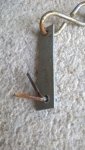
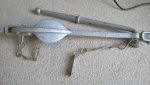
Now for something different, as I recently purchased a new folding admiralty pattern fishermans, (Only for temporary use in rocks or weeds) BUT, decided to test it for corrosion by leaving it in the garden , so this is the result after 2 rainy weeks. The actual anchor is OK, BUT the chains are ungalvanised rubbish. If it had been stored in damp salty air or on deck, it would been far worse. I'm stunned that they think a steel cotter pin could be used to secure the cross bar.
 

Attachments

  • Rusty pin.jpg
    Rusty pin.jpg
    288.4 KB · Views: 6
  • Anchor with rusty chains.jpg
    Anchor with rusty chains.jpg
    306.3 KB · Views: 5
Others complain about long and verbose posts. I have learnt very quickly to be selective in the posts I read. I wonder why instead of reading long posts others don’t do the same and stop whinging.

Life is too short to spend time reading a post you know will upset you and then invest time in repetitively moaning. Beggars belief.

Jonathan
 
I'm feeling mellow and quite moderate, for once. Thanks, TNLI, for the 20 minutes of chuckles....

I endorse the idea of 'geem's 'bullshit' button but would suggest it might seem more refined, more educated were we to call it the 'Bolleaux Button'..... :LOL:

And... add in an 'unlike' vote-feature. It's available in the catalogue.
 
In a former life I was active in several standards organizations (API, ASTM). Many standards call for a "baseline" piece of equipment, such as an engine or pump. It was not intended to be a low performer, but rather something middle of the road that was widely used and well understood. And the baseline equipment was commonly changed to something more modern every 10-20 years, as products and the market evolved.

The baseline anchor, then, should be a new generation anchor that has been used widely all over the world. There are a few obvious choices.

As for Danforth and Fortress anchors, it should be obvious that pivoting fluke anchors and scoop/plow anchors are as different as monohulls and multihulls, and thus are separate categories that will have separate baselines.

In my testing I used a NG and a pivoting fluke anchor as separate baselines, and limited my direct comparisons between the two categories. Comparing a Fortress with an Excel is rather like comparing pliers with an open end wrench. Not fruitful.

One thing I want to point out is that most of my comments relate to selecting an anchor to use in seriously bad conditions, which for many boaters is the main anchor because they get caught out by a sudden serious squall or a forecast that was incorrect and don't have a sensible secodary availble, or conditions are just too bad to set a second anchor. So when comparing anchors, it's essential to list the force required to bend it and the force required to brake it in straight pull terms. Otherwise what you do by publishing all the fancy tables for holding power, is to encourage designers and manfacturers to build lighter anchors.

In terms of a baseline or comparison anchor it makes sense to use the most popular anchor that is in current production. So if you are looking at different anchors in the UK or EU, the most common one is the Lewmar Delta, which is a very good anchor.

For applications where tough anchors that can't be bent or broken are of no interest, then the baseline would be a steel Danforth, BUT I would also list the Fortress with a warning about the low bend force figure, or write that column next to it. Then you will see that if you ignore the anchor strenth related issue and look at holding power per pound, as far as I can see, none of the new generation anchors beat the Fortress, and in many comparisons it was missing from the list, and the Danforth anchors are far easier to set, set in a shorter distance and reset faster. So if you have a yacht with no engine, it's a real good choice as you might not be able to set a CQR or Delta correctly.
 
Yup, fairyland.

do not forget your own advice

Don’t feed the trolls.

Jonathan


I'm feeling mellow and quite moderate, for once. Thanks, TNLI, for the 20 minutes of chuckles....

I endorse the idea of 'geem's 'bullshit' button but would suggest it might seem more refined, more educated were we to call it the 'Bolleaux Button'..... :LOL:

And... add in an 'unlike' vote-feature. It's available in the catalogue.

Casting pearls before swine ?

or

water off a ducks back


just wait for the return of the UK Spade, the American WWII Bruce and the Martian Northhill. (much mentioned by HG Wells and John Wyndham)

;)

Jonathan
 
HOW TO SET A STORM ANCHOR

I just want to explain why this anchor or daft stainlees swivel failure is important and why you do not want to finish up with a bent anchor.

If you are unlucky enough to be caught by a sudden seriously interesting thunderstorm or cold front related squall in an anchorage that is either open or has enough fetch to result in waves large enough to turn your yacht into an anchored submarine at times, you do need to know how to set a storm anchor properly. It's not difficult, as the part to remember is to use a plow anchor of some approved type, (Might even be a Mk 2 Excel if they decide to make it), a Lewmar Delta or one of the slightly better performing Lewmar CQR's. Then after you have selected the best place to anchor before the line squall arrives, or the unforecast South Pacific Convergence zone decides to send you a present of 50 to 75 knots down the elongated anchorage in Vavau for a few hours, when you are at the wrong end and unable to escape, (My steel yacht's donkey was too small to try and depart and the gusty winds would have turned an attempt to sail out into a case of mission impossible). So I needed to set my main storm anchor correctly, and that means putting the maximum force possible in an attempt to bury it, then motoring or even sailing back towards the anchor and going slightly nuts at full sail or full power to did it even further. You need to do that 3 or 4 times, check checking to see if the anchor is still moving. Some of your neighbours will think you have drunk too much or got an anchor stuck in a coral head or into debris.

The CQR is incredible when used in good holding, preferably soft mud if you have the choice, but even in sand it will keep digging further and further in until you will find it very difficult to retrieve, (I needed to overrun my CQR in Colons main anchorage at full power to get it to trip once), I've been told the Delta does not dig in quite so far when treated in the same way. When the squall or small tornado arrives, (Florida is a fun place as is the entire Gulf), it will probably produce a wind at some point that is not from the direction you set the anchor in. Bad bad news if the shank can be bent and if it does trip, the speed of the boat in the wind and waves might mean it will not reset if it's a lightly built one. Obviously a long heavy chain rode will help a lot in reset terms.

All of the good plow desigs act in a similar way when set correctly for a storm, (The CQR is the best in terms of heading for the center of the planet in soft mud in particular), but no one has made a good video of an attempt to bury one. Once you have done your best setting wise, set your secondary main, BUT in a normal manner at at an angle that might relate to a new forecast wind direction, although in many squall situations you don't know what that will be, so just set it 30 degrees off the bow. Check on than anchor during the passing squall or storm to make sure you are not really pulling on it, in other words let the storm anchor do its job and use the secondary as insurance.

OK, now I will stop posting as I only got one interesting reply about a potential Mk 2 Excel plow. Just a lot of trollers and time wasters. I've also finished being stuck with nothing to do, due to my temporay job as a carer for a relative who is in a bad way. Luckily he is 91 years old and has done enough in life to be ready to meet our Lord in the not too distant future. He's an ex RN chap who also knows about anchoring in bad conditions, although only if it's a destroyer or minelayer. HMS MANXMAN, the fastest ship in the fleet, capable of 37 kts at flank fully loaded, The harbour authorities don't like minlayers blocking the entrance to a port, so they are inclined to start shelling you or chasing you with an E boat. The minelayers have a destroyers hull, smaller main arnament, similar AA guns, no torpedos, BUT have the engines of a cruiser. They were often used as an express frieight delivery service in the Med in particular. Not funny when you are asked to carry tons of ammunition rather than food or general cargo. I had to laugh once when my father told me that a new chap joined the ship for a serious ammunition delivery and asked the senior engineer where his life jacket was. The engine room chaps looked at him like he was some special kind of idiot, before the officer told him that if they took a serious hit, he would be in heaven or hell before he ever got to his locker!

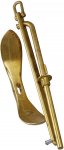
Back indirectly on topic, (3 hrs stuck waiting for the district nurse etc), the fisharmans anchor is important, although for most boaters it is often kept in a locker. I've done enough research to figure out that the normal cheap bar version I purchased, (Pre abused), is not reall the best version, the folding admiraly pattern one is good, but that was new so will be returned to Fleabay with pictires of the terrible rusty chains and cotter pin. The best version for a small boat like mine is the HERRESHOF, (Warning, might be German), as it's a 3 piece and has enough hookn area to provide a ceratain amount, (Rather low but OK for a light wind and current lunch stop), of holding power in mud or sand. Fairly OK in gravel or pebbles, but a real star in serious weed and rocks.
The other thing I like is the bronze version looks cool, BUT will need coating with a metal varnish or hard wax to stop the dreaded green vergie bug.

SO TO ANSWER THE OP's question:

GENUINE CQR or Lewmar stainless steel CQR if you like to impress your fellow boaters, good used DELTA if you are short of dosh.
DANFORTH, probably from Force 4 or West Marine, but for a weight critical race or power boat, a FORTRESS
HERRESHOF or stainless Admiralty pattern. (Rocks heavy weed and deep water anchoring).

Good used, or new Force 4 CQR or plough in a locker just in case your main gets stolen or lost might be worth adding for a serious cruise.

2 all chain rodes, one correct size for boat, one which is a size bigger if you are planning to go on a serious offshore crusie. 50m absolute minimum, but try for 75 or 100m each rode if possible.
A set of Panama Canal approved lines of standard 3 ply, for spare rode, deep water anchoring, (Attached to the end of the chain etc), towing or trailing warps in a storm.

Many offshore sailors talk or carry a large storm anchor, athough this is not a bad idea at all, Most of the boats I can remember that were lost at anchor never had a chance to deploy it as they were taken by surprise. If you have room and a matching chain, then it is a good idea, BUT in the real world the important thing is to get a secondary main deployed ASAP.

In safety terms beachable boats, (All RNLI and most USCG boats can be beached), do have the option of weighing anchor and if unable to depart or the weather outside is a no go, beach the boat. I had to do that once only onto a soft mud bank where I spent the night heeled over about 45 degrees, listening to the mayday calls and screams from boat getting smashed up in drag related collisions in St Martins Lagoon. No idea why they thought there was anyone able to help them.
 

Attachments

  • Herreshof.jpg
    Herreshof.jpg
    173.6 KB · Views: 3
Last edited:
I know people fall out in these discussions but it's easy to overlook what a privilege it is to have here several major contributors with extensive anchor research and experience willing to share their thoughts. What a resource - all free!
 
Status
Not open for further replies.
Top