Anchor setup for serious crusing - anchor size for 25 foot, 2 tons (4500 pounds) yachts

Status
Not open for further replies.
Just a quick note about what or is not available in the way of fishermans anchors, which are a must have if you are going on a serious cruise around the UK due to the need to anchor in some dubious areas of rocks and heavy weed.
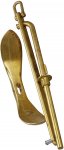
The cheap common bar fishermans is worse than useless in sand or mud, the admiralty version is better, but still poor. Some of the folding admiralty versions are better, but it seems that by far the best version is the Herreshof 3 piece, BUT alas it's also rather expensive as the only one in production is made of bronze. If anyone finds one in galvanised steel, please let me know, even if it's a bit rusy.

Traditional fishermans anchor are not just for rocks and heavy weed, as they will start to dig in on a 2 to 1 scope of rope rather than chain. The amount of holding power might well be poor, but some abilty to anchor in deep water is a real good idea. I've used grapnels for that task before, but they are not great in heavy weed, so the answer seems to be a Herreshof for sure.

Also looking for a good used stainles angel like the anchor ring, but not found a manufacturer yet.

Don't forget the 2 chain rodes and lots of good old 3 ply for the fishermans.
Except that the Excel has twice the hold of a Delta and sets easily and reliably. I think over 10 years use, from Sydney to the southern tip of Tasmania, of the aluminium Excel with the bolt in shank without issue is a better test of security that some vague idea that it might fall apart from someone who has never even seen one.

Jonathan

If you jam an alloy kit built Excel under or between 2 rocks it can be bent, so it's of no real use as a main storm anchor. Very good secondary main though. The Excel is far better than most of the so called new generation anchors in sand, mud or light gravel. The only other modern anchor with such a good performance, is a modified copy of a Brugal, namely the UK Spade, (Or Spade UK), although they are getting bent a tad too often and the yellow paint falls off just before they starts rusting. Lewmar know their ar5- from their elbow about different types of anchor, so a stainless Epsilon might well be very difficult to bend, and produce as good figures as a lightly built Excel. Not seen any sensilble comparison tests yet. They also need to be compared with a steel Danforth, my favourite secondary main.

When you suggest an anchor type, it's good to say what type of sea bed it's designed for, and if it can be used in a serious storm. Many anchorages have rocks or heavy weed around them, or even in them, and I'm currently looking for a better type of admiralty pattern fishermans for deep water anchoring, or use in potential rock and weed situation. So far I think the answer is a bronze Herreshof, as you will not bend a thick bronze bar too easily. Alas a small 7.5KG one costs 500 quid plus extras new. Can't find a used one at present.

PS: I have no clue about anchors, I know nothing about lifeboats, and my posts are all considered by some regular trollers be highly offensive rubbish etc !!!

Lewmar Epsilon 44lb Anchor Test/Review. Anchor Video # 109 - YouTube

UMM, ERRR! Think I'm going to stick with a GENUINE CQR and Force 4 Danforth as mains. The CQR mentioned in that clip was a copy, and the tester has issued an appology for not using the real thing. The weight on the tip is important and the copies never seem to get is right, although no idea if the Force 4 copy is a good one or not.
 

Attachments
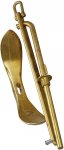
  • Herreshof.jpg
    Herreshof.jpg
    173.6 KB · Views: 2
Last edited:
"Normally we would deploy anchors to allow us to stay through a second high tide and to allow us to float off at our convenience, not that of the tide. Here we have our primary, I think we were testing the Viking 10, on our 6mm rode with a Spade A80 and FX 16 on dyneema (retired halyards) rodes off the transom using the sheet winches".

Is the Viking a modified copy of a Lewmar Delta ?? And by FX 16, do you mean a Lewmar FX series Danforth or a Fortress Danforth ??

CHANGE OF TACK; One big reason I like the look of the Herreshof fishermans, is that they do hold fairly well in both sand and mud. So are in effect a general purpose anchor that is best in heavy weed and rocks. Some of the places I had to anchor overnight whilst singlehanding the inside passage from Cairns to Darwin, were marked as unknown in terms of sea bed type, but the Escape river seemed to have a lot of fine weed. Conditions were fair and no issues at anchor, BUT if I ever went there again I would want to use an anchor that is better in heavy weed than the genuine CQR I used for 90% of the anchorages in Auz. The light gravel bar before the Escape river was truly the most sporting of the anchorages you need to overnight in, as it's seriously steep to fine gravel. The guide book said something about almost running aground before trying to set the main. Used my steel Danforth from the bow and a grapnel kedge off the stern in case I got stuck. Woke up to find a few prawn trawlers had anchored near me. Alas I had to follow a fairly tight tidal flow timeline, so never got a chance to check out what they using for anchors, or most important of all, how I could bag a few large prawns for dinner !!
 
Last edited:
Thanks for th
FX 16, a, genuine, Fortress.

For a Fishermans you could look at Luke (but they too are expensive):

Storm Anchors, Maine. Rocky and coral bottoms. P. E. Luke, Full Service Boatyard.

For Viking look at: Viking Anchors - Advanced Anchoring Systems

Jonathan
Thanks for that, and already have almost exactly the same type of fishermans, although the version I have is fully folding, so a 4 piece job. I'm changing the 2 chains that hold the main clevis pin in, as they started to rust, and the cross bar locking insert end chain has also gone in the bin cos of rust. 3mm stainless chain on order at present for the 2 sections. I'm going to get it powder coated red when I next pay a visit to the local spray and bake shop. Luckily I can get that done as a freebie if they use leftover tins, although I will have no idea what red they will use. Burgundy or Crimson would be nice, as they don't show rust stains up too much.
 
Thanks for th

Thanks for that, and already have almost exactly the same type of fishermans, although the version I have is fully folding, so a 4 piece job. I'm changing the 2 chains that hold the main clevis pin in, as they started to rust, and the cross bar locking insert end chain has also gone in the bin cos of rust. 3mm stainless chain on order at present for the 2 sections. I'm going to get it powder coated red when I next pay a visit to the local spray and bake shop. Luckily I can get that done as a freebie if they use leftover tins, although I will have no idea what red they will use. Burgundy or Crimson would be nice, as they don't show rust stains up too much.

You suggested that the aluminium Excel would be inadequate and might bend in rocks. You can bend any anchor but those using BIS80, an 800mPa steel for the shank appear to be sufficiently robust as I don't recall seeing any descriptions of bent shanks. The aluminium Excel shank is cut from a HT aluminium alloy, 7075, and has a shank thickness increased by about 30%. The resultant shank of the aluminium Excel has a strength similar to that of the steel version which is the same steel used in the original Rocna, made in NZ, and the Supreme (also made in NZ). The steel Excel meets proof test requirements for a SHHP anchor as tested, see below, in the same manner as Lloyds would approve.


robertson test anchors 09 002.jpeg
robertson test anchors 09 003.jpeg

I do paint my anchors but primarily so they will show up a bit more clearly for photography when they are underwater. Rather than paint and if the anchor is worth the effort I would regalvanise - and check the galvanising quality.

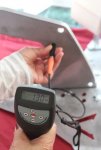
Checking gal thickness on a Viking, 130 microns - a generous coating. We check chain galvanising thickness in a similar way with a specification of 100 microns. Some people, who should know better, check gal quality by looking at it :)

IMG_4478.jpeg

These anchors, below, are not galvanised, guess how you know. If the gal goes on your anchor then it acts as a source of pigmentation for your the deck at the bow (and painting is a waste of time :( ).

IMG_1316.jpeg

Jonathan
 
Thanks for th
FX 16, a, genuine, Fortress.

For a Fishermans you could look at Luke (but they too are expensive):

Storm Anchors, Maine. Rocky and coral bottoms. P. E. Luke, Full Service Boatyard.

For Viking look at: Viking Anchors - Advanced Anchoring Systems

Jonathan
Thanks for that, and already have almost exactly the same type of fishermans, although the version I have is fully folding, so a 4 piece job. I'm changing the 2 chains that hold the main clevis pin in, as they started to rust, and the cross bar locking insert end chain has also gone in the bin cos of rust. 3mm stainless chain on order at present for the 2 sections. I'm going to get it powder coated red when I next pay a visit to the local spray and bake shop. Luckily I can get that done as a freebie if they use leftover tins, although I will have no idea what red they will use. Burgundy or Crimson would be nice, as they don't show rust stains up too much.
You suggested that the aluminium Excel would be inadequate and might bend in rocks. You can bend any anchor but those using BIS80, an 800mPa steel for the shank appear to be sufficiently robust as I don't recall seeing any descriptions of bent shanks. The aluminium Excel shank is cut from a HT aluminium alloy, 7075, and has a shank thickness increased by about 30%. The resultant shank of the aluminium Excel has a strength similar to that of the steel version which is the same steel used in the original Rocna, made in NZ, and the Supreme (also made in NZ). The steel Excel meets proof test requirements for a SHHP anchor as tested, see below, in the same manner as Lloyds would approve.


View attachment 149837
View attachment 149838

I do paint my anchors but primarily so they will show up a bit more clearly for photography when they are underwater. Rather than paint and if the anchor is worth the effort I would regalvanise - and check the galvanising quality.

Checking gal thickness on a Viking, 130 microns - a generous coating. We check chain galvanising thickness in a similar way with a specification of 100 microns. Some people, who should know better, check gal quality by looking at it :)

View attachment 149839

These anchors, below, are not galvanised, guess how you know. If the gal goes on your anchor then it acts as a source of pigmentation for your the deck at the bow (and painting is a waste of time :( ).

View attachment 149840

Jonathan

If the steel Excel is made of the same steel as the Rocna that means it will probably be just as easy to bend the shank, also the straight pull figures are of no real interest as most anchors were designed to OK with a direct pull. Not sure if your test rig can do 90 degree clamp tests or not. If you can and the test can be filmed until the shank is at 45 degrees then that would be of real interest. Never seen an alloy anchor of any type produce sensible figures that show it's worthy of use as a storm anchor, I do know that a very expensive to make ally anchor can be designed and manufactured to match the cheaper steel ones in tensile and shear strength terms. There was one in production that looked promising a few years ago, but I don't recall it's type or name.

As for secondary surface coatings, there is indeed no real point powder coating a steel anchor after the rust has been shot blasted back to bare stee if it's used in rocks, gravel or hard sand. Perfectly OK in mud or fine sand, BUT, the folding fishermans I'm going to coat with some left over bright reflective red, yellow, orange or pink, (Probably not pink !!), will be done on top of a very good layer of hot dipped Zinc coating. I might ask for them to coat it silver, BUT, for some odd reason they don't mix up silver paint too often. Beggards like me and my part time crew of lunatics can't be choosers comes to mind when it comes to paying for parts or services. Alas hot dip galvanising is far too expensive unless you live near a blast and dip shop.

Warning Off Topic Drift
New keel cooled Beta 30 installation in progress this week, (Long job), onto modified, (The mounts don't match the old BMC's beds), signal red powder coated engine beds. Long task to make the 1m square internal, (Alloy hull), cooling tank or tanks. As soon as that fairly big task has been completed, I will fit the worlds best marine head system, based on a used, (Yes I did clean it), LAVAC, which is by far the best type of head ever designed. It will be a pure joy to sit upon, even in a severe gale, a truly great shower in a seriously tight area where the user has only one foot of head room and 6 inches of side room. That's essential as was once sitting upon a cheap and nasty marine head in rolly polly conditions in my very first yacht, (Pacific Seacraft Dana 24), and just as I had fished a big jobbie the entire head assembly pulled out all 3 bronze screws from the teak base plate, resulting in one smelly disaster. Took me all day to clean the head area and through bolt the head back in place so it would not teach me a lesson about heavy weather sailing again.

PS: The ships anchors in the last picture are brand new from a foundry, they are ready to be sand blasted clean and then hot dipped into a molten Zinc bath. It's not unusual for them to be then be coated with gold epoxy paint if requested by the new owner. Seriously expensive International Algrip, (Different name these days), is very tough, probably slightly better than powder coated paint. Oddly enough there is a very expensive single pot grey paint that was used back in the 60's when my lifeboat was built, that is also very tough indeed. The RNLI used it to over paint some galvanised steel deck hardware items, BUT, alas I've never managed to ID the type of paint, other than it's a single pot cos I've cleaned off some of it with acetone having heated it up first until very hot. As soon as the part cools down and the acetone dries off, it sets again, so you have to try again. Gave up several times and finally dumped a set of solid steel stachions in a very hot bonfire to get it off.
 

Attachments

  • Toilet assembly 2.jpg
    Toilet assembly 2.jpg
    195.6 KB · Views: 9
  • Near Richards Bay SA.jpg
    Near Richards Bay SA.jpg
    21.5 KB · Views: 7
  • Dicha bow.jpg
    Dicha bow.jpg
    25.7 KB · Views: 6
Last edited:
I would gently suggest there's an element of TMI in the above post.

Isn't 'potty humour' disallowed by the Mods?
 
T[...]t. Oddly enough there is a very expensive single pot grey paint that was used back in the 60's when my lifeboat was built, that is also very tough indeed. The RNLI used it to over paint some galvanised steel deck hardware items, BUT, alas I've never managed to ID the type of paint, other than it's a single pot cos I've cleaned off some of it with acetone having heated it up first until very hot. As soon as the part cools down and the acetone dries off, it sets again, so you have to try again. Gave up several times and finally dumped a set of solid steel stachions in a very hot bonfire to get it off.
Galvafroid?
 
Just a quick note about what or is not available in the way of fishermans anchors, which are a must have if you are going on a serious cruise around the UK due to the need to anchor in some dubious areas of rocks and heavy weed.
……………..
Well that is your personal opinion. But I do not think it is likely to be shared by most people who “do serious cruising round the UK”.

Your fisherman and CQR approach is completely at odds with what people on the water here are actually using successful.
 
Well that is your personal opinion. But I do not think it is likely to be shared by most people who “do serious cruising round the UK”.

Your fisherman and CQR approach is completely at odds with what people on the water here are actually using successful.

My opinions are based only on what the RNLI, USCG and TNLI have for equipment, and in my own case, serious anchoring or commercial fishing at anchor, (Homemade disposable grapnels on very long Poly. lines). They are also based on the cause of a number of serious accidents when the boat had tried to anchor, or was lost from an anchorage.

In safety terms some of those losses and rescue tasks resulted from the inability of the boat to anchor after an engine or rig failure where they needed to anchor in deep water, or in an area of rocks and weeds, before drifting onto the rocks or cliffs. Most yachties are not trained correctly, or have not read anything about how to anchor in deep water. Most of the boats lack a good secondary anchor, (I always have some type of steel Danforth rigged and ready), and have no deep water gear onboard. Some of them don't even have a second anchor, (I'm rather keen on secondary anchor use).

Most of the old timers who spend their lives wondering around the UK and anchoring in some very interesting anchorages and conditions will have some type of fishermans, often stored in a locker. I doubt very much if the admiralty pattern fishermans can be beaten by any modern anchor in wrecks, rocks, heavy gravel, pebblestones or weed, although I'm looking long and hard at slightly different versions like my folding version that has extra small flukes on the ends to help it hold in sand and mud on a short scope. Ultimately I suspect the solution to a more multipurpose deep water anchor might be the Herreshof version of the classic fishermans. Alas they are one of the more expensive bronze anchors available. If anyone sees a small used one for sale, please let me know, BUT, it must not be a steel copy.

The most popular anchor on private boats in the UK, is the Lewmar Delta, but it will not work in serious conditions on a 2 to 1 rope rode unless it gets jammed into a wreck or bolders, so is of no interest for deep water incidents or applications. The performance of the genuine CQR has been proven to be very slighly better than the Lewmar D Delta, (Note, nearly every comparison test with a CQR vs modern anchor was done with a cheap copy, not the real Lewmar CQR, OR were done with too short a scope for a plow to set correctly). The tests were designed to sell light modern anchors and they failed to do at least 3 tests to get some kind of average. Some of them were just a scam as they failed to compare anchors in both size vs holding, AND weight vs holding. That tends to bias the results towards alloy anchors, that in most cases are far too easily bent or are bolt together kits using very cheap Chinese or Indian stainless that has not been annealed, so has a poor shear strength and a fatigue life of fork all.

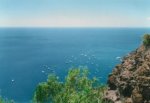
Picture is of St Helena's main anchorage where you have to use the local boat shuttle service, (Very sporting snatch and grab knotted ropes on a frame for the landing shelf). My old corroded steel Van Der Stadt 34 is on the LHS , (Burgundy colured . Lovely place to visit, but if the wind shifts you must leave unless they are convinced you have the boat, (Steel), anchoring gear, (Mixed type of seabed, so 2 different mains, prefeably unbendable on all chain rodes etc). Alas I got asked to leave, even though the onshore blow was not going to be a bad one), and the reason stated was that my secondary main did not have enough chain, (It had 20m of chain then a good size 3 ply Polyprop. rode), AND they didn't think it would be a good idea for a single hander to be on anchor watch for 2 days or so. I also lacked a dingy or tender capable of making progress to windward in the forecast conditions. The other picture is of Moorea near Tahiti where I did have to suffer a fairly windy cold front at anchor, and made a nasty mistakes of leaving it too late before deploying my secondary anchor consisting of 20m of chain spliced, (Do not use any type of connector, stainless in particular, just get it spliced), to a long 3 ply Polypropelene line, (It tries to float, so does not get wrapped around any coral heads), When I used the Danforth, the 20m of chain was connected to a 100m of Polyprop line, as you must not let normal rope rodes near the bottom due to coral coated boulders, debris and smashed up sunken boats.

On one old fishing boat I deckhanded on, we used very light Poly. line from the same large reel it was on when purchased and mounted on a cheap and nasty frame, when it was needed, We nearly always carried at least 3 homemade steel grapnels attached with a weak link that would snap if the anchor got jammed into an old fish trap or wreck. We only used it in fair conditions to anchor in 500m, often around the Cannery Island to set a shortish deep water bottom line to catch some very valuable but potentially dangerous, (Nasty spines), bottom fish that are top of the range in the very best fish orientated restaurants. The red Canterraera, (iffy spellin), was my favoutite for a special dinner. Once we had enough high value fish we would start calling various restaurants around Grand Cannery, Fartaventura or even Tentonareef!

C.Q.R.® Anchors - Stainless Steel | Lewmar

Lewmar LFF Anchor Galvanised (force4.co.uk)
 

Attachments

  • Herreshof.jpg
    Herreshof.jpg
    173.6 KB · Views: 7
  • St Helena.jpg
    St Helena.jpg
    20.4 KB · Views: 7
Last edited:
The performance of the genuine CQR has been proven to be very slighly better than the Lewmar D Delta...... a cheap copy, not the real Lewmar CQR

As someone who once 'anchored' in the foul ground of Oban Bay using a cwt. ( remember them? ) of boulders in a discarded cod-end netting bag, so we could 'slip' and go, I nod with approval reading above of effective alternatives.

But.... I find myself wondering what the far-travelled fisherman TNLI means when he writes of 'the real Lewmar CQR'.
I was brought up to understand that the REAL CQR was patented and manufactured by the Clydeside firm of Simpson-Lawrence.... but then, I have a long and occasionally misleading memory.

:cool:

p.s. what on earth am I to make of the red-rug avatar pic?
 
My opinions are based only on what the RNLI, USCG and TNLI have for equipment,……..
It is amusing how you seem so keen to push your ideas on this basis. RNLI lifeboats are not a good guide for choosing anchor equipment for a cruising yacht for a number of reasons, but particularly, as has already been pointed out earlier:
- it is extremely rare for all weather lifeboats to use their anchors - in almost all cases they hold position where necessary under engine power
- they never leave the lifeboat anchored and unattended - if in some extreme case the lifeboat is anchored, a full crew will be on board and on watch, and likely engines running.

(NB. Different from inshore lifeboats and the Y boats, which use anchors in very specific rescue situations to hold the bows into waves when doing a rescue from close to shore. Again the anchor requirements very different from a cruising yacht)

Many would also not consider an old lifeboat a good choice of cruising yacht, due to their very different design priorities, but each to their own preferences
 
As someone who once 'anchored' in the foul ground of Oban Bay using a cwt. ( remember them? ) of boulders in a discarded cod-end netting bag, so we could 'slip' and go, I nod with approval reading above of effective alternatives.

But.... I find myself wondering what the far-travelled fisherman TNLI means when he writes of 'the real Lewmar CQR'.
I was brought up to understand that the REAL CQR was patented and manufactured by the Clydeside firm of Simpson-Lawrence.... but then, I have a long and occasionally misleading memory.

:cool:

p.s. what on earth am I to make of the red-rug avatar pic?

Yes you are correct, BUT I don't class that as a safe version of the original CQR, AND they have all rusted away or in a few cases been bent. I suppose when I say oroginal or OEM I should say with the exception of the Mk 1 SL version. Those anchors are not marked in the manner I described, and I've been informed they have a 1/2 lb at the end of the weigh figure. If one was in real good condition, it might be worth some money, as Lewmar have a display of all their products that includes some real old examples of the original type that they developed or purchased the copyrights for.

Never seen a CWT, (Counterweight anchor), down South or over in the US. Most of the boats I crewed on in a very part time manner made their own gear when ashore, or even at sea sometimes. So if one was needed, the Spanish boys would make their own, unless the fishermans coperative could supply them from a manufacturer in Spain. Do you have any pictures of one in use, as I'm not familiar with their use ??

PS: I've deployed moorings based on hessian bags of rocks held together by a fishing net made from degradable rope, (All sat on a wooden pallet for the big drop). They last at least a year in warm water, BUT I do not like using any type of nylon or Poly. net, because when the mooring nets and bags fail, (Some clown using a grapnel or lump of steel dragging into it), OLD FISHING NETS ARE DANGEROUS FOR DIVERS or BOATS. I've also nearly lost a 42ft Striker in rough conditions after running over an old cod end or bundle of fishing net, I was up on the bridge/upper deck helm position and did not see it until it was too late. It was a blue Poly. net that had been in the water for a long time. Potentially lethal for local divers, cos if some tourist surfaces without looking up often enough and comes up under the net, the resulting tangle could easily take hours for them to cut through. One of the boats in the group, (Some might say boat mob), found a badly decomposed diver off Grand Cannery tangled up under an old small net. Alas some other local boat had already recovered/stolen their bottle and scuba gear. A nice little earner for some crew!
 
Och, dearie me, TNLI. You must be really YOUNG..... for you clearly do not remember.

Hundredweight abrv cwt.

noun
noun: hundredweight; plural noun: hundredweight; plural noun: hundredweights; noun: long hundredweight; plural noun: long hundredweights; noun: hundred-weight; plural noun: hundred-weight; plural noun: hundred-weights; plural noun: long hundredweight; symbol: cwt.; noun: short hundredweight; plural noun: short hundredweight; plural noun: short hundredweights; noun: metric hundredweight; plural noun: metric hundredweight; plural noun: metric hundredweights

  1. 1.
    British
    a unit of weight equal to 112 lb avoirdupois (about 50.8 kg).

  2. 2.
    US
    a unit of weight equal to 100 lb (about 45.4 kg).

Note the 'Murricains distorting the IMPERIAL SYSTEM again, to give 'short measure'.

I do share the concern about choosing to leave netting litter, but this circumstance was prior to the start of the Scottish Islands Peaks Race half-a-lifetime ago, when competitors were required to anchor in Oban Bay before embarking one's runners, right where the chart - and the harbourmaster - indicated Foul Ground due to decades of discarded fishing gear. Others had been known, on previous years, to have fouled their anchors on this junk and taken a couple of hours to get free.

Determined to avoid that fate, your correspondent found a piece of discarded cod-end netting about 2m. square on the beach, made it into a bag with about a cwt. of beach boulders, reeved a slip-line through the neck - and lowered it to the seabed where it held 'secure' until we wanted to leave.

QED

.
 
Yes you are correct, BUT I don't class that as a safe version of the original CQR, AND they have all rusted away or in a few cases been bent. I suppose when I say oroginal or OEM I should say with the exception of the Mk 1 SL version. Those anchors are not marked in the manner I described, and I've been informed they have a 1/2 lb at the end of the weigh figure. If one was in real good condition, it might be worth some money, as Lewmar have a display of all their products that includes some real old examples of the original type that they developed or purchased the copyrights for.
Simpson Lawrence produced CQR anchors in two materials, drop forged steel and cast iron. The steel ones had whole number weights forged into them, the cast iron ones had weights in number plus 1/2. I have a photo of one of the latter type with a brittle fracture at the hinge pin. Posted here by a member, it had been in collision with a pontoon.
 
Och, dearie me, TNLI. You must be really YOUNG..... for you clearly do not remember.


  1. 1.
    British
    a unit of weight equal to 112 lb avoirdupois (about 50.8 kg).

  2. 2.
    US
    a unit of weight equal to 100 lb (about 45.4 kg).

Note the 'Murricains distorting the IMPERIAL SYSTEM again, to give 'short measure'.

I do share the concern about choosing to leave netting litter, but this circumstance was prior to the start of the Scottish Islands Peaks Race half-a-lifetime ago, when competitors were required to anchor in Oban Bay before embarking one's runners, right where the chart - and the harbourmaster - indicated Foul Ground due to decades of discarded fishing gear. Others had been known, on previous years, to have fouled their anchors on this junk and taken a couple of hours to get free.

Determined to avoid that fate, your correspondent found a piece of discarded cod-end netting about 2m. square on the beach, made it into a bag with about a cwt. of beach boulders, reeved a slip-line through the neck - and lowered it to the seabed where it held 'secure' until we wanted to leave.

QED

.

Thanks for the reply, and I was a bit concerned that you were putting down a larger bag mooring, like the ones I used to deploy or use. None of the boats I crewed or skipped had large winches or small cranes, so we just did a corner tilt and shove drop, which is rather faster method that requires the pallet to be postion on the stern, normally to one side. If the boat rolls too far in a heavy swell, it just falls off. Alas there was one fatality on one of the fleet when one of the crew was half asleep and did not realise he was standing on the attached mooring line. It was dark and starting to get rather too rolly for the task, and whilst he was standing there with his back to the bag, it fell over the side as the boat rolled too far, (It's listing due to the extra weight in the corner). We all spent a long time the next day looking for me, as did the rescue services, but he was never found. I got lucky in very calm conditions and found the attached Poly line, (The float marker was not attached to the end when it went overboard). We then attached one of our used fenders and logged the exact position and depth. The skipper and myself, (I did not have a Spanish skippers license), both finished up laughing each time over some daft joke about why the bottom fishing was so good when moored there. I could not really understand Spanish humour, but they kept singing a short daft song about how the lost marinero had chumed the bottom. The mooring itself used to turn into a good place to fish one the bags had rotted enough to allow some good marine growth on it, although the ones I deployed were primarily for Tuna fishing. If we caught any good bottom fish whilst chumming from the lost mooring, I used to clean the fish up and arrange for it to be delivered to the lost crewman's family.
 
Last edited:
Yes so it'
Simpson Lawrence produced CQR anchors in two materials, drop forged steel and cast iron. The steel ones had whole number weights forged into them, the cast iron ones had weights in number plus 1/2. I have a photo of one of the latter type with a brittle fracture at the hinge pin. Posted here by a member, it had been in collision with a pontoon.
Yep, so it's the cast iron ones that had the half and are no good. Can't understand why SL would do something as daft as make a CQR from Iron ?? Did they issue a product withdrawl notice or something to get the bad version recalled ??
 
Yes so it'

Yep, so it's the cast iron ones that had the half and are no good. Can't understand why SL would do something as daft as make a CQR from Iron ?? Did they issue a product withdrawl notice or something to get the bad version recalled ??
No, there are plenty around. Lots of Bruce copies in cast iron too, some very badly cast. They are a cheap option, satisfactory for many unless there is a big impact.
 
It is amusing how you seem so keen to push your ideas on this basis. RNLI lifeboats are not a good guide for choosing anchor equipment for a cruising yacht for a number of reasons, but particularly, as has already been pointed out earlier:
- it is extremely rare for all weather lifeboats to use their anchors - in almost all cases they hold position where necessary under engine power
- they never leave the lifeboat anchored and unattended - if in some extreme case the lifeboat is anchored, a full crew will be on board and on watch, and likely engines running.

(NB. Different from inshore lifeboats and the Y boats, which use anchors in very specific rescue situations to hold the bows into waves when doing a rescue from close to shore. Again the anchor requirements very different from a cruising yacht)

Many would also not consider an old lifeboat a good choice of cruising yacht, due to their very different design priorities, but each to their own preferences

Alas you have no idea about how the inshore or offshore RNLI operations function, or about the nature of my own previous armed rescue operations and how they were arranged or carried out.

Most but not all offshore boats spend far more time fairly close, (Sometimes very close, as they carry their own RIB), to the shore backing up local inshore boats, or conducting searches at night or in bad weather in particular. When the weather is really bad, the inshore RIBS can't carry out a S&R task outside of the local harbour or bay area. Obviously it varies a lot from station to station. Some places most shouts are for incidents fairly near the station that can be dealt with by one of the RIB's and the offshore boat is not used too often during the day, unless it's for towing etc. Other stations might not have any tourist beaches, or private boaters active near their station, and most shouts are offshore. The offshore boats seem to be capable of carrying out almost any type of inshore rescue, and if the depth is an issue, don't hesistate to launch their own small RIB.

So an Offshore boat must be capable of double anchoring in any type of bottom, or any depth in heavy weather. In my own case, I never waste engine hours or fuel when just killing time waiting for sunrise, or an update on where to start a search. I'm also rather careful about close in searches for capsized boats at night, because even the best crew, some small boats and debris can be difficult to see and the boats I used to be on, did not have fully recesed enclosed props, so they were vunerable to larger fishing nets.

I'm definitely not building a plastic rag and stick boat, or a small gin palace, I'm building a long range rescue or offshore fishing boat for 3rd world countries where the fishing boats double up as rescue boats. Fuel economy is very important, as it the ability to beach the boat. They also need to be OK to live on, as most small villages don't have a marina. The bolt on fold down A frame mast, (In my fathers garden at present), and optional square or lateen rig, (Four 20ft thick walled alloy scaffolding poles). In the longer term, I hope a second production version can manufacture with a steel hull, but similar topsides and interior, and they would be available for any type of customer to purchase, even canal boaters, as my boat is just inside the limits. Some private customers do want a self righting, beachable and almost unsinkable, (Water tight bulkheads and stuffed locker floatation).

PS: The oil rig on station rescue, Pilot boat services, RNLI, USCG, TNLI and serious offshore fishing boats who all anchor up on occasions, (Some more than others), all use very similar anchors and associated gear, because they all know nothing about anchors or anchoring, and nothing they use in equipments terms could be of any use to a private boat in bad conditions. So it's very wrong of any private rag and stick or gin palace clown to use a genuine CQR, a Lewmar Danforth, or an Admiralty fishermans in particular. As a private boater you should never bother to have 2 anchors rigged and ready on all chain rodes with long 3 ply snubber lines to an expensive chain hook. The TNLI who love to do drag anchoring, (Out of limits in scope terms), just to save fuel, have no clue about anything!
Hope all the trollers who never seem to add anything like an interesting link or intelligent well informed comment happy !!!
 
No, there are plenty around. Lots of Bruce copies in cast iron too, some very badly cast. They are a cheap option, satisfactory for many unless there is a big impact.

OK, I was told by one local old timer who knows all about bad copies of boat gear, that if you see a good non rusty CQR with the 1/2 lb mark, it's a copy of the problematic SL cast Iron CQR. Stunned that there are cast Iron Bruce copies around!
It's definitely looking like it's a real good idea to buy a new Lewmar CQR, (They make a stainless and a galvanised version).
 
Status
Not open for further replies.
Top